
Supplemental Examination Guide
Request USPTO supplemental examination for patents
Request USPTO supplemental examination for patents within deadlines including filing fees and certificate cost.
Formats
About this book
Free sample
Chapter 1: The Million-Dollar Oversight...--–- It begins with a letter. Not a cease-and-desist letter, though that will come. Not a summons and complaint, though that will follow shortly. No, this particular letter arrives in a nondescript envelope from the United States Patent and Trademark Office, and it bears a deceptively simple subject line: "Notice of Intent to Issue Reexamination Certificate." For the patent owner who receives it, that letter represents either salvation or catastrophe. For the one who does not receive it—the one who never filed the request that would have triggered it—that absence may represent something far worse: the quiet, invisible destruction of a million-dollar patent asset.The scenario is as common as it is tragic.
A pharmaceutical company spends twelve years and 800milliondevelopinganewdrug.Itsecuresapatentwithclaimsthatelegantlycoverthecompound,theformulation,andthemethodoftreatment.Thedruglaunches.Salesreach800 million developing a new drug. It secures a patent with claims that elegantly cover the compound, the formulation, and the method of treatment. The drug launches. Sales reach 800milliondevelopinganewdrug.Itsecuresapatentwithclaimsthatelegantlycoverthecompound,theformulation,andthemethodoftreatment.Thedruglaunches.Salesreach200 million annually. Then a generic manufacturer files an Abbreviated New Drug Application (ANDA) with a Paragraph IV certification, alleging that the patent is invalid.
In discovery, the generic's lawyers uncover a single journal article—published three years before the patent's priority date, cited in an information disclosure statement (IDS) but only as a "B" reference, never discussed by the examiner. The article discloses a closely related compound. The generic argues inequitable conduct: the patent prosecutor knew about this article, knew it was material, and buried it in a list of thirty-seven references without explanation. The court agrees. The patent is held unenforceable.
Not invalid—unenforceable. The difference is everything. Invalid means the invention was never patentable. Unenforceable means the invention was patentable, but the patent owner committed a sin against the USPTO and must lose all rights as punishment. The drug goes generic eighteen years early.
The loss: $3.6 billion in revenue.This is not a hypothetical. This is the reality of post-Therasense patent litigation, and it is the problem that supplemental examination was designed to solve.The High Cost of a Clean Conscience Before…
This is the end of the free sample. Get the eBook to keep going. Buy now
Contents
- Chapter 1
- Chapter 2
- Chapter 3
- Chapter 4
- Chapter 5
- Chapter 6
- Chapter 7
- Chapter 8
- Chapter 9
- Chapter 10
- Chapter 11
- Chapter 12
Details
- Author
- Byrnes Casandra
- Publisher
- SamEnrico
- Language
- English
- Genre
- Non-Fiction, Annual Checkup, Supplemental Exam, Reexamination
- Released
- 2026-06-01
- Pages (approx.)
- 142
- Available as
- eBook, Audiobook

Read better in the ZLOADR app
Your eBooks on your phone or tablet. Sign in with your SamEnrico account and start reading.
More by Byrnes Casandra
 The Remote Work Morning HuddleByrnes Casandra$11.99
 Resentment and Shame HandbookByrnes Casandra$11.99
 Plant Based Menopause Nutrition ManualByrnes Casandra$11.99
 The Construction Worker StretchByrnes Casandra$11.99
 John Tyler Accidental President GuideByrnes Casandra$11.99
 The Desert Codebreakers: Unlocking Ancient Secrets in Jordan's Secret LabByrnes Casandra$11.99
 Pets.com: The $300 Million Dog That Didn’t BarkByrnes Casandra$11.99
 Understanding CryoglobulinemiaByrnes Casandra$17.99
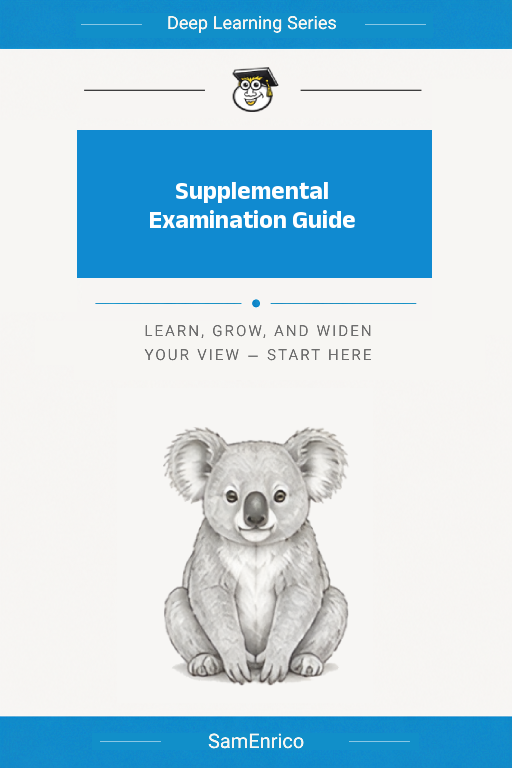 Supplemental Examination GuideByrnes Casandra$12.99
 SPIN Selling Script GuideByrnes Casandra$12.99
 Smart Home InstallerByrnes Casandra$11.99
 A Beginners Guide to Bank pool (Volume 1)Byrnes Casandra$11.99