
Non-FictionAnnual CheckupSupplemental ExamReexamination
Supplemental Examination Guide eBook
Request USPTO supplemental examination for patents
Request USPTO supplemental examination for patents within deadlines including filing fees and certificate cost.
Formats
Free sample
Chapter 1: The Million-Dollar Oversight...--–- It begins with a letter. Not a cease-and-desist letter, though that will come. Not a summons and complaint, though that will follow shortly. No, this particular letter arrives in a nondescript envelope from the United States Patent and Trademark Office, and it bears a deceptively simple subject line: "Notice of Intent to Issue Reexamination Certificate." For the patent owner who receives it, that letter represents either salvation or catastrophe. For the one who does not receive it—the one who never filed the request that would have triggered it—that absence may represent something far worse: the quiet, invisible destruction of a million-dollar patent asset.The scenario is as common as it is tragic.
A pharmaceutical company spends twelve years and 800milliondevelopinganewdrug.Itsecuresapatentwithclaimsthatelegantlycoverthecompound,theformulation,andthemethodoftreatment.Thedruglaunches.Salesreach800 million developing a new drug. It secures a patent with claims that elegantly cover the compound, the formulation, and the method of treatment. The drug launches. Sales reach 800milliondevelopinganewdrug.Itsecuresapatentwithclaimsthatelegantlycoverthecompound,theformulation,andthemethodoftreatment.Thedruglaunches.Salesreach200 million annually. Then a generic manufacturer files an Abbreviated New Drug Application (ANDA) with a Paragraph IV certification, alleging that the patent is invalid.
In discovery, the generic's lawyers uncover a single journal article—published three years before the patent's priority date, cited in an information disclosure statement (IDS) but only as a "B" reference, never discussed by the examiner. The article discloses a closely related compound. The generic argues inequitable conduct: the patent prosecutor knew about this article, knew it was material, and buried it in a list of thirty-seven references without explanation. The court agrees. The patent is held unenforceable.
Not invalid—unenforceable. The difference is everything. Invalid means the invention was never patentable. Unenforceable means the invention was patentable, but the patent owner committed a sin against the USPTO and must lose all rights as punishment. The drug goes generic eighteen years early.
The loss: $3.6 billion in revenue.This is not a hypothetical. This is the reality of post-Therasense patent litigation, and it is the problem that supplemental examination was designed to solve.The High Cost of a Clean Conscience Before diving into the mechanics of supplemental examination—the fees, the forms, the deadlines—we must first understand why this obscure procedure exists and why every patent owner with a valuable asset should consider using it. The answer lies at the intersection of human fallibility, legal strategy, and the peculiar economics of patent enforcement.Let us begin with the human element. Patent prosecution is imperfect. It is conducted by examiners who have, on average, nineteen hours to search the prior art, read the application, and draft a first office action.
It is conducted by patent attorneys who juggle dozens of applications simultaneously, who face relentless pressure from clients to narrow claims quickly to secure allowance, and who operate in an information environment that is simply too vast for any human to master completely. The USPTO receives over 600,000 patent applications annually. The global body of prior art grows by millions of documents each year. Even the most diligent prosecutor will miss something.The law recognizes this imperfection. For decades, the doctrine of inequitable conduct served as a check on intentional fraud—a way to strip patent rights from those who deliberately deceived the USPTO.
But over time, the doctrine expanded. Accused infringers began pleading inequitable conduct as a routine defense, not because they believed the patentee had committed fraud, but because the defense triggered discovery into the patent prosecution history. That discovery was expensive. It was intrusive. And it often forced settlements regardless of the merits of the underlying validity challenge.The Federal Circuit tried to rein in this abuse in its 2011 en banc decision, Therasense, Inc.
v. Becton, Dickinson & Co., 649 F.3d 1276 (Fed. Cir. 2011). The court raised the standard for materiality to "but-for" materiality: omitted prior art is material only if the patent would not have issued had the examiner known about it.
The court also required specific intent to deceive, which could not be inferred solely from the omission of material information. These changes made inequitable conduct harder to prove. Much harder.But here is the dirty secret that Therasense did not eliminate: the defense remains expensive to defeat. Even if the patent owner ultimately prevails on summary judgment or at trial, the cost of litigating an inequitable conduct claim often exceeds $1 million in attorney fees, expert witness costs, and discovery expenses. The patent owner must produce its prosecution files.
Its attorneys must sit for depositions. Its inventors must testify about what they knew and when they knew it. The distraction is immense, and the strategic leverage that the defense provides to the accused infringer is often dispositive, regardless of the ultimate legal standard.The Safe Harbor That Changed Everything Congress understood this problem. When it passed the Leahy-Smith America Invents Act (AIA) in 2011, it included a provision that was largely overlooked at the time but has since become one of the most powerful tools in the patent owner's arsenal: supplemental examination.The provision, codified at 35 U.S.C. § 257, allows a patent owner to request that the USPTO consider, reconsider, or correct information that may be relevant to the patent.
The request can include prior art, evidence of public use or sale, or any other information that the patent owner believes might affect patentability. The USPTO then has three months to determine whether the information raises a substantial new question of patentability (SNQ). If the answer is no, the USPTO issues a Supplemental Examination Certificate, and the patent receives a statutory safe harbor: it cannot later be held unenforceable for inequitable conduct based on any information considered during the supplemental examination.Read that again. It is perhaps the most powerful immunity provision in all of intellectual property law. The safe harbor is absolute.
It is not subject to a materiality analysis. It is not subject to a balancing test. If the USPTO determines that the submitted information does not raise an SNQ, then the patent is immune from inequitable conduct challenges based on that information. Period. A court cannot second-guess the USPTO's finding.
A jury cannot hear evidence about the omitted reference. The defense is dead.This immunity is the reason that every patent of significant value should undergo supplemental examination. It is a prophylactic measure—a vaccine against the most pernicious defense in patent litigation. And like any vaccine, it works best when administered before the patient is sick.The Strategic Decision Matrix: When to File The question that every patent owner faces is timing. When should one file a request for supplemental examination?
The answer depends on the threat environment, the value of the patent, and the nature of the information to be submitted.Pre-Litigation Filing (No Threat)This is the optimal scenario. The patent owner has no pending litigation, no cease-and-desist letter, no reason to believe that an infringer is preparing a challenge. The patent owner simply reviews its prosecution files, identifies any prior art that was cited but not fully considered, identifies any art that was missed entirely, and files a request for supplemental examination. The USPTO reviews the request with a neutral eye. There is no opposing counsel to scrutinize the filing.
There is no discovery to complicate the analysis.The cost is the only downside. The fees are real, and they come…
This is the end of the free sample. Get the eBook to keep going. Buy now
About this book
Details
- Author
- Byrnes Casandra
- Publisher
- SamEnrico
- Language
- English
- Genre
- Non-Fiction, Annual Checkup, Supplemental Exam, Reexamination
- Released
- 2026-06-01
- Pages (approx.)
- 142
- Available as
- eBook, Audiobook

Read better in the ZLOADR app
Your eBooks on your phone or tablet. Sign in with your SamEnrico account and start reading.
More by Byrnes Casandra
 The Remote Work Morning HuddleByrnes Casandra$11.99
 Resentment and Shame HandbookByrnes Casandra$11.99
 Plant Based Menopause Nutrition ManualByrnes Casandra$11.99
 The Construction Worker StretchByrnes Casandra$11.99
 John Tyler Accidental President GuideByrnes Casandra$11.99
 The Desert Codebreakers: Unlocking Ancient Secrets in Jordan's Secret LabByrnes Casandra$11.99
 Pets.com: The $300 Million Dog That Didn’t BarkByrnes Casandra$11.99
 Understanding CryoglobulinemiaByrnes Casandra$17.99
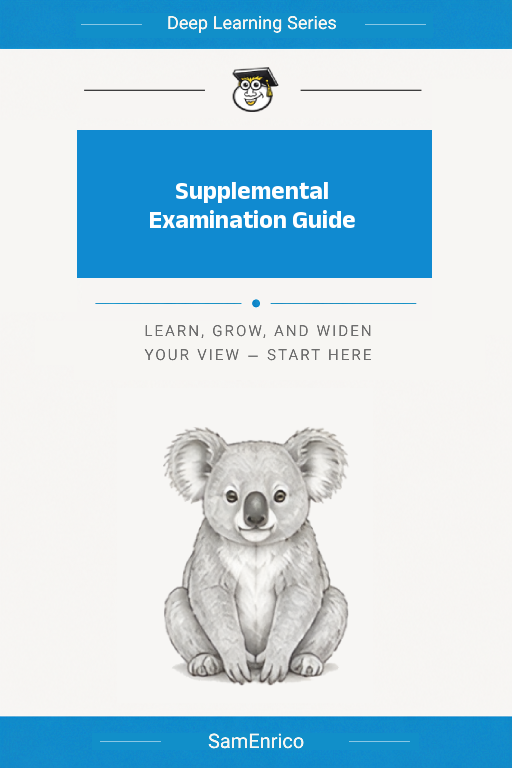 Supplemental Examination GuideByrnes Casandra$12.99
 SPIN Selling Script GuideByrnes Casandra$12.99
 Smart Home InstallerByrnes Casandra$11.99
 A Beginners Guide to Bank pool (Volume 1)Byrnes Casandra$11.99
You may also like
 Hong Kong Handover 1997Dunn Johnnie$11.99
 Zumba For Postnatal Recovery CourseNeal Christian$11.99
 Zumba for BeginnersLadner Nikia$11.99
 YouTube Comment Mining GuideHumes Pandora$12.99
 Worry Box MeditationCarlin Rudy$11.99
 Workplace Stress MeditationNguyen Lynn$11.99
 Workplace Stress and Sleep RepairHawley Ivory$11.99
 Workplace Perfectionism CureDelaney Jeffry$11.99
 Workplace Injustice Anger GuideWallen Isabelle$11.99
 Work Addiction and Burnout LinkGreenwood Ester$11.99
 Women in Yoga and WellnessBeattie Galina$11.99
 Women in Stand Up ComedyChun Evangeline$11.99