
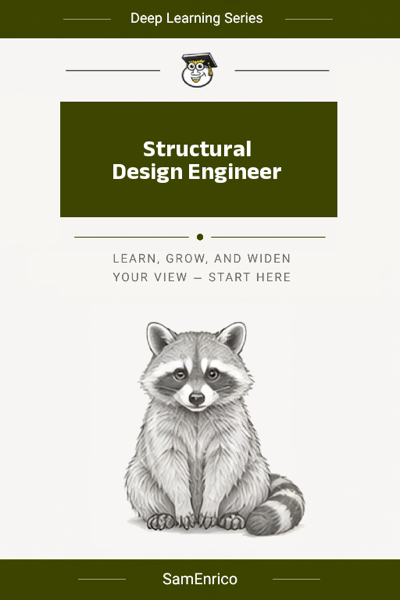
Structural Design Engineer Audiobook
A Coursebook on Structural Design Engineer
A Coursebook on Structural Design Engineer
Formats
Free sample
Chapter 1: The Grammar of Standing Still--–- On a cold December evening in 1940, a few hundred feet above the Tacoma Narrows in Washington State, a bridge began to dance. The concrete and steel ribbon—nicknamed "Galloping Gertie" for its notorious habit of swaying in even modest winds—had thrilled and terrified drivers for only four months. But on that final night, with winds blowing a steady 42 miles per hour, the dance became a death spiral. The roadway twisted into waves. Concrete barriers cracked and tumbled.
And then, with a sound that witnesses described as "a deep, groaning sigh," the 2,800-foot center span tore loose and plunged into the icy water below.Remarkably, the only casualty was a three-legged dog trapped in a car on the bridge. But the engineering profession suffered a wound that would never fully heal. Because Galloping Gertie had been designed by some of the brightest minds of her era. She had been calculated, modeled, and built according to the best practices of 1940. And she had still collapsed.What went wrong?The answer, distilled to its essence, is simpler than you might think: the bridge forgot the first rule of standing still.
It failed to maintain equilibrium—not with gravity, which it handled perfectly well, but with the wind. The forces acting on the bridge became unbalanced, and the structure responded the only way it could: by moving violently until it tore itself apart.This is the fundamental truth that every structural engineer must internalize before designing anything larger than a toothpick: A structure stands still not because it is heavy or strong, but because all forces acting upon it are in perfect balance. The moment that balance fails, the structure either moves, deforms, or collapses. There is no third option.This chapter teaches you the grammar of that balance—the language of forces, the logic of free-body diagrams, and the mathematics of equilibrium. These tools are not abstract academic exercises.
They are the difference between a bridge that stands for a century and a bridge that dances itself to death in four months.1.1 The Unreasonable Stability of Buildings Before we dive into equations, pause for a moment to consider something remarkable. You are, at this very moment, reading words printed on paper or glowing on a screen while surrounded by a structure that defies chaos. The building around you—whether a university lecture hall, a coffee shop…
This is the end of the free sample. Get the Audiobook to keep going. Buy now
About this book
Details
- Author
- Delvalle Angele
- Publisher
- SamEnrico
- Language
- English
- Genre
- Non-Fiction, Informative, Educational
- Released
- 2026-06-02
- Pages (approx.)
- 157
- Available as
- eBook, Audiobook

Listen in the VoxFlicks app
Audiobooks and audio dramas wherever you go. Sign in with your SamEnrico account and press play.
More by Delvalle Angele
 Walking Meditation For Teens GuideDelvalle Angele$11.99
 Learning Language Memory BoostDelvalle Angele$11.99
 Construction Trade Alcohol RecoveryDelvalle Angele$11.99
 The Forgiveness Chair TechniqueDelvalle Angele$11.99
 Body Scan for Nurses GuideDelvalle Angele$11.99
 The Ballot Box Bombing: New Zealand's Forgotten Political AssassinationDelvalle Angele$11.99
 Understanding Occupational Asthma Animals, Insects and FungiDelvalle Angele$17.99
 Heijunka Production Leveling HandbookDelvalle Angele$12.99
 German Academic Record RecognitionDelvalle Angele$12.99
 How to Start a Chimney Cleaning Business (Beginners Guide)Delvalle Angele$11.99