
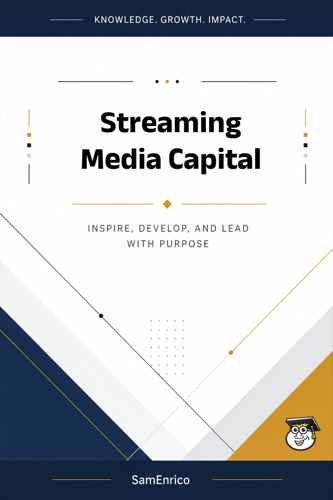
Streaming Media Capital
Allocate across content production, streaming plat
by Himes Carl
Allocate across content production, streaming platforms, and OTT infrastructure.
Formats
About this book
Free sample
Chapter 1: The $200 Billion Bonfire--–- On May 18, 2022, Netflix lost $70 billion in market value in a single day. Not because their service broke. Not because a competitor launched a better product. Not because of a cyberattack, a regulatory crackdown, or a global pandemic. They lost $70 billion because they admitted something that everyone in Hollywood had spent five years denying: streaming was not a magic money machine.The conference call lasted forty-seven minutes.
Netflix executives reported that the company had lost 200,000 subscribers in the first quarter of 2022—the first net loss in over a decade. They projected a loss of another 2 million in the second quarter. The market reacted with the fury of a spurned lover. By the closing bell, Netflix’s market capitalization had dropped from $273 billion to $203 billion. In the weeks that followed, the contagion spread.
Disney lost $50 billion. Warner Bros. Discovery, freshly merged from the ruins of two media empires, saw its stock price cut in half. Paramount Global, Roku, and Spotify all bled double-digit percentage losses. By the end of June 2022, streaming companies had destroyed more than $200 billion in shareholder value.The content wars were over.
The streaming industry had entered what would come to be known as the Efficiency Era—a period of brutal capital reallocation that would separate the survivors from the walking dead. This chapter dismantles the prevailing myth of the prior decade: that “more content equals more subscribers equals success.” It introduces the foundational concept that will guide the entire book—Return on Invested Capital (ROIC)—and uses the market corrections of 2023 through 2026 to illustrate how the smartest operators abandoned the land-grab mentality and began treating streaming as a capital efficiency problem, not a content arms race.The Myth of Unlimited Growth Between 2015 and 2021, streaming executives operated under a simple, seductive theory. Consumers were cutting the cable cord in record numbers. The pandemic had accelerated digital adoption by five years in a single eighteen-month stretch. And the major technology platforms—Netflix, Amazon, Apple—had trained investors to value subscriber growth above all else.
The logic was circular but compelling: spend money to acquire subscribers, use subscriber growth to justify more spending, and eventually…
This is the end of the free sample. Get the eBook to keep going. Buy now
Contents
- Chapter 1
- Chapter 2
- Chapter 3
- Chapter 4
- Chapter 5
- Chapter 6
- Chapter 7
- Chapter 8
- Chapter 9
- Chapter 10
- Chapter 11
- Chapter 12
Details
- Author
- Himes Carl
- Publisher
- SamEnrico
- Language
- English
- Genre
- Non-Fiction, Forecast & Outlook, Streaming Media
- Released
- 2026-06-08
- Pages (approx.)
- 151
- Available as
- eBook, Audiobook

Read better in the ZLOADR app
Your eBooks on your phone or tablet. Sign in with your SamEnrico account and start reading.
More by Himes Carl
 Self Regulation ToolboxHimes Carl$11.99
 Postpartum Babywearing GuideHimes Carl$11.99
 Sheppard Case Evidence LogHimes Carl$11.99
 The Equestrian Loss GuideHimes Carl$11.99
 IBS Meal Prep CookbookHimes Carl$11.99
 Alcohol Recovery and ConcertsHimes Carl$11.99
 Time Audit And ResetHimes Carl$11.99
 Anger After InfidelityHimes Carl$11.99
 When the Sun Stole the Moon: The Hopi Emergence MythHimes Carl$11.99
 Paws of Justice: The K9 Heroes of 9/11Himes Carl$11.99
 Gilded Shadows: The Secret Life of Marie Antoinette’s PerfumerHimes Carl$11.99
 How to Become a Infantry Weapons CrewmemberHimes Carl$11.99