
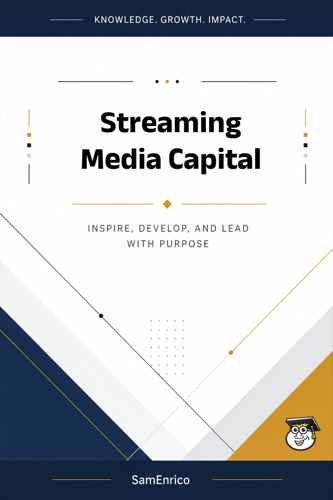
Non-FictionForecast & OutlookStreaming Media
Streaming Media Capital eBook
Allocate across content production, streaming plat
by Himes Carl
Allocate across content production, streaming platforms, and OTT infrastructure.
Formats
Free sample
Chapter 1: The $200 Billion Bonfire--–- On May 18, 2022, Netflix lost $70 billion in market value in a single day. Not because their service broke. Not because a competitor launched a better product. Not because of a cyberattack, a regulatory crackdown, or a global pandemic. They lost $70 billion because they admitted something that everyone in Hollywood had spent five years denying: streaming was not a magic money machine.The conference call lasted forty-seven minutes.
Netflix executives reported that the company had lost 200,000 subscribers in the first quarter of 2022—the first net loss in over a decade. They projected a loss of another 2 million in the second quarter. The market reacted with the fury of a spurned lover. By the closing bell, Netflix’s market capitalization had dropped from $273 billion to $203 billion. In the weeks that followed, the contagion spread.
Disney lost $50 billion. Warner Bros. Discovery, freshly merged from the ruins of two media empires, saw its stock price cut in half. Paramount Global, Roku, and Spotify all bled double-digit percentage losses. By the end of June 2022, streaming companies had destroyed more than $200 billion in shareholder value.The content wars were over.
The streaming industry had entered what would come to be known as the Efficiency Era—a period of brutal capital reallocation that would separate the survivors from the walking dead. This chapter dismantles the prevailing myth of the prior decade: that “more content equals more subscribers equals success.” It introduces the foundational concept that will guide the entire book—Return on Invested Capital (ROIC)—and uses the market corrections of 2023 through 2026 to illustrate how the smartest operators abandoned the land-grab mentality and began treating streaming as a capital efficiency problem, not a content arms race.The Myth of Unlimited Growth Between 2015 and 2021, streaming executives operated under a simple, seductive theory. Consumers were cutting the cable cord in record numbers. The pandemic had accelerated digital adoption by five years in a single eighteen-month stretch. And the major technology platforms—Netflix, Amazon, Apple—had trained investors to value subscriber growth above all else.
The logic was circular but compelling: spend money to acquire subscribers, use subscriber growth to justify more spending, and eventually scale would produce profits.The numbers were staggering. Netflix increased its annual content budget from $6.7 billion in 2016 to $17 billion in 2021. Disney+ launched in November 2019 with a promise of 600 original series by 2024. Warner Media announced a $1 billion budget for HBO Max in its first year alone. Apple, Amazon, and eventually Paramount and Comcast all joined the arms race, driving the total global streaming content spend past $50 billion annually by 2022.Behind the scenes, however, the economics were rotting from within.
The average cost per episode of prestige drama doubled between 2015 and 2022, from $5 million to $10 million, with top-tier shows like Stranger Things and The Crown exceeding $30 million per episode. Marketing costs rose even faster, as streamers competed for attention in an increasingly crowded marketplace. The customer acquisition cost (CAC) for a new streaming subscriber increased from an average of $35 in 2018 to $87 in 2022—a 148 percent increase in just four years.Yet subscription prices remained stubbornly low. Netflix charged $8.99 for its basic plan in 2015 and only $9.99 in 2022—an 11 percent increase over seven years, while production costs had tripled. Disney+ launched at $6.99 and stayed there for two full years, losing an estimated $1.5 billion annually on content alone.
The industry was subsidizing consumer behavior with cheap capital from zero interest rates, and no one wanted to be the first to raise prices and risk slowing subscriber growth.The turning point came in two phases. First, Apple and Amazon—the only streamers with profitable businesses outside of streaming—signaled that they would no longer subsidize unlimited losses. Apple CEO Tim Cook reportedly told the streaming division in early 2022 to “find a path to breakeven” after cumulative losses exceeded $5 billion. Amazon, facing slowing AWS growth, cut its content budget by $1 billion. Then Netflix blinked.
The password crackdown that began in Latin America in 2021 was expanded globally, converting an estimated 15 million freeloaders into paying subscribers at near-zero marginal cost. And the company announced a cheaper, ad-supported tier—something co-founder Reed Hastings had called “an interesting option for consumers” just two years earlier.The message was clear: the era of spending without accountability was over.Enter Return on Invested Capital The metric that separates winning streamers from losing ones is not subscriber count, not revenue growth, not even profitability in the traditional sense. It is Return on Invested Capital—ROIC. ROIC measures how efficiently a company generates profit from the capital it has deployed. The formula is deceptively simple:ROIC = Net Operating Profit After Taxes (NOPAT) ÷ Total Invested Capital Total invested capital includes everything a company has spent to build its streaming business: content libraries (both produced and licensed), technology infrastructure (CDNs, cloud contracts, software development), marketing (customer acquisition), and platform operations (payment processing, customer support, app store fees).
For a mature streamer, ROIC should exceed the cost of capital (typically 8-10 percent for media companies). If it does not, the company is destroying value with every dollar spent.Most streamers in the 2020-2024 period had negative ROIC. For every dollar Disney invested in Disney+, they generated less than eighty cents in long-term value. The problem was not gross margins, which looked healthy at 40-60 percent on paper. The problem was content amortization—the accounting rule that spreads production costs over three to five years, masking the fact that most shows never generate enough viewership to justify their budgets.Consider a typical super-premium drama with a $120 million production cost spread over four years.
On the income statement, the company records $30 million in amortization expense each year, plus ongoing marketing and infrastructure costs. If the show generates $50 million in annual subscription revenue (attributable via engagement metrics), the gross margin looks healthy. But if the show required $100 million in upfront cash that could have been deployed elsewhere—into a lower-cost reality franchise, into infrastructure optimization, into share buybacks—the ROIC tells a different story.The Capital Calculus of the Content Wars To understand why ROIC matters more than gross margin, we must examine the specific mechanisms that destroyed value during the content wars.First, content amortization schedules create a dangerous illusion. Production costs are capitalized on the balance sheet and expensed over time, meaning that the cash outflow occurs years before the expense appears on the income statement. This disconnect allows executives to spend billions in cash while reporting paper profits.
Disney, for example, reported $3.2 billion in operating income from its streaming division in 2023 while burning $2.1 billion in cash. The difference was amortization—shows that had been paid for but not yet expensed.Second, the hit-driven nature of streaming creates extreme variance. A show like Stranger Things or Squid Game generates enough subscriber value to justify dozens of failures. But the law of large numbers works against streamers as they scale. With fifty original series per year, the odds that any single show becomes a cultural phenomenon drop precipitously.
Netflix’s own data, leaked in 2024, showed that the top 5 percent of titles accounted for 85 percent of subscriber retention value. The other 95 percent were economically neutral or negative.Third, capital is not infinite. The era of zero interest rates allowed streamers to borrow…
This is the end of the free sample. Get the eBook to keep going. Buy now
About this book
Details
- Author
- Himes Carl
- Publisher
- SamEnrico
- Language
- English
- Genre
- Non-Fiction, Forecast & Outlook, Streaming Media
- Released
- 2026-06-08
- Pages (approx.)
- 151
- Available as
- eBook, Audiobook

Read better in the ZLOADR app
Your eBooks on your phone or tablet. Sign in with your SamEnrico account and start reading.
More by Himes Carl
 Self Regulation ToolboxHimes Carl$11.99
 Postpartum Babywearing GuideHimes Carl$11.99
 Sheppard Case Evidence LogHimes Carl$11.99
 The Equestrian Loss GuideHimes Carl$11.99
 IBS Meal Prep CookbookHimes Carl$11.99
 Alcohol Recovery and ConcertsHimes Carl$11.99
 Time Audit And ResetHimes Carl$11.99
 Anger After InfidelityHimes Carl$11.99
 When the Sun Stole the Moon: The Hopi Emergence MythHimes Carl$11.99
 Paws of Justice: The K9 Heroes of 9/11Himes Carl$11.99
 Gilded Shadows: The Secret Life of Marie Antoinette’s PerfumerHimes Carl$11.99
 How to Become a Infantry Weapons CrewmemberHimes Carl$11.99
You may also like
 Hong Kong Handover 1997Dunn Johnnie$11.99
 Zumba For Postnatal Recovery CourseNeal Christian$11.99
 Zumba for BeginnersLadner Nikia$11.99
 YouTube Comment Mining GuideHumes Pandora$12.99
 Worry Box MeditationCarlin Rudy$11.99
 Workplace Stress MeditationNguyen Lynn$11.99
 Workplace Stress and Sleep RepairHawley Ivory$11.99
 Workplace Perfectionism CureDelaney Jeffry$11.99
 Workplace Injustice Anger GuideWallen Isabelle$11.99
 Work Addiction and Burnout LinkGreenwood Ester$11.99
 Women in Yoga and WellnessBeattie Galina$11.99
 Women in Stand Up ComedyChun Evangeline$11.99