
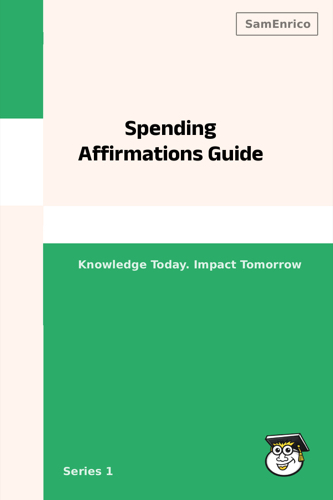
Non-FictionSelf-Help / Affirmations
Spending Affirmations Guide Audiobook
undefined
by Brandt Zelda
undefined
Formats
Free sample
Chapter 1: The Saving Trap--–- Every morning, Maria checked her bank balance before she checked her pulse. At thirty-four years old, she had $47,000 in savings—an objectively impressive figure for a social worker in Portland. She rarely ate out, drove a fifteen-year-old Honda, and hadn't bought new clothes in two years. By every conventional financial metric, Maria was winning. But when her best friend invited her to a weekend yoga retreat in Costa Rica—$1,200 for flights, lodging, and meals—Maria felt something she couldn't name.
Not hesitation. Not budgeting. Something closer to terror.She said no. Then she cried about saying no. Then she felt guilty for crying, because wasn't she supposed to be grateful for her safety net?
The retreat would have been her first vacation in four years. Her friend went without her. The photos on Instagram showed sunsets, laughter, and a version of Maria that didn't exist—the version who said yes. Meanwhile, her savings account grew by another $1,200. And Maria felt nothing.
Not pride. Not security. Just the familiar, hollow thrum of scarcity humming through her bones like a low-grade fever.Maria is not broken. Maria is not bad with money. Maria is trapped in what this book will call the scarcity loop—a psychological pattern that disguises itself as financial responsibility while quietly stealing joy, connection, and the very life that money is supposed to support.
And if you're reading this introduction, there's a chance you recognize something of yourself in her story.You've been told your whole life that saving more is always virtuous. That the person with the highest bank balance wins. That financial freedom means saying no more often than you say yes. But what if that advice—well-intentioned, culturally enshrined, repeated by every parent and pundit and personal finance guru—is actually making you miserable? What if the relentless pressure to save is not a path to peace but a trauma response dressed up in a budgeting app?This chapter will challenge the most sacred cow in personal finance: the idea that saving more is always good.
We will explore the psychology of the scarcity loop, distinguish between two radically different kinds of saving, and introduce a framework for understanding whether your financial habits are protecting you or imprisoning you. By the end of this chapter, you will have a new lens for seeing your relationship with money—and a single, powerful…
This is the end of the free sample. Get the Audiobook to keep going. Buy now
About this book
Details
- Author
- Brandt Zelda
- Publisher
- SamEnrico
- Language
- English
- Genre
- Non-Fiction, Self-Help / Affirmations
- Released
- 2026-06-08
- Pages (approx.)
- 153
- Available as
- eBook, Audiobook

Listen in the VoxFlicks app
Audiobooks and audio dramas wherever you go. Sign in with your SamEnrico account and press play.
More by Brandt Zelda
 Self Talk for Coaches GuideBrandt Zelda$11.99
 Vajikarana Aphrodisiac GuideBrandt Zelda$11.99
 The Online Romance Scam VictimBrandt Zelda$11.99
 Contrast Principle GuideBrandt Zelda$11.99
 Emotional Eating vs Physical Hunger TestBrandt Zelda$11.99
 High Sierra ThunderstormsBrandt Zelda$11.99
 Manic Episode SymptomsBrandt Zelda$11.99
 The Silent Coup: What If the 1973 Yom Kippur War Changed the World?Brandt Zelda$11.99
 Blood and Ink: The Forgotten War Correspondents of the Opium WarsBrandt Zelda$11.99
 How to Produce Homebrewing and Winemaking SuppliesBrandt Zelda$11.99
 How to Produce Tennis Racquet Grips and TapeBrandt Zelda$11.99
 Part Time Jobs for Students ChinaBrandt Zelda$12.99
You may also like
 Hong Kong Handover 1997Dunn Johnnie$11.99
 Zumba For Postnatal Recovery CourseNeal Christian$11.99
 Zumba for BeginnersLadner Nikia$11.99
 YouTube Comment Mining GuideHumes Pandora$12.99
 Worry Box MeditationCarlin Rudy$11.99
 Workplace Stress MeditationNguyen Lynn$11.99
 Workplace Stress and Sleep RepairHawley Ivory$11.99
 Workplace Perfectionism CureDelaney Jeffry$11.99
 Workplace Injustice Anger GuideWallen Isabelle$11.99
 Work Addiction and Burnout LinkGreenwood Ester$11.99
 Women in Yoga and WellnessBeattie Galina$11.99
 Women in Stand Up ComedyChun Evangeline$11.99