
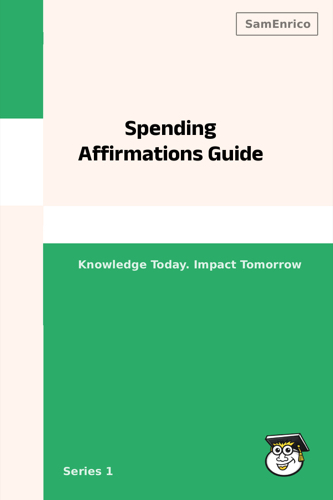
Spending Affirmations Guide eBook
undefined
by Brandt Zelda
undefined
Formats
Free sample
Chapter 1: The Saving Trap--–- Every morning, Maria checked her bank balance before she checked her pulse. At thirty-four years old, she had $47,000 in savings—an objectively impressive figure for a social worker in Portland. She rarely ate out, drove a fifteen-year-old Honda, and hadn't bought new clothes in two years. By every conventional financial metric, Maria was winning. But when her best friend invited her to a weekend yoga retreat in Costa Rica—$1,200 for flights, lodging, and meals—Maria felt something she couldn't name.
Not hesitation. Not budgeting. Something closer to terror.She said no. Then she cried about saying no. Then she felt guilty for crying, because wasn't she supposed to be grateful for her safety net?
The retreat would have been her first vacation in four years. Her friend went without her. The photos on Instagram showed sunsets, laughter, and a version of Maria that didn't exist—the version who said yes. Meanwhile, her savings account grew by another $1,200. And Maria felt nothing.
Not pride. Not security. Just the familiar, hollow thrum of scarcity humming through her bones like a low-grade fever.Maria is not broken. Maria is not bad with money. Maria is trapped in what this book will call the scarcity loop—a psychological pattern that disguises itself as financial responsibility while quietly stealing joy, connection, and the very life that money is supposed to support.
And if you're reading this introduction, there's a chance you recognize something of yourself in her story.You've been told your whole life that saving more is always virtuous. That the person with the highest bank balance wins. That financial freedom means saying no more often than you say yes. But what if that advice—well-intentioned, culturally enshrined, repeated by every parent and pundit and personal finance guru—is actually making you miserable? What if the relentless pressure to save is not a path to peace but a trauma response dressed up in a budgeting app?This chapter will challenge the most sacred cow in personal finance: the idea that saving more is always good.
We will explore the psychology of the scarcity loop, distinguish between two radically different kinds of saving, and introduce a framework for understanding whether your financial habits are protecting you or imprisoning you. By the end of this chapter, you will have a new lens for seeing your relationship with money—and a single, powerful affirmation that will serve as the foundation for everything that follows.The Scarcity Loop: How Fear Rewires the Brain Let us begin with a neuroscientific fact that most money books ignore: the human brain cannot distinguish between a tiger in the bushes and an overdue credit card notice. The same threat-detection system—the amygdala, the HPA axis, the flood of cortisol—activates whether you are running from a predator or opening an envelope from collections. This system evolved over millions of years to keep you alive. But it did not evolve to help you thrive.The scarcity loop is a feedback cycle that begins with a perceived threat of not having enough.
That perception triggers a stress response. The stress response drives protective behavior—hoarding, avoiding, restricting. That behavior temporarily reduces the stress. And because the stress reduction feels like relief, the brain learns to repeat the loop. The pattern becomes automatic.
Unconscious. Invisible.Here is how the scarcity loop typically manifests in spending behavior:Trigger: You see your bank balance. Or a friend mentions a vacation you cannot afford. Or you receive an unexpected medical bill. Or you simply remember, in that low-level way that never quite leaves, that you grew up with parents who fought about money.Thought: "I don't have enough.
I'll never have enough. I need to hold on to everything I have."Feeling: Fear. Anxiety. A tightness in the chest. Shame about the fear, because you know you should be grateful.Action: You save more.
You skip the coffee, the dinner out, the concert tickets. You transfer an extra $50 to savings. You say no to something that would have brought you joy.Result: Your bank account grows slightly. Your cortisol drops slightly. You feel a brief rush of what feels like safety.
But because the relief came from avoiding a threat rather than approaching a value, the underlying fear remains. The loop resets. And tomorrow, you will need another small act of self-denial to feel safe again.This is not financial wisdom. This is a neurological trap.The scarcity loop explains why some of the most diligent savers are also the most anxious people in any room. It explains why lottery winners often go bankrupt.
It explains why a person with $47,000 in savings can cry over a $1,200 yoga retreat. The problem is not the amount of money. The problem is the relationship between the money and the nervous system.Two Kinds of Saving: A Distinction That Changes Everything To escape the scarcity loop, we must first dismantle the false assumption that all saving is created equal. This book draws a sharp line between two fundamentally different behaviors that look identical from the outside but produce opposite psychological results.Trauma-Driven Saving is what we have been describing. It is motivated by fear.
It is hoarding without a purpose—saving for the sake of saving, with no clear goal except the vague, haunting sense that disaster is coming. It feels like never enough, because the feeling of "enough" was never calibrated to a number; it was calibrated to an absence of fear. And because fear has no satiation point, trauma-driven saving has no finish line. You could save a million dollars and still feel poor. In fact, many millionaires do.Trauma-driven saving tends to avoid all spending, even spending that would clearly improve quality of life.
It says no to joy not because the joy is unaffordable but because saying yes feels dangerous. It confuses safety with deprivation. And it is often invisible to the person doing it, because our culture celebrates it. We call trauma-driven savers "disciplined" and "responsible." We give them gold stars for being afraid.Healthy Saving is something else entirely. Healthy saving is motivated by goals, not fear.
It is allocated to specific future spending—a down payment on a house, a sabbatical, a child's education, a retirement full of travel and hobbies. Healthy saving feels like peace, not like a clenched jaw. It has a purpose that the saver can articulate in plain language: "I am saving $200 a month for a trip to Japan in three years." Or "I am setting aside six months of expenses so that I can leave my toxic job without panic."Healthy saving allows intentional spending because it is not threatened by spending. When you know why you are saving, you can also know when to stop saving and start living. Healthy savers say yes to value-aligned purchases without guilt.
They do not check their bank accounts with dread. They do not cry over yoga retreats.The difference between these two kinds of saving is not mathematical. It is psychological. And it is the single most important distinction you will learn in this book.The Cultural Conspiracy That Keeps You Stuck If trauma-driven saving is so damaging, why…
This is the end of the free sample. Get the eBook to keep going. Buy now
About this book
Details
- Author
- Brandt Zelda
- Publisher
- SamEnrico
- Language
- English
- Genre
- Non-Fiction, Self-Help / Affirmations
- Released
- 2026-06-08
- Pages (approx.)
- 153
- Available as
- eBook, Audiobook

Read better in the ZLOADR app
Your eBooks on your phone or tablet. Sign in with your SamEnrico account and start reading.
More by Brandt Zelda
 Self Talk for Coaches GuideBrandt Zelda$11.99
 Vajikarana Aphrodisiac GuideBrandt Zelda$11.99
 The Online Romance Scam VictimBrandt Zelda$11.99
 Contrast Principle GuideBrandt Zelda$11.99
 Emotional Eating vs Physical Hunger TestBrandt Zelda$11.99
 High Sierra ThunderstormsBrandt Zelda$11.99
 Manic Episode SymptomsBrandt Zelda$11.99
 The Silent Coup: What If the 1973 Yom Kippur War Changed the World?Brandt Zelda$11.99
 Blood and Ink: The Forgotten War Correspondents of the Opium WarsBrandt Zelda$11.99
 How to Produce Homebrewing and Winemaking SuppliesBrandt Zelda$11.99
 How to Produce Tennis Racquet Grips and TapeBrandt Zelda$11.99
 Part Time Jobs for Students ChinaBrandt Zelda$12.99
You may also like
 Interruption AffirmationsBrunner Alysa$11.99
 Habit AffirmationsSanderson Belkis$11.99
 Goal Setting AffirmationsAviles Pattie$11.99
 Divorce Affirmations AudioMccarter Gianna$11.99
 Child Loss AffirmationsYu Tori$11.99
 Remote Work AffirmationsSegura Lina$11.99
 Pain AffirmationsHoff Connie$11.99
 Anticipatory Grief AffirmationsKirby Catarina$11.99
 Job Loss AffirmationsHarden Ayesha$11.99
 Gratitude AffirmationsLenz Amira$11.99
 Financial Stress Audio AffirmationsYarbrough Flor$11.99
 Anger Affirmations for CouplesLockwood Lynwood$11.99