
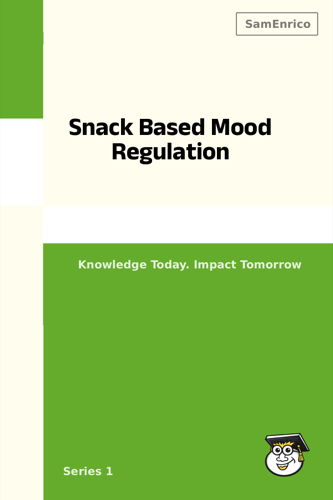
Snack Based Mood Regulation eBook
Use healthy snacks to prevent low blood sugar irri
Use healthy snacks to prevent low blood sugar irritability while driving.
Formats
Free sample
Chapter 1: The Glucose Trap--–- Sarah was a rational person. She paid her taxes on time, never texted while driving, and believed firmly that emotions were best managed with deep breathing and good communication. So when she found herself screaming obscenities at a minivan for the unforgivable crime of going the speed limit, she assumed something was wrong with her personality. Maybe she had anger issues. Maybe she was secretly a bad person.
Maybe her mother was right about that temper.None of those things were true. What was true—what Sarah would discover only after three more explosive commutes, a tearful conversation with her husband, and one very expensive therapy session—was that her brain had been starving for forty-five minutes. The oatmeal and banana she had eaten at 7:00 AM, the breakfast every wellness influencer had told her was "clean" and "healthy," had set a biochemical trap. By 9:30 AM, her blood sugar had plummeted, her amygdala had hijacked her prefrontal cortex, and she had become someone she didn't recognize.This book exists because Sarah is not unusual. She is not broken.
She is not weak-willed or emotionally immature. She is a normal human being whose metabolism, combined with modern food and modern driving conditions, produced a predictable neurological event. The science of blood sugar regulation has advanced dramatically in the last decade, thanks largely to researchers using continuous glucose monitors (CGMs) that track blood sugar in real time. What these monitors have revealed is astonishing: most people experience multiple blood sugar crashes every single day. Most people have no idea.
And most people blame themselves for the resulting mood swings, calling themselves "hangry" as if it were a quirky personality trait rather than a medical event.This chapter will introduce you to the glucose roller coaster, explain why driving makes everything worse, and give you the first critical tool you need to recognize a crash before it controls you. By the end of this chapter, you will never look at a bowl of oatmeal the same way again.The Breakfast That Betrayed You Let us examine the standard "healthy" breakfast that millions of people eat before driving to work. A bowl of oatmeal: approximately 30 grams of carbohydrates, almost entirely from complex starches and sugars. A banana: another 25 grams of carbohydrates, mostly natural fruit sugars. A glass of orange juice: 22 grams of sugar, with no fiber to slow absorption.
A cup of coffee: caffeine, which will soon matter enormously. Total carbohydrates: nearly 80 grams. Total protein: perhaps 5 grams from the oatmeal. Total fat: negligible unless you added milk or nuts.From a conventional nutrition perspective, this breakfast looks fine. It contains whole grains, fruit, and no processed junk.
But from a blood sugar perspective, it is a disaster waiting to happen. Here is what actually happens inside your body after that breakfast:Minutes 0-15: The simple sugars from the orange juice and banana hit your small intestine almost immediately. They pass into your bloodstream, and your blood glucose begins to rise. The oatmeal, being more complex, takes slightly longer but follows close behind.Minutes 15-30: Your blood glucose spikes. This means it climbs rapidly to a peak well above normal fasting levels.
For most people, that peak will be somewhere between 140 and 180 mg/d L—not diabetic territory, but significantly elevated. You feel good. You have energy. You might even feel slightly euphoric. This is the "sugar high," and it is deceptive.Minutes 30-60: Your pancreas detects the rising blood sugar and releases insulin.
Insulin is a hormone that tells your cells to absorb glucose from the bloodstream. In a healthy person, the pancreas releases exactly enough insulin to bring blood sugar back to normal. But here is the problem: simple carbohydrates (juice, banana) cause a rapid spike, and the pancreas often overcorrects. It releases more insulin than strictly necessary because it cannot see the future and does not know that the oatmeal is still digesting.Minutes 60-90: This is the danger window. The insulin surge continues, but now the simple sugars have been cleared from your bloodstream.
The only glucose left is from the oatmeal, which digests more slowly. However, the insulin is still active, still telling your cells to absorb glucose. Blood sugar begins to drop below baseline. You might not notice yet.Minutes 90-120: The crash. Your blood sugar falls below 70 mg/d L, a condition called reactive hypoglycemia.
You feel shaky, irritable, anxious, tired, and foggy. Your ability to concentrate collapses. Your patience evaporates. You become someone else—someone who yells at minivans for no good reason.This is not a theory. This is not pop science.
This is the established physiology of glucose metabolism, confirmed by thousands of continuous glucose monitor readings collected by researchers like Jessie Inchauspé, whose book Glucose Revolution documented these patterns across hundreds of subjects. The oatmeal-and-banana breakfast produced crashes in nearly every subject within two hours. The only people who avoided the crash were those who added significant protein and fat—eggs, sausage, full-fat yogurt—to slow the absorption of carbohydrates.Why Your Brain Goes Haywire To understand why a blood sugar crash makes you want to commit vehicular manslaughter, you need to understand how your brain gets its fuel. The brain is the most energy-hungry organ in your body. It represents only 2 percent of your body weight but consumes approximately 20 percent of your glucose.
Unlike your muscles, which can switch to burning fat when glucose is scarce, your brain has no backup fuel system. It runs exclusively on glucose. When glucose drops, the brain panics.The panic is not metaphorical. The brain has a hierarchy of functions, and when fuel is limited, it makes brutal choices about what to keep running. The brainstem, which controls breathing and heart rate, stays online no matter what—those functions are non-negotiable.
The cerebellum, which coordinates movement, also gets priority. But the prefrontal cortex—the part of your brain responsible for impulse control, emotional regulation, long-term planning, and social behavior—is considered optional. When glucose drops, the prefrontal cortex is the first system to be downregulated.Meanwhile, the amygdala—a small, almond-shaped cluster of nuclei deep in the brain—does the opposite. The amygdala is your threat-detection system. It is primitive, fast, and not very smart.
It does not distinguish between a mountain lion and a slow driver. It only knows that when glucose is low, the body might be in danger, so it ramps up its activity. It becomes hypervigilant. It interprets neutral stimuli as threats. It prepares your body for fight or flight by releasing adrenaline and cortisol.The result is a perfect storm: the prefrontal cortex, which would normally tell the amygdala to calm down, is offline.
The amygdala, unchecked, is screaming that everything is a threat. Your body is flooded with stress hormones. And you, sitting in your car, are convinced that the driver ahead of you is personally trying to ruin your life. You are not having a character failure. You are having a neurological event.This phenomenon has a name.
In 2018, researchers at the University of Guelph published a study demonstrating that induced hypoglycemia significantly impaired emotional regulation and increased aggressive responses in a standardized laboratory task.…
This is the end of the free sample. Get the eBook to keep going. Buy now
About this book
Details
- Author
- Givens Sherrill
- Publisher
- SamEnrico
- Language
- English
- Genre
- Non-Fiction, Self-Help, Nutrition
- Released
- 2026-06-11
- Pages (approx.)
- 144
- Available as
- eBook, Audiobook

Read better in the ZLOADR app
Your eBooks on your phone or tablet. Sign in with your SamEnrico account and start reading.
More by Givens Sherrill
 Impossible Deadlines Coping GuideGivens Sherrill$11.99
 Cooperative Leather Tanning GuideGivens Sherrill$11.99
 The TMS Depression Treatment GuideGivens Sherrill$11.99
 The Titanic Survivor Wreck NarrativesGivens Sherrill$11.99
 The Outback Visionaries: Pioneering the Soul of AustraliaGivens Sherrill$11.99
 How to Start a Church of Christ Scientist Business (Beginners Guide)Givens Sherrill$11.99
 State Street SWOTGivens Sherrill$12.99
 Study in Canada PR RoadmapGivens Sherrill$12.99
 Understanding Oral-pharyngeal DisordersGivens Sherrill$17.99
 Plum HarvestingGivens Sherrill$11.99
You may also like
 Hong Kong Handover 1997Dunn Johnnie$11.99
 Zumba For Postnatal Recovery CourseNeal Christian$11.99
 Zumba for BeginnersLadner Nikia$11.99
 YouTube Comment Mining GuideHumes Pandora$12.99
 Worry Box MeditationCarlin Rudy$11.99
 Workplace Stress MeditationNguyen Lynn$11.99
 Workplace Stress and Sleep RepairHawley Ivory$11.99
 Workplace Perfectionism CureDelaney Jeffry$11.99
 Workplace Injustice Anger GuideWallen Isabelle$11.99
 Work Addiction and Burnout LinkGreenwood Ester$11.99
 Women in Yoga and WellnessBeattie Galina$11.99
 Women in Stand Up ComedyChun Evangeline$11.99