
Non-FictionInformativeEducational
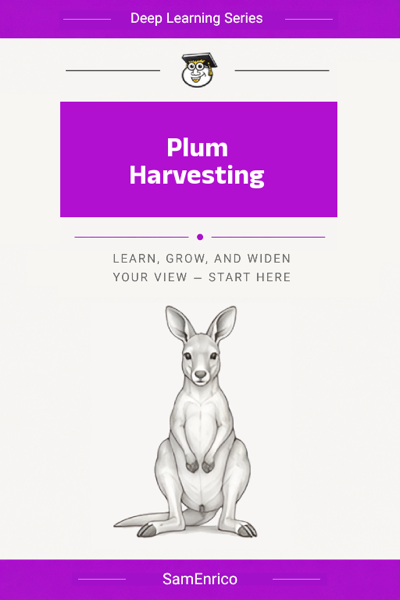
Plum Harvesting
A Coursebook on Plum Harvesting
A Coursebook on Plum Harvesting
Formats
About this book
Free sample
Chapter 1: The Hidden Orchard...---- Every plum that reaches a consumer’s hand begins its journey in a moment of profound vulnerability. The fruit hangs from a branch, attached by a slender stem, its skin intact, its flesh firm, its sugars still accumulating in the final days before harvest. In that moment, the plum is alive—respiring, transpiring, and slowly converting starches to sugars. And then, in a single second, a hand reaches up, twists, and pulls. The stem detaches.
The plum falls into a picking bag, then into a bin, then onto a truck, then through a packing line, then into a refrigerator, then onto a store shelf, and finally into a shopping cart. Between the tree and the consumer lie dozens of opportunities for that plum to fail—to bruise, to rot, to become mealy, to lose flavor, or simply to be rejected for the wrong shade of red.-- The grower who understands this chain of vulnerability controls it. The grower who does not becomes a victim of it. This is the central premise of Plum Harvesting: A Coursebook on Sustainable Production, Postharvest Physiology, and Value-Added Processing. And before we can discuss harvest techniques, cooling protocols, or packing lines, we must first understand what a plum actually is—botanically, historically, and globally.
Because the decisions that determine harvest success begin not in the harvest season itself, but in the selection of species, the understanding of domestication, and the recognition of how biological traits dictate every subsequent handling choice.The Genus Prunus: A Botanical Framework-- The plum belongs to the genus Prunus, a group that includes almonds, apricots, cherries, peaches, and nectarines. What unites these seemingly diverse fruits is a shared botanical structure: all are drupes, meaning they consist of a thin skin (exocarp), a fleshy middle layer (mesocarp), and a hard, stone-like endocarp that surrounds a single seed. In common language, we call this stone the "pit." The plum's relationship to its relatives is close enough that many Prunus species can be grafted onto one another's rootstocks, a fact that becomes critically important when we discuss cultivar selection…
This is the end of the free sample. Get the eBook to keep going. Buy now
Contents
- Chapter 1
- Chapter 2
- Chapter 3
- Chapter 4
- Chapter 5
- Chapter 6
- Chapter 7
- Chapter 8
- Chapter 9
- Chapter 10
- Chapter 11
- Chapter 12
Details
- Author
- Givens Sherrill
- Publisher
- SamEnrico
- Language
- English
- Genre
- Non-Fiction, Informative, Educational
- Released
- 2026-05-04
- Pages (approx.)
- 149
- Available as
- eBook, Audiobook

Read better in the ZLOADR app
Your eBooks on your phone or tablet. Sign in with your SamEnrico account and start reading.
More by Givens Sherrill
 Snack Based Mood RegulationGivens Sherrill$11.99
 Impossible Deadlines Coping GuideGivens Sherrill$11.99
 Cooperative Leather Tanning GuideGivens Sherrill$11.99
 The TMS Depression Treatment GuideGivens Sherrill$11.99
 The Titanic Survivor Wreck NarrativesGivens Sherrill$11.99
 The Outback Visionaries: Pioneering the Soul of AustraliaGivens Sherrill$11.99
 How to Start a Church of Christ Scientist Business (Beginners Guide)Givens Sherrill$11.99
 State Street SWOTGivens Sherrill$12.99
 Study in Canada PR RoadmapGivens Sherrill$12.99
 Understanding Oral-pharyngeal DisordersGivens Sherrill$17.99
You may also like
 Hong Kong Handover 1997Dunn Johnnie$11.99
 Zumba For Postnatal Recovery CourseNeal Christian$11.99
 Zumba for BeginnersLadner Nikia$11.99
 YouTube Comment Mining GuideHumes Pandora$12.99
 Worry Box MeditationCarlin Rudy$11.99
 Workplace Stress MeditationNguyen Lynn$11.99
 Workplace Stress and Sleep RepairHawley Ivory$11.99
 Workplace Perfectionism CureDelaney Jeffry$11.99
 Workplace Injustice Anger GuideWallen Isabelle$11.99
 Work Addiction and Burnout LinkGreenwood Ester$11.99
 Women in Yoga and WellnessBeattie Galina$11.99
 Women in Stand Up ComedyChun Evangeline$11.99