
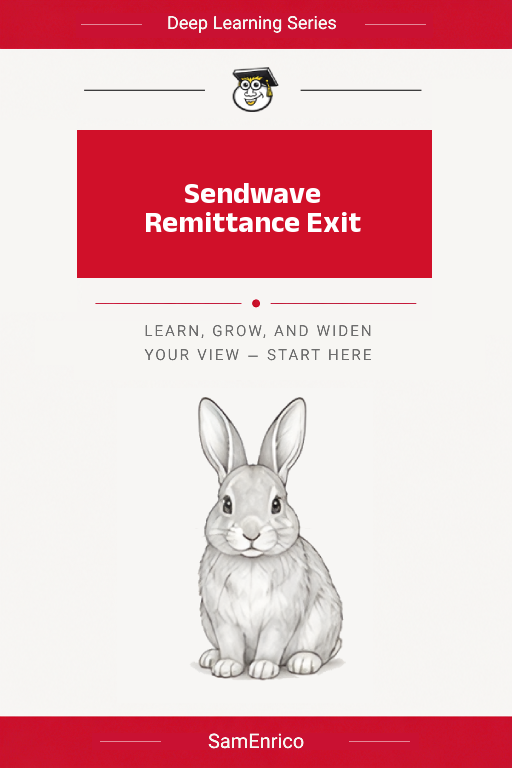
Non-FictionBusiness BriefRemittance
Sendwave Remittance Exit Audiobook
Trace the diaspora money transfer app's sale to Ch
Trace the diaspora money transfer app's sale to Chime.
Formats
Free sample
Chapter 1: The Immigrant Tax...--The money left Boston at 9:17 on a Tuesday morning.Aisha Mohammed, a 34-year-old intensive care nurse at Boston Medical Center, had just finished a double shift. She stood in the freezing rain outside a Western Union location in Dorchester, her scrubs still damp from a patient’s bed bath. In her hand was $200 in crumpled bills—money she had promised her mother in Mombasa for a roof repair before the long rains began.The agent behind the plexiglass screen typed slowly. “Two hundred dollars to Kenya. Fee is fifteen dollars.
Will arrive in three to five business days.”Aisha did the math in her head. Her mother would receive $185. Maybe. If the agent in Mombasa didn’t charge an additional pickup fee. If the transfer wasn’t delayed by a public holiday.
If the branch was open when her mother walked two miles to collect it.She paid anyway. What choice did she have?Three days later, her mother called. The roof had leaked. The mattress was ruined. And the money still hadn’t arrived.“It’s okay, Mama,” Aisha lied.
“I’ll send more next week.”That next week, she downloaded an app called Sendwave.The $700 Billion Secret Aisha’s story is not unusual. It is not even remarkable. It is, in fact, the daily reality for more than 280 million migrant workers worldwide who send money home to their families. The global remittance market—the formal flow of money across borders by individuals working outside their home countries—exceeded $700 billion annually by 2020. To put that number in perspective, it is larger than the entire GDP of Saudi Arabia, Switzerland, or Argentina.
It is three times the size of all foreign aid combined.Yet despite its staggering scale, the remittance industry has operated for decades like a legalized cartel. A handful of players—Western Union, Money Gram, and a network of regional banks—have controlled the corridors through which money moves from wealthy nations to developing ones. And they have extracted an enormous toll for that service.The global average cost of sending $200 was approximately 6.5 percent in 2020, according to the World Bank. But that average concealed vast disparities. Sending money from the United States to Mexico—the largest single corridor in the world—cost as little as 3 percent, thanks to competition and established banking relationships.
But sending the same $200 from the United States to Kenya, Ghana, or Nigeria cost 10 percent or more. To…
This is the end of the free sample. Get the Audiobook to keep going. Buy now
About this book
Details
- Author
- Lemons Leandra
- Publisher
- SamEnrico
- Language
- English
- Genre
- Non-Fiction, Business Brief, Remittance
- Released
- 2026-06-07
- Pages (approx.)
- 139
- Available as
- eBook, Audiobook

Listen in the VoxFlicks app
Audiobooks and audio dramas wherever you go. Sign in with your SamEnrico account and press play.
More by Lemons Leandra
 Loci for Cooking RecipesLemons Leandra$11.99
 The Single Parent StudentLemons Leandra$11.99
 Medication for NightmaresLemons Leandra$11.99
 EQ For Teachers And EducatorsLemons Leandra$11.99
 Drug Dependency Success StoriesLemons Leandra$11.99
 Mindfulness Meditation for Addiction RecoveryLemons Leandra$11.99
 Memory Palace PodcastsLemons Leandra$11.99
 Self Worth And WorkaholismLemons Leandra$11.99
 Metta For IndecisionLemons Leandra$11.99
 The Silk and the Spy: A Love Affair That Changed HistoryLemons Leandra$11.99
 The Last Whisper of the Nightingale: The Enigmatic Tale of the Vanishing SongbirdsLemons Leandra$11.99
 The Janes: Abortion on TrialLemons Leandra$11.99
You may also like
 Hong Kong Handover 1997Dunn Johnnie$11.99
 Zumba For Postnatal Recovery CourseNeal Christian$11.99
 Zumba for BeginnersLadner Nikia$11.99
 YouTube Comment Mining GuideHumes Pandora$12.99
 Worry Box MeditationCarlin Rudy$11.99
 Workplace Stress MeditationNguyen Lynn$11.99
 Workplace Stress and Sleep RepairHawley Ivory$11.99
 Workplace Perfectionism CureDelaney Jeffry$11.99
 Workplace Injustice Anger GuideWallen Isabelle$11.99
 Work Addiction and Burnout LinkGreenwood Ester$11.99
 Women in Yoga and WellnessBeattie Galina$11.99
 Women in Stand Up ComedyChun Evangeline$11.99