
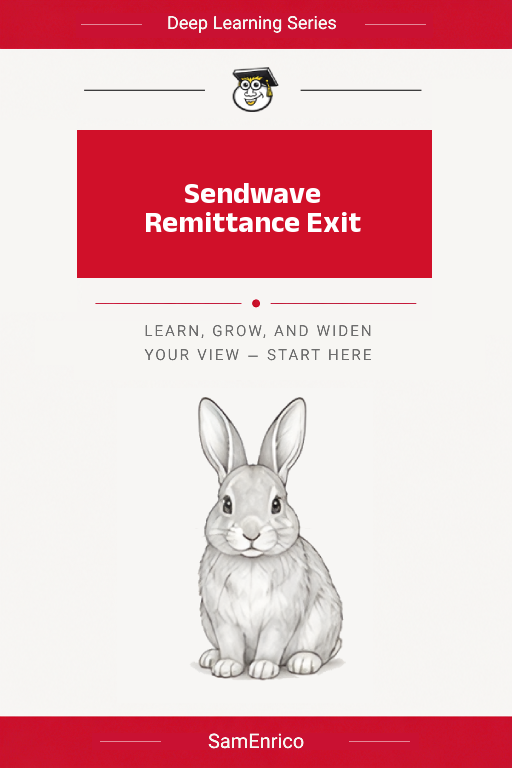
Non-FictionBusiness BriefRemittance
Sendwave Remittance Exit eBook
Trace the diaspora money transfer app's sale to Ch
Trace the diaspora money transfer app's sale to Chime.
Formats
Free sample
Chapter 1: The Immigrant Tax...--The money left Boston at 9:17 on a Tuesday morning.Aisha Mohammed, a 34-year-old intensive care nurse at Boston Medical Center, had just finished a double shift. She stood in the freezing rain outside a Western Union location in Dorchester, her scrubs still damp from a patient’s bed bath. In her hand was $200 in crumpled bills—money she had promised her mother in Mombasa for a roof repair before the long rains began.The agent behind the plexiglass screen typed slowly. “Two hundred dollars to Kenya. Fee is fifteen dollars.
Will arrive in three to five business days.”Aisha did the math in her head. Her mother would receive $185. Maybe. If the agent in Mombasa didn’t charge an additional pickup fee. If the transfer wasn’t delayed by a public holiday.
If the branch was open when her mother walked two miles to collect it.She paid anyway. What choice did she have?Three days later, her mother called. The roof had leaked. The mattress was ruined. And the money still hadn’t arrived.“It’s okay, Mama,” Aisha lied.
“I’ll send more next week.”That next week, she downloaded an app called Sendwave.The $700 Billion Secret Aisha’s story is not unusual. It is not even remarkable. It is, in fact, the daily reality for more than 280 million migrant workers worldwide who send money home to their families. The global remittance market—the formal flow of money across borders by individuals working outside their home countries—exceeded $700 billion annually by 2020. To put that number in perspective, it is larger than the entire GDP of Saudi Arabia, Switzerland, or Argentina.
It is three times the size of all foreign aid combined.Yet despite its staggering scale, the remittance industry has operated for decades like a legalized cartel. A handful of players—Western Union, Money Gram, and a network of regional banks—have controlled the corridors through which money moves from wealthy nations to developing ones. And they have extracted an enormous toll for that service.The global average cost of sending $200 was approximately 6.5 percent in 2020, according to the World Bank. But that average concealed vast disparities. Sending money from the United States to Mexico—the largest single corridor in the world—cost as little as 3 percent, thanks to competition and established banking relationships.
But sending the same $200 from the United States to Kenya, Ghana, or Nigeria cost 10 percent or more. To Tanzania? Twelve percent. To Angola? Nearly 15 percent.These percentages, expressed in dollars, are painful but manageable for a single transaction.
But remittance senders do not send once. They send every month, often for years or decades. A nurse like Aisha, sending $200 monthly from Boston to Mombasa over ten years, would lose more than $2,300 to fees alone—money that could have paid for a child’s school fees, a new roof, or a small business loan.This is the immigrant tax. It is not a tax in the legal sense—no government imposes it, no treasury collects it. But it functions exactly like a tax: compulsory, invisible, and deducted before the money ever reaches its intended recipient.
And like most taxes, it falls heaviest on those who can least afford it.The Banks Said No To understand why the immigrant tax exists, one must first understand what banks think about poor people.This sounds harsh, but it is not an accusation. It is a description of incentives. Banks are not charities; they are risk-managing institutions that allocate capital to its most profitable use. A migrant worker sending $200 to a rural village in Kenya presents a set of problems that no bank is eager to solve.First, the transaction size is tiny. A bank’s cost to process a wire transfer—conducting Know Your Customer (KYC) checks, screening against sanctions lists, filing currency transaction reports, and settling across correspondent banking networks—is roughly fixed regardless of the amount sent.
A $10,000 wire and a $200 wire cost the bank nearly the same to process. But the $10,000 wire generates ten times the potential revenue. Banks rationally prioritize larger transactions.Second, the compliance burden is enormous. Anti-money laundering (AML) and counter-terrorism financing (CTF) regulations, particularly those enforced by the US Treasury’s Financial Crimes Enforcement Network (Fin CEN), require banks to know exactly who is sending money, where it is going, and for what purpose. A remittance sender in Boston presents a relatively low risk.
But the recipient in Mombasa? The bank has no relationship with that person, no way to verify their identity, and no ability to monitor how the money is used. In regulatory terms, that recipient is a black box—and black boxes attract scrutiny.Third, the infrastructure does not exist. The rural village where Aisha’s mother lives has no bank branch. It may not have reliable electricity or paved roads.
Western Union and Money Gram built their businesses by contracting with local grocery stores, post offices, and gas stations—anywhere with a cash drawer and a phone line. But banks never made that investment. The unit economics did not work.So the banks said no. Not explicitly, not in a public statement. They simply declined to serve the market.
And into that vacuum stepped Western Union and Money Gram, building a duopoly that would last for more than a century.The Duopoly and Its Defenses Western Union traces its origins to 1851, when it began transmitting messages by telegraph. The company quickly realized that its telegraph network could also transmit money—a service that became indispensable to immigrants moving to the United States during the great waves of European migration. By the time the first World War ended, Western Union had become the default system for moving money across borders.Money Gram, founded in 1940 as Travelers Express, entered the market later but followed the same playbook: build a physical agent network, charge a percentage-based fee, and compete primarily on brand recognition rather than price or speed.For decades, this duopoly faced no serious competition. New entrants could not replicate the agent networks—Western Union alone had more than 500,000 locations worldwide, including tens of thousands in remote villages. Regulatory barriers protected the incumbents; obtaining money transmitter licenses in all fifty US states costs millions of dollars and years of legal work.
And the network effects were brutal: a new remittance service is useless if the recipient has no way to collect the money.The incumbents defended their position with arguments that sounded reasonable. “We provide a valuable service,” Western Union’s executives would say. “We enable families to stay connected across borders. Our fees reflect the cost of compliance, fraud prevention, and global infrastructure.”These arguments were not entirely false. But they were also not entirely true.
The gap between Western Union’s marginal cost of processing a transfer and its fee was enormous—a spread that generated billions in annual profits. The duopoly was not charging what the service cost. It was charging what the market would bear.And the market would bear a great deal, because the alternative was nothing.The Mobile Money Revolution In 2007, a mobile phone operator in Kenya changed everything.Safaricom, a subsidiary of Britain’s Vodafone, launched a product called M-Pesa. The name combined “M”…
This is the end of the free sample. Get the eBook to keep going. Buy now
About this book
Details
- Author
- Lemons Leandra
- Publisher
- SamEnrico
- Language
- English
- Genre
- Non-Fiction, Business Brief, Remittance
- Released
- 2026-06-07
- Pages (approx.)
- 139
- Available as
- eBook, Audiobook

Read better in the ZLOADR app
Your eBooks on your phone or tablet. Sign in with your SamEnrico account and start reading.
More by Lemons Leandra
 Loci for Cooking RecipesLemons Leandra$11.99
 The Single Parent StudentLemons Leandra$11.99
 Medication for NightmaresLemons Leandra$11.99
 EQ For Teachers And EducatorsLemons Leandra$11.99
 Drug Dependency Success StoriesLemons Leandra$11.99
 Mindfulness Meditation for Addiction RecoveryLemons Leandra$11.99
 Memory Palace PodcastsLemons Leandra$11.99
 Self Worth And WorkaholismLemons Leandra$11.99
 Metta For IndecisionLemons Leandra$11.99
 The Silk and the Spy: A Love Affair That Changed HistoryLemons Leandra$11.99
 The Last Whisper of the Nightingale: The Enigmatic Tale of the Vanishing SongbirdsLemons Leandra$11.99
 The Janes: Abortion on TrialLemons Leandra$11.99
You may also like
 Hong Kong Handover 1997Dunn Johnnie$11.99
 Zumba For Postnatal Recovery CourseNeal Christian$11.99
 Zumba for BeginnersLadner Nikia$11.99
 YouTube Comment Mining GuideHumes Pandora$12.99
 Worry Box MeditationCarlin Rudy$11.99
 Workplace Stress MeditationNguyen Lynn$11.99
 Workplace Stress and Sleep RepairHawley Ivory$11.99
 Workplace Perfectionism CureDelaney Jeffry$11.99
 Workplace Injustice Anger GuideWallen Isabelle$11.99
 Work Addiction and Burnout LinkGreenwood Ester$11.99
 Women in Yoga and WellnessBeattie Galina$11.99
 Women in Stand Up ComedyChun Evangeline$11.99