
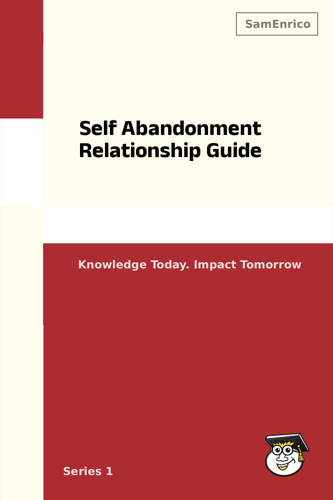
Non-FictionSelf-HelpSelf Abandonment
Self Abandonment Relationship Guide eBook
Stop losing yourself in love using this self estee
by Cody Kamala
Stop losing yourself in love using this self esteem recovery workbook.
Formats
Free sample
Chapter 1: The Parking Lot Panic Attack--–- You are sitting in your car. The engine is off, but your heart is racing as if you just ran a mile. The apartment building in front of you is familiar. Too familiar. You know which window is theirs.
You know which parking spot is theirs. You know that if you look up right now, you might see their silhouette moving behind the blinds, and that possibility alone has hijacked every cell in your body.You drove here without consciously deciding to. Forty-five minutes through evening traffic, through the fading light of rush hour, through the part of town where you swore you would never live because the commute would be too long. And yet here you are. Again.
Your phone is in your hand. The last text you sent—the one that went unanswered for three hours now—is open on the screen. Three dots never appeared. No typing bubble. No "sorry, busy." Just silence.You check the time.
Then you check it again. You have been sitting in this parking spot for eleven minutes. Eleven minutes of your one precious life, spent waiting for the courage to walk to that door, or the wisdom to drive away, or some sign from the universe that you are not, in fact, losing your mind. You haven't eaten dinner. You cancelled on your best friend.
You told yourself you were just "running an errand." You lied.And somewhere beneath the fog of anxiety, beneath the thrum of please don't leave me that has become the background music of your entire romantic life, a quieter voice is trying to speak. It sounds like this: What am I doing? When did I become someone who sits in parking lots waiting for someone else to validate my existence? When did I lose myself?That quieter voice is the reason you are reading this book. It is the part of you that has not yet been consumed.
The part that knows something is wrong, even if you cannot name it. The part that is exhausted from the endless cycle of giving, waiting, shrinking, and hoping. That part is not weak. That part is the survivor. And it is time to let that part drive.Welcome to the end of losing yourself in love.The Cultural Lie That Broke You Before we go any further, we need to name the enemy.
And the enemy is not your partner. It is not your ex. It is not your parents, your attachment style, or your childhood wounds. The enemy is a story. A story so pervasive, so woven into the fabric of every movie, every song, every holiday commercial, and every well-meaning friend who tells you that "relationships take work," that you have never thought to question it.The story is this: Love requires sacrifice.
And the more you sacrifice, the more you love.This is the lie that fuels self-abandonment. It sounds noble. It sounds like devotion, like commitment, like the kind of love that poets write about. But let us look closely at what this story actually demands of you.It demands that you silence your voice when disagreement feels too dangerous. It demands that you tolerate behavior that you would never accept from a stranger, because "everyone has bad days." It demands that you shrink your needs, your preferences, your dreams, and your identity until you fit neatly into the space someone else has left for you.
It demands that you become small. And then it calls that smallness "love."Here is the truth that this book will argue on every single page: Self-sacrifice is not love. Self-sacrifice is self-erasure. And self-erasure is not a virtue. It is a survival strategy that has outlived its usefulness.The woman who cancels her plans every time her partner "needs her" is not generous.
She is terrified. The man who stops seeing his friends because his girlfriend "gets anxious when he goes out" is not devoted. He is disappearing. The person who says "I don't mind" when they very much do mind is not easygoing. They are afraid that if they take up space, they will be left.And somewhere along the way—probably a long time ago, probably when you were too young to know you were being trained—you learned that being left was the worst thing that could happen.
Worse than being lonely. Worse than being angry. Worse than being yourself. So you made a deal. You promised yourself that you would do whatever it took to stay.
You would be flexible. You would be agreeable. You would be anything they needed, as long as they did not leave.That deal worked for a while. It kept you safe. It got you love.
It got you relationship after relationship, even if those relationships left you hollow. But now the deal is bankrupt. The cost has exceeded the value. And it is time to tear it up.The Codependent Cycle: How Anxiety Becomes Control Becomes Burnout Let us name the pattern you have been living. Drawing on the foundational work of Melody Beattie in Codependent No More, we call this the Codependent Cycle.
It has four stages, and once you see them, you will see them everywhere.Stage One: Anxiety It starts with a feeling. Not love. Not excitement. Not even affection. It starts with anxiety.
You send a text and they do not reply quickly enough. Your chest tightens. Your mind begins to race. What did I do? What did I say?
Are they angry? Are they leaving?This anxiety is not a response to anything they actually did. It is a response to silence. To space. To the ordinary ebb and flow of another human being having their own life.
But your nervous system does not register silence as normal. It registers silence as danger. Because a long time ago, silence meant abandonment. Silence meant you were alone. Silence meant you had to fend for yourself, and you were too small to do that.So the anxiety arrives.
And it is unbearable.Stage Two: Controlling Behavior Because the anxiety is unbearable, you do something to make it stop. You text again. You call. You drive to their apartment. You ask "Is everything okay?" for the third time.
You offer to help with something they did not ask for help with. You change your plans to accommodate theirs. You say yes when you meant no. You agree when you disagree. You perform.
You manage. You control.Here is the cruel irony: you are not trying to control them. You are trying to control your own anxiety. But the only way you have learned to control your anxiety is by controlling the external environment. If I can just get them to reply, the anxiety will stop.
If I can just make sure they are happy, the anxiety will stop. If I can just be perfect enough, good enough, small enough, the anxiety will stop.It never stops. It only pauses.Stage Three: Burnout Controlling another person's emotions is exhausting work. It is a full-time job with no breaks, no pay, and no gratitude. You are monitoring their moods, anticipating their needs…
This is the end of the free sample. Get the eBook to keep going. Buy now
About this book
Details
- Author
- Cody Kamala
- Publisher
- SamEnrico
- Language
- English
- Genre
- Non-Fiction, Self-Help, Self Abandonment
- Released
- 2026-06-06
- Pages (approx.)
- 131
- Available as
- eBook, Audiobook

Read better in the ZLOADR app
Your eBooks on your phone or tablet. Sign in with your SamEnrico account and start reading.
More by Cody Kamala
 Parenting Stress And Chronic IllnessCody Kamala$11.99
 Caffeine Energy StrategyCody Kamala$11.99
 Dream Group Facilitation GuideCody Kamala$11.99
 Ragnarök and the Fox’s Gambit: Loki’s Pact with the KitsuneCody Kamala$11.99
 The Secret Islands of Knowledge: Medieval Scholars in the South SeasCody Kamala$11.99
 Understanding Hereditary Paroxysmal Cerebral AtaxiaCody Kamala$17.99
 Cloud CRM Outlook 2030Cody Kamala$12.99
 Zero Inventory Shopify WorkbookCody Kamala$12.99
 Casting AssistantCody Kamala$11.99
 How to Start a Press Used To Make Wine, Cider, Fruit Juices, Etc. Business (Beginners Guide)Cody Kamala$11.99
You may also like
 Hong Kong Handover 1997Dunn Johnnie$11.99
 Zumba For Postnatal Recovery CourseNeal Christian$11.99
 Zumba for BeginnersLadner Nikia$11.99
 YouTube Comment Mining GuideHumes Pandora$12.99
 Worry Box MeditationCarlin Rudy$11.99
 Workplace Stress MeditationNguyen Lynn$11.99
 Workplace Stress and Sleep RepairHawley Ivory$11.99
 Workplace Perfectionism CureDelaney Jeffry$11.99
 Workplace Injustice Anger GuideWallen Isabelle$11.99
 Work Addiction and Burnout LinkGreenwood Ester$11.99
 Women in Yoga and WellnessBeattie Galina$11.99
 Women in Stand Up ComedyChun Evangeline$11.99