
Non-FictionSelf-HelpFacilitationGroup
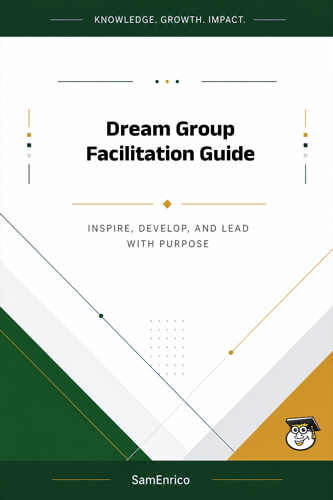
Dream Group Facilitation Guide
Lead safe dream sharing groups for trauma survivor
by Cody Kamala
Lead safe dream sharing groups for trauma survivors using structured protocols.
Formats
About this book
Free sample
Chapter 1: The Witness Protocol--–- The first time I watched a trauma survivor describe a nightmare in a room full of strangers, I expected chaos. I expected tears, flight, maybe even a door slam. What I got instead was a quiet gasp – not of terror, but of recognition. The dreamer had just said, “The thing chasing me has no face,” and across the circle, another member whispered, “Mine either.” In that moment, something shifted. Not because anyone interpreted the dream, but because the dream itself became a bridge between two people who had never spoken their waking horrors aloud.
That is the strange mercy of nightmares: they are already symbolic. They have already done the work of translation that waking memory refuses to do. And for trauma survivors, that symbolic distance is not a weakness to be analyzed away. It is a safety rail. This book is about how to build groups that protect that safety rail – groups where the dreamer remains the sole authority, where structured protocols replace well-meaning interpretation, and where the goal is not to decode the nightmare but to enter it alongside the dreamer, following their lead.The Silence That Speaks Trauma steals language.
Not just the words for what happened, but the very architecture of narrative. A survivor of assault may be able to list facts – date, location, physical details – while feeling absolutely nothing, or may feel everything while being unable to attach it to any sequence of events. This is not a failure of will. It is a biological fact. When the amygdala detects a threat that overwhelms the brain's coping capacity, it effectively takes the helm, shunting resources away from the hippocampus (which organizes memories into linear stories) and toward the fight-flight-freeze response.
The result is a memory that is not stored as a coherent narrative but as fragments: a smell, a sound, a sensation of pressure, a flash of color. These fragments do not obey chronology. They intrude. And nowhere do they intrude more powerfully than in sleep, when the brain's usual daytime filters are offline.This is where dreams enter. Unlike waking…
This is the end of the free sample. Get the eBook to keep going. Buy now
Contents
- Chapter 1
- Chapter 2
- Chapter 3
- Chapter 4
- Chapter 5
- Chapter 6
- Chapter 7
- Chapter 8
- Chapter 9
- Chapter 10
- Chapter 11
- Chapter 12
Details
- Author
- Cody Kamala
- Publisher
- SamEnrico
- Language
- English
- Genre
- Non-Fiction, Self-Help, Facilitation, Group
- Released
- 2026-06-07
- Pages (approx.)
- 144
- Available as
- eBook, Audiobook

Read better in the ZLOADR app
Your eBooks on your phone or tablet. Sign in with your SamEnrico account and start reading.
More by Cody Kamala
 Parenting Stress And Chronic IllnessCody Kamala$11.99
 Caffeine Energy StrategyCody Kamala$11.99
 Self Abandonment Relationship GuideCody Kamala$11.99
 Ragnarök and the Fox’s Gambit: Loki’s Pact with the KitsuneCody Kamala$11.99
 The Secret Islands of Knowledge: Medieval Scholars in the South SeasCody Kamala$11.99
 Understanding Hereditary Paroxysmal Cerebral AtaxiaCody Kamala$17.99
 Cloud CRM Outlook 2030Cody Kamala$12.99
 Zero Inventory Shopify WorkbookCody Kamala$12.99
 Casting AssistantCody Kamala$11.99
 How to Start a Press Used To Make Wine, Cider, Fruit Juices, Etc. Business (Beginners Guide)Cody Kamala$11.99
You may also like
 Hong Kong Handover 1997Dunn Johnnie$11.99
 Zumba For Postnatal Recovery CourseNeal Christian$11.99
 Zumba for BeginnersLadner Nikia$11.99
 YouTube Comment Mining GuideHumes Pandora$12.99
 Worry Box MeditationCarlin Rudy$11.99
 Workplace Stress MeditationNguyen Lynn$11.99
 Workplace Stress and Sleep RepairHawley Ivory$11.99
 Workplace Perfectionism CureDelaney Jeffry$11.99
 Workplace Injustice Anger GuideWallen Isabelle$11.99
 Work Addiction and Burnout LinkGreenwood Ester$11.99
 Women in Yoga and WellnessBeattie Galina$11.99
 Women in Stand Up ComedyChun Evangeline$11.99