
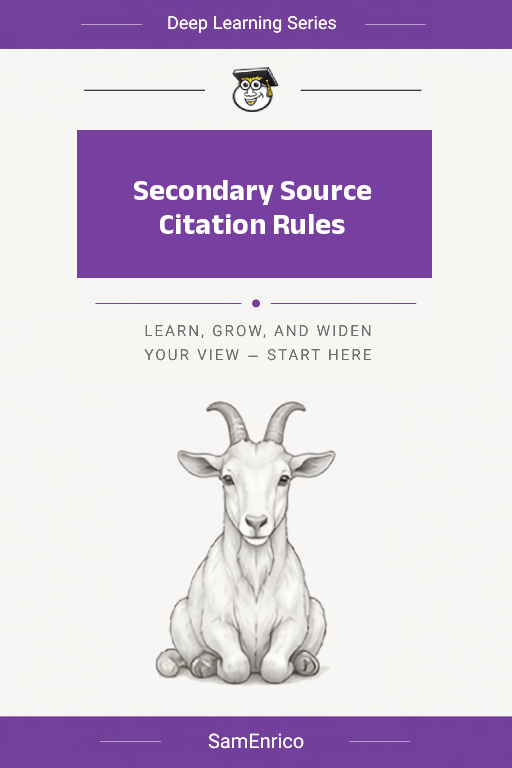
Secondary Source Citation Rules
Cite a source cited within another source without
by Strauss Asha
Cite a source cited within another source without confusing readers.
Formats
About this book
Free sample
Chapter 1: The Telephone Game...--–- In 2018, a tenured political scientist named Dr. Elena Vasquez submitted what she believed was the crowning achievement of her career: a 40-page manuscript arguing that voter turnout in midwestern swing states followed a predictable psychological pattern first described in a 1975 study by researchers at the University of Michigan. Her argument was elegant, her data was meticulous, and her citations were flawless—or so she thought. The journal's peer reviewers returned with a verdict that was not rejection but something far worse: a formal inquiry into academic misconduct. Dr.
Vasquez had not fabricated data. She had not plagiarized. She had simply cited a study that another study had cited. And the original 1975 paper, when the journal's fact-checkers finally located a physical copy in a university archive, said almost the exact opposite of what Dr. Vasquez had claimed.
The error was not hers alone—the secondary source she had trusted had misrepresented the original. But the journal did not care. The retraction notice, published eighteen months later, named Dr. Vasquez as the sole author responsible. Her university's promotion committee delayed her advancement by three years.
And in the world of political science, her name became a quiet warning whispered in graduate seminars: Don't pull a Vasquez.This is the telephone game played for academic blood. And it happens far more often than anyone wants to admit.The Problem That Has No Name (But Should)Every writer who has ever opened a textbook, a scholarly article, or even a well-researched blog post has encountered the secondary source. It is the quotation within a quotation. The study mentioned in passing. The statistic that appears in one book but originally came from another.
The famous line from a speech that you read not in the original transcript but in a biography. Secondary sources are everywhere because they are necessary. No single person can read every original document, every archival letter, every foreign-language study, every out-of-print monograph. We rely on others to summarize, quote, and contextualize the work that came before us.But here is the uncomfortable truth that no style…
This is the end of the free sample. Get the eBook to keep going. Buy now
Contents
- Chapter 1
- Chapter 2
- Chapter 3
- Chapter 4
- Chapter 5
- Chapter 6
- Chapter 7
- Chapter 8
- Chapter 9
- Chapter 10
- Chapter 11
- Chapter 12
Details
- Author
- Strauss Asha
- Publisher
- SamEnrico
- Language
- English
- Genre
- Non-Fiction, Student's Shortcut
- Released
- 2026-05-30
- Pages (approx.)
- 158
- Available as
- eBook, Audiobook

Read better in the ZLOADR app
Your eBooks on your phone or tablet. Sign in with your SamEnrico account and start reading.
More by Strauss Asha
 Pain Point Prioritization GuideStrauss Asha$11.99
 Thunberg vs World LeadersStrauss Asha$11.99
 Special Teams Excellence GuideStrauss Asha$11.99
 Manager Stress Detection GuideStrauss Asha$11.99
 The Imposter Teen FixStrauss Asha$11.99
 Discussing Miscarriage With PartnerStrauss Asha$11.99
 George McGovernStrauss Asha$11.99
 Habit Mistakes GuideStrauss Asha$11.99
 Caregiver Burnout ReliefStrauss Asha$11.99
 The Last Blockbuster: A Reel of ResilienceStrauss Asha$11.99
 The Alchemists' Feast: A Scientific Revolution BanquetStrauss Asha$11.99
 Andreas Vesalius: The Rebel Anatomist Who Redrew the Human BodyStrauss Asha$11.99
You may also like
 LSE Online Program LengthAgee Letisha$11.99
 Harvard Extension School for Working AdultsRoush Yer$11.99
 LSE Online Reading ListAshford Ludivina$11.99
 LSE Online Language RequirementsWhitten Daphine$11.99
 LSE Online Class SizeHughey Garret$11.99
 LSE Online Alumni MentorshipWild Lyla$11.99
 London School of Economics Alumni NetworkDutton Chantal$11.99
 Harvard Extension School Student SupportCantrell Christene$11.99
 Harvard Extension School Library AccessSantana Adah$11.99
 Harvard Extension School Degree CompletionBray Wyatt$11.99
 Harvard Extension School Course AuditingAbbott Craig$11.99
 Harvard Extension School Extension DiplomaNew Joane$11.99