
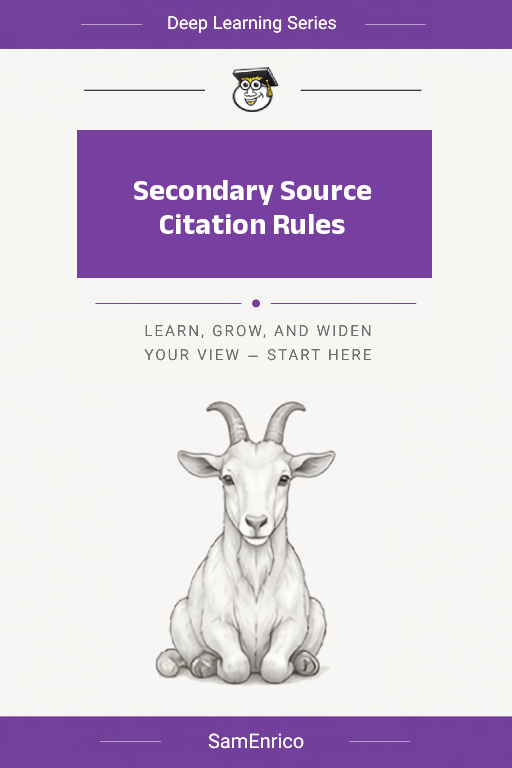
Secondary Source Citation Rules eBook
Cite a source cited within another source without
by Strauss Asha
Cite a source cited within another source without confusing readers.
Formats
Free sample
Chapter 1: The Telephone Game...--–- In 2018, a tenured political scientist named Dr. Elena Vasquez submitted what she believed was the crowning achievement of her career: a 40-page manuscript arguing that voter turnout in midwestern swing states followed a predictable psychological pattern first described in a 1975 study by researchers at the University of Michigan. Her argument was elegant, her data was meticulous, and her citations were flawless—or so she thought. The journal's peer reviewers returned with a verdict that was not rejection but something far worse: a formal inquiry into academic misconduct. Dr.
Vasquez had not fabricated data. She had not plagiarized. She had simply cited a study that another study had cited. And the original 1975 paper, when the journal's fact-checkers finally located a physical copy in a university archive, said almost the exact opposite of what Dr. Vasquez had claimed.
The error was not hers alone—the secondary source she had trusted had misrepresented the original. But the journal did not care. The retraction notice, published eighteen months later, named Dr. Vasquez as the sole author responsible. Her university's promotion committee delayed her advancement by three years.
And in the world of political science, her name became a quiet warning whispered in graduate seminars: Don't pull a Vasquez.This is the telephone game played for academic blood. And it happens far more often than anyone wants to admit.The Problem That Has No Name (But Should)Every writer who has ever opened a textbook, a scholarly article, or even a well-researched blog post has encountered the secondary source. It is the quotation within a quotation. The study mentioned in passing. The statistic that appears in one book but originally came from another.
The famous line from a speech that you read not in the original transcript but in a biography. Secondary sources are everywhere because they are necessary. No single person can read every original document, every archival letter, every foreign-language study, every out-of-print monograph. We rely on others to summarize, quote, and contextualize the work that came before us.But here is the uncomfortable truth that no style guide will say aloud: every time you use a secondary source, you are trusting a stranger with your reputation.Think about what actually happens when you cite Smith (2020) for a claim that Smith attributed to Jones (1975). You have not read Jones.
You do not know if Jones actually wrote those words. You do not know if Jones was being sarcastic, tentative, or speculative. You do not know if Jones's study was retracted, debunked, or published in a predatory journal. You know only what Smith told you. And Smith—who is likely a well-intentioned scholar—may have made a mistake.
Smith may have paraphrased carelessly. Smith may have quoted out of context. Smith may have copied the error from someone else. You are not citing Jones. You are citing Smith's version of Jones.
And versions are never perfect.The children's game of telephone works because the message changes with each transmission. "We are having pizza for dinner" becomes "We are harping on a sinner." The original meaning erodes through a combination of poor memory, creative reinterpretation, and the simple physics of sound traveling from one ear to another. Scholarly citation is not fundamentally different. A 2010 study in the journal Science and Engineering Ethics tracked 200 claims across three generations of citation and found that by the time a finding had been cited twice indirectly (original → secondary → tertiary), the accuracy of the claim had degraded by an average of 37 percent. Thirty-seven percent.
That is not a rounding error. That is the difference between "exercise improves memory in older adults" and "exercise cures Alzheimer's."The problem has no single name because it is not a single problem. It is a cascade of failures that can occur at any point in the chain: the original author might have been wrong; the secondary author might have misunderstood; the typesetter might have dropped a negative sign; the database might have misindexed the year; the writer might have misread the secondary source; the reader might misinterpret the citation. Each link in the chain is a potential point of failure. And when you cite a secondary source, you are vouching for every link you did not inspect yourself.The Three Ways Secondary Citations Go Wrong (And How They Almost Got You)Before we can fix the problem, we have to name its specific forms.
Over a decade of analyzing student papers, peer-reviewed articles, and professional writing, researchers have identified three distinct failure modes for secondary citations. Understanding these modes is the first step toward avoiding them.Failure Mode One: The Phantom Source The phantom source is a citation to an original work that either does not exist, does not say what the secondary source claims, or cannot be verified. This is the most dangerous failure mode because it is invisible to the writer. You read Smith (2020). Smith says, "Jones (1975) found that 80 percent of participants preferred chocolate over vanilla." You cite Jones.
You have never seen Jones's paper. You do not know that Jones actually found 80 percent preferred vanilla. You do not know that Jones's sample size was seven people. You do not know that the paper was retracted in 1980. You know only Smith's summary.The phantom source is responsible for the most spectacular citation failures in academic history.
In 2015, a meta-analysis in a prominent medical journal was retracted because the authors had cited twelve secondary sources without verifying the original studies. Three of the original studies did not exist at all. Two had been retracted for fraud. The remaining seven had findings that were, at best, loosely related to the claims made in the meta-analysis. The lead author's defense—"I trusted the secondary sources"—did not save his career.How do you spot a phantom source before it spots you?
The warning signs are subtle but detectable. If a secondary source makes a quantitative claim without providing a specific page number for the original, treat it with suspicion. If the claim seems too neat—a perfect percentage, a clean dichotomy, a dramatic effect size—ask whether the original likely contained more nuance. If the secondary source is summarizing a study from before the digital era (pre-1990) and provides no direct quotation, assume the summary may be unreliable until proven otherwise.Failure Mode Two: The Double Paraphrase The double paraphrase occurs when you paraphrase a secondary source that is itself paraphrasing an original. You are not just one step removed from the truth; you are two steps removed.
And each paraphrase introduces its own distortions.Imagine a game of telephone where each person is allowed to rephrase the message in their own words before passing it along. By the time the message reaches the fifth person, it is unrecognizable. The double paraphrase works the same way. The original author writes, "Under certain laboratory conditions, with a specific population of male undergraduates aged 18-22, we observed a modest correlation between sleep deprivation and reaction time (r = .23, p < .05)." The secondary author paraphrases: "Sleep deprivation slows reaction time in young men." You paraphrase the secondary author: "Lack of sleep makes people react slower." The nuance—the laboratory conditions, the specific…
This is the end of the free sample. Get the eBook to keep going. Buy now
About this book
Details
- Author
- Strauss Asha
- Publisher
- SamEnrico
- Language
- English
- Genre
- Non-Fiction, Student's Shortcut
- Released
- 2026-05-30
- Pages (approx.)
- 158
- Available as
- eBook, Audiobook

Read better in the ZLOADR app
Your eBooks on your phone or tablet. Sign in with your SamEnrico account and start reading.
More by Strauss Asha
 Pain Point Prioritization GuideStrauss Asha$11.99
 Thunberg vs World LeadersStrauss Asha$11.99
 Special Teams Excellence GuideStrauss Asha$11.99
 Manager Stress Detection GuideStrauss Asha$11.99
 The Imposter Teen FixStrauss Asha$11.99
 Discussing Miscarriage With PartnerStrauss Asha$11.99
 George McGovernStrauss Asha$11.99
 Habit Mistakes GuideStrauss Asha$11.99
 Caregiver Burnout ReliefStrauss Asha$11.99
 The Last Blockbuster: A Reel of ResilienceStrauss Asha$11.99
 The Alchemists' Feast: A Scientific Revolution BanquetStrauss Asha$11.99
 Andreas Vesalius: The Rebel Anatomist Who Redrew the Human BodyStrauss Asha$11.99
You may also like
 LSE Online Program LengthAgee Letisha$11.99
 Harvard Extension School for Working AdultsRoush Yer$11.99
 LSE Online Reading ListAshford Ludivina$11.99
 LSE Online Language RequirementsWhitten Daphine$11.99
 LSE Online Class SizeHughey Garret$11.99
 LSE Online Alumni MentorshipWild Lyla$11.99
 London School of Economics Alumni NetworkDutton Chantal$11.99
 Harvard Extension School Student SupportCantrell Christene$11.99
 Harvard Extension School Library AccessSantana Adah$11.99
 Harvard Extension School Degree CompletionBray Wyatt$11.99
 Harvard Extension School Course AuditingAbbott Craig$11.99
 Harvard Extension School Extension DiplomaNew Joane$11.99