
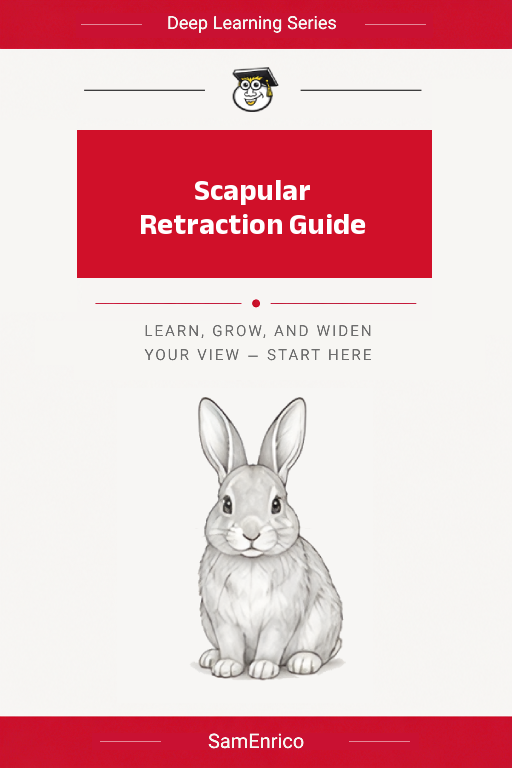
Scapular Retraction Guide eBook
Pull shoulder blades together and down to improve
Pull shoulder blades together and down to improve posture and reduce upper back strain.
Formats
Free sample
Chapter 1: The Invisible Backpack--Let me ask you something you have probably never been asked before.When did you first notice that your shoulders felt heavy?Not the acute pain of an injury—not the sharp, stabbing kind that makes you gasp and reach for a heating pad. I mean the dull, persistent, low-grade heaviness that has become so normal you barely register it anymore. The sensation that someone has quietly slipped a backpack onto your shoulders while you weren't looking, and over the years, that backpack has been filling with stones. One stone for every hour you spent hunched over a keyboard. One stone for every commute spent craning your neck toward a GPS.
One stone for every evening slumped on the couch, scrolling through a phone held somewhere around your sternum.You cannot see this backpack. You did not choose to put it on. But you can feel it right now, can't you? That subtle pull forward. That vague tightness between your shoulder blades.
That sensation that standing up straight requires a conscious effort—a sort of muscular sigh—before you inevitably collapse back into the familiar slouch.This chapter is about naming that invisible backpack. It is about understanding the anatomy of what has gone wrong, but not in the dry, textbook way that puts you to sleep. Instead, we are going to tell the story of your shoulder blades—the scapulae—as if they are characters in a drama that has been playing out inside your body for years. By the time you finish this chapter, you will never look at your upper back the same way again. More importantly, you will understand, for the first time, why every "sit up straight" command you have ever given yourself has failed.The Keystone You Have Never Heard Of Let us start with a thought experiment.Imagine a suspension bridge.
The Golden Gate Bridge, if you like. It has two towers, a long span of roadway, and thousands of cables holding everything in place. Now imagine that one of the anchor points—the massive concrete block on the shore that keeps the whole thing from swinging into the bay—has started to crack. No one notices at first. The bridge still stands.
Cars still drive across. But the crack widens with every gust of wind, every passing truck, every temperature change.That anchor point is your scapula.The scapula—shoulder blade—is a flat, triangular bone about the size of a paperback book. It does not attach directly to your ribcage. Instead, it floats on your upper back, held in place entirely by muscles. Seventeen different muscles, to be precise, attach to this single bone.
It is the most mobile bone in your upper body, capable of sliding up, down, left, right, and rotating in two different directions. That mobility is a gift. It allows you to reach into high cabinets, throw a baseball, scratch your own back, and hug another human being.But mobility comes at a cost. Because the scapula is not bolted down, it relies entirely on the coordinated action of its muscle teams to stay in the right position. When those muscles work together in harmony, your shoulder blade glides smoothly across your ribs like a sailboat across calm water.
When they fall out of sync, your scapula drifts into positions it was never designed to hold—and everything upstream and downstream starts to break down.Here is the truth that most posture books get wrong: your scapula is not supposed to be "in one position." It is not a shelf that should be level, or a picture frame that should be square against the wall. Your scapula is designed to move. Constantly. The problem is not that your scapula moves. The problem is that modern life has trapped it in a narrow, dysfunctional range of motion—specifically, a range dominated by forward sliding (protraction) and upward shrugging (elevation)—while starving it of the movements it needs to stay healthy: pulling back (retraction) and pulling down (depression).The Six Directions of the Shoulder Blade Before we go any further, we need a common language.
You cannot fix what you cannot name. So let us learn the six movements of the scapula. I promise this will not feel like memorizing Latin verb conjugations. Instead, think of these as the six ways your shoulder blades can move through space. You have probably done all of them today without realizing it.Retraction.
This is the movement of pulling your shoulder blades together toward your spine. Imagine you are trying to hold a pencil between your shoulder blades. That squeezing sensation—that is retraction. It is the primary movement we are trying to restore in this book. Most people have lost about 40 percent of their healthy retraction range after years of desk work.Protraction.
The opposite of retraction. This is reaching your shoulder blades forward, away from your spine, as if you are pushing something away from your chest. Think of the position your shoulders are in when you type on a keyboard—rounded forward, chest collapsed. That is protraction. It is not inherently bad.
Protraction is essential for pushing, punching, and reaching. The problem is chronic, unopposed protraction, where your shoulder blades get stuck in the forward position and forget how to come back.Elevation. This is the shrugging movement, where your shoulders move upward toward your ears. A small amount of elevation is normal—it happens every time you lift a grocery bag or carry a suitcase. But chronic elevation, where your upper trapezius muscles are constantly clenched like a fist, is one of the primary causes of neck pain and tension headaches.Depression.
The downward movement of the shoulder blades, pulling them away from your ears and toward your back pockets. This is the "down" part of our central cue. Depression is the movement that creates length in your neck and space between your shoulders and ears. Most people have forgotten how to do this without also protracting.Upward Rotation. A more complex movement, where the bottom tip of your shoulder blade swings outward and upward as you raise your arm overhead.
This is what allows you to reach for a cup on a high shelf without impinging your rotator cuff. When upward rotation is restricted, your shoulder pinches on every overhead movement.Downward Rotation. The return from upward rotation, where the shoulder blade rotates back to neutral as you lower your arm. Like protraction, downward rotation is not bad—it is necessary. But when it becomes dominant, your shoulder blades tilt in a way that encourages impingement and instability.Here is what you need to remember from this list: retraction and depression are the movements that have been starved.
Protraction and elevation are the movements that have been overfed. Your goal is not to eliminate protraction and elevation—they are necessary for life. Your goal is to restore balance, so that your shoulder blades can access their full range of motion instead of being locked in the forward-up position.The Muscle Teams: Heroes, Villains, and the Silent Stabilizer Every good story has characters. Your upper back is no different. Let me introduce you to the muscle teams…
This is the end of the free sample. Get the eBook to keep going. Buy now
About this book
Details
- Author
- Pritchett Carlena
- Publisher
- SamEnrico
- Language
- English
- Genre
- Non-Fiction, Mental Wealth
- Released
- 2026-06-01
- Pages (approx.)
- 125
- Available as
- eBook, Audiobook

Read better in the ZLOADR app
Your eBooks on your phone or tablet. Sign in with your SamEnrico account and start reading.
More by Pritchett Carlena
 War Correspondent Stress GuidePritchett Carlena$11.99
 The DIY Repair GenerationPritchett Carlena$11.99
 The Downsizing Retirement Housing GuidePritchett Carlena$11.99
 Concert Small Talk GuidePritchett Carlena$11.99
 Listening to Nonverbal Autistic CommunicationPritchett Carlena$11.99
 Social Media Personal BrandingPritchett Carlena$11.99
 Morning Routine QuizPritchett Carlena$11.99
 Low Carb for Beginners PrimerPritchett Carlena$11.99
 The Sydney 2000 Olympics: The Secret Score That Stole the ShowPritchett Carlena$11.99
 The Phantom Drummers of Marston Moor: Ghosts of the English Civil WarPritchett Carlena$11.99
 Service Providers Guide to Independent ContractorsPritchett Carlena$11.99
 A Collector's Handbook to the Mercedes-benz 280slPritchett Carlena$11.99
You may also like
 Student Mental Health Board GuideBerg Meghann$12.99
 High Achiever Mental Health BoardRosas Synthia$12.99
 Technology Addiction AdvisorRoby Shakita$12.99
 Pet Bereavement AdvisorSam Reyna$12.99
 Peer Support Group IntegrationDuffy Renay$12.99
 Exercise Mental Health AdvisorBurnett Dewayne$12.99
 Disclosing Depression To InvestorsBadger Kazuko$12.99
 Yawn Stretch RegulationRomano Berna$12.99
 Wrist Flexion ReleaseBusch Kandace$12.99
 Workplace Mental Health AllyValentine Meta$12.99
 Workplace Mental Health AdvisorAshcraft Johnie$12.99
 Wealthy Upbringing Guilt GuideXiong Deeanna$12.99