
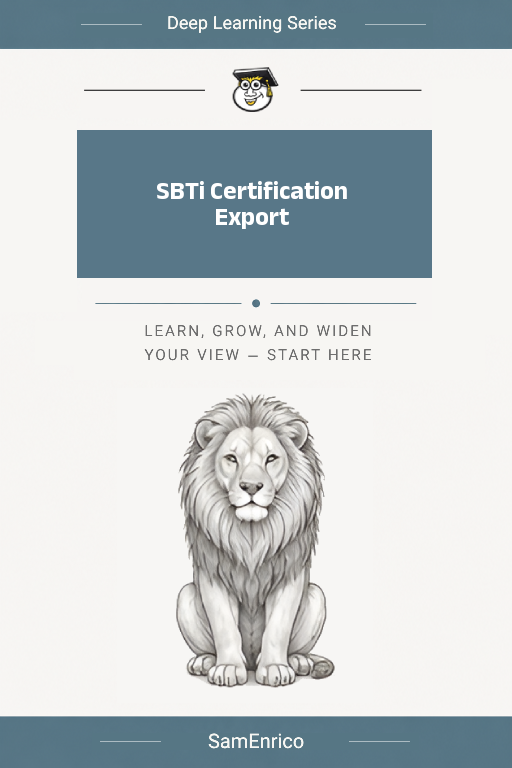
SBTi Certification Export eBook
Get Science Based Targets initiative certification
Get Science Based Targets initiative certification for export. Verified climate targets.
Formats
Free sample
Chapter 1: The Greenwashing Graveyard--The conference room smelled of stale coffee and desperation. Maria Vasquez, export director for a 200millionelectronicsmanufacturerin Guadalajara,hadjustwatchedhercompanylosea200 million electronics manufacturer in Guadalajara, had just watched her company lose a 200millionelectronicsmanufacturerin Guadalajara,hadjustwatchedhercompanylosea50 million contract with a German automotive parts buyer. The reason was not price, quality, or delivery time. Her factory had outperformed all competitors on every traditional metric. The loss came down to a single acronym she had barely heard of six months earlier: SBTi.The winning bidder, a smaller Vietnamese competitor, had secured Science Based Targets initiative validation eighteen months prior.
Maria’s company had a glossy “carbon neutral” certificate bought from a broker who bundled offsets from a reforestation project in Peru. The German buyer’s procurement algorithm, updated quietly in 2024, now automatically deprioritized any supplier without third-party validated science-based targets. Maria’s certificate was worthless at the moment of truth.This scenario is not hypothetical. It is happening now, across every export sector that touches the European Union, the United Kingdom, and an expanding list of North American buyers. The rules of global trade have shifted beneath the feet of exporters who were paying attention to quality, logistics, and price — but not to the quiet, relentless standardization of climate credentials.This chapter is not a defense of environmentalism.
It is a warning about market access. And it is a guide to understanding why the distinction between real climate action and corporate greenwashing has become the single most important competitive differentiator for exporters in 2026 and beyond.The Death of Carbon Neutrality as a Trade Credential For nearly a decade, “carbon neutral” was a convenient label. Companies purchased offsets — often from forestry, renewable energy, or methane capture projects — and claimed that their operations or products had no net impact on the climate. Buyers accepted these claims because there was no better alternative and no penalty for doing so.That era ended in 2024. The European Parliament formally adopted the Green Claims Directive, which prohibits generic environmental claims without substantiation.
The UK Competition and Markets Authority published the Green Claims Code, warning that vague terms like “carbon neutral” would be treated as potential greenwashing. And most importantly for exporters, major corporate buyers began auditing not just the existence of a claim, but the rigor behind it.Consider the difference between two statements.Statement one: “Our factory has achieved carbon neutrality through the purchase of verified carbon offsets representing 100% of our Scope 1 and 2 emissions.”Statement two: “Our company has set science-based targets approved by the Science Based Targets initiative, committing to a 50% absolute reduction in Scope 1, 2, and material Scope 3 emissions by 2030 from a 2022 baseline, consistent with the 1.5°C pathway.”The first statement is a claim. The second is a verified commitment with measurable accountability. The first can be purchased. The second requires years of operational transformation.
The first can be revoked quietly. The second is public, tracked annually, and subject to removal from the SBTi website if progress lags.Global procurement directors have learned to distinguish between these two statements. They have learned because their own regulators now require them to report Scope 3 emissions — the emissions that come from suppliers like you. A buyer who accepts a “carbon neutral” claim without science-based validation is exposing themselves to regulatory risk, shareholder lawsuits, and reputational damage.The Procurement Algorithm Is Not Your Friend The most dangerous myth among exporters today is that human buyers will read their sustainability reports and make reasoned judgments. They will not.
In 2026, the majority of large corporate procurement decisions involving climate criteria are made by automated systems.Walmart’s Project Gigaton, expanded in 2025, now integrates SBTi status as a weighted factor in supplier scoring. Suppliers without validation receive an automatic deduction that no human buyer can override without executive approval — a process so burdensome that it effectively excludes non-validated suppliers from consideration.Apple’s Supplier Clean Energy Program, updated in early 2026, requires suppliers to report progress toward science-based targets as a condition of maintaining active vendor status. The system flags non-compliant suppliers monthly, and procurement managers receive automated alerts to diversify sourcing away from flagged vendors.IKEA’s IWAY standard, the purchasing code of conduct for thousands of suppliers globally, now explicitly references SBTi validation as a preferred indicator of climate performance. Suppliers without validation are still eligible, but they face additional audits and shorter contract terms.These algorithms are not malevolent. They are efficient.
They reduce the workload of procurement teams who cannot manually assess the climate claims of thousands of suppliers. But efficiency is merciless. An exporter who fails to meet the automated threshold simply disappears from search results, recommendation lists, and bid invitations.The math is brutal. A mid-sized exporter typically competes against three to five direct rivals for a given contract. If two of those rivals have SBTi validation and you do not, the algorithm will present them first.
By the time a human buyer reviews the shortlist, you are already invisible.The Chemistry of a Real Climate Target To understand why SBTi validation matters more than carbon neutral claims, one must understand the underlying climate science. The Paris Agreement, adopted in 2015, set a goal of limiting global warming to well below 2°C above pre-industrial levels, with efforts to limit it to 1.5°C. In 2018, the Intergovernmental Panel on Climate Change (IPCC) published a special report demonstrating that the difference between 1.5°C and 2°C is not incremental — it is catastrophic. At 1.5°C, 70% of coral reefs are lost. At 2°C, 99% are lost.
At 1.5°C, Arctic sea ice persists in some summers. At 2°C, it disappears entirely.The IPCC calculated the remaining carbon budget — the total amount of carbon dioxide that can be emitted while still staying within the 1.5°C limit. That budget shrinks every year. In 2020, it was approximately 500 gigatons of CO2. By 2026, it is closer to 250 gigatons.
Global emissions in 2025 were approximately 40 gigatons. At current rates, the budget will be exhausted before 2035.SBTi translates this global chemistry into corporate accounting. A 1.5°C-aligned target requires annual absolute emissions reductions of approximately 4.2% per year. This is not a suggestion. It is derived directly from the IPCC carbon budget divided among global economic sectors.By contrast, a typical “carbon neutral” claim requires no annual reductions at all.
A company could maintain the same emissions for a decade, purchase offsets each year, and still claim carbon neutrality. The emissions do not decrease. The planet does not benefit. Only the marketing improves.This is not speculation. In 2024, an investigation by a major European consumer protection organization found that more than 40% of “carbon neutral” claims in the electronics and apparel sectors relied on offsets that either did not represent real emission reductions or would have occurred anyway without the offset purchase.
These are not isolated bad actors. They are the norm.The Three Tiers of Climate Credibility Understanding the hierarchy of climate claims is essential for exporters navigating buyer demands. There are three distinct tiers, each with different costs, credibility, and market consequences.Tier One: Unsubstantiated Claims The lowest tier includes vague statements like “we care about the environment,” “we are reducing our carbon footprint,” or “we support climate action.” These claims appear on websites, in marketing materials, and on product packaging. They require no verification, no data, and…
This is the end of the free sample. Get the eBook to keep going. Buy now
About this book
Details
- Author
- Maclean Linnea
- Publisher
- SamEnrico
- Language
- English
- Genre
- Non-Fiction, Business Brief, Eco-Compliance
- Released
- 2026-06-01
- Pages (approx.)
- 135
- Available as
- eBook, Audiobook

Read better in the ZLOADR app
Your eBooks on your phone or tablet. Sign in with your SamEnrico account and start reading.
More by Maclean Linnea
 The Workplace Aggression AuditMaclean Linnea$11.99
 French Revolutionary Wars 1792-1802 HandbookMaclean Linnea$11.99
 Dale Earnhardt Intimidator StoryMaclean Linnea$11.99
 Talent Acquisition Case StudiesMaclean Linnea$11.99
 The Teen Sleep Deprivation GuideMaclean Linnea$11.99
 Blood and Gold: The Mamluks' Last Stand at Marj DabiqMaclean Linnea$11.99
 Environmental LawMaclean Linnea$11.99
 Brand Valuation for BankruptcyMaclean Linnea$12.99
 How to Start a NAAFI Canteen Business (Beginners Guide)Maclean Linnea$11.99
 Understanding Sweeley–klionsky DiseaseMaclean Linnea$17.99
You may also like
 RSPO Certification ExportBeaty Hien$12.99
 Zero Deforestation ExportPeachey Alona$12.99
 WRAP Certification ExportBeaudoin Magen$12.99
 Water Neutral Export GuideEchols Seema$12.99
 UTZ Coffee Export GuideTimmons Tama$12.99
 Sprouts Certification ExportArroyo Denese$12.99
 SMETA Audit Export GuideHeath Elana$12.99
 Rainforest Alliance ExportHardin Madelyn$12.99
 Rainforest Alliance CoffeeWiseman Erasmo$12.99
 Plastic Neutral Export GuideHazel Lissa$12.99
 Organic Vegetable Export GuideRiddick Latasha$12.99Organic Vegetable Export GuideRiddick Latasha$12.99