
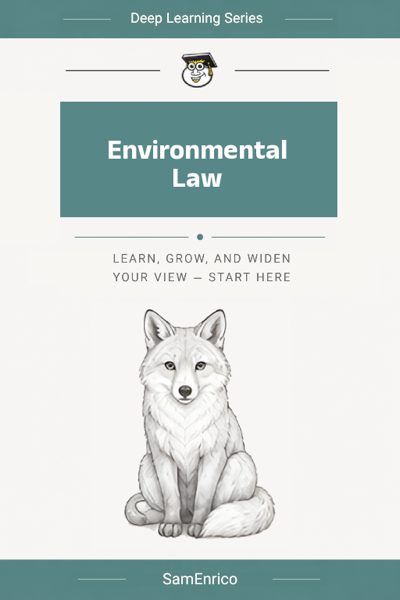
Environmental Law
A Coursebook on Environmental Law
A Coursebook on Environmental Law
Formats
About this book
Free sample
Chapter 1: The Poisoned Tap...--–- On April 25, 2014, the city of Flint, Michigan, did something that seemed utterly mundane. It switched its drinking water source from Lake Huron to the Flint River. This single administrative decision—signed by a state-appointed emergency manager with no environmental training—would over the next eighteen months poison thousands of children, trigger a federal emergency, and expose the catastrophic failures of a legal system that was supposed to protect the public. The water that came out of Flint’s taps was the color of rust, smelled of decay, and carried lead levels so high that the city's water treatment plant later described it as "toxic waste." Yet for 547 days, government lawyers, state regulators, and environmental agencies did nothing. Or rather, they did something worse: they assured the public the water was safe while knowing it was not.–- This is not a story about bad pipes or aging infrastructure.
This is a story about law—about what environmental law is supposed to do, how it fails, and who pays the price when it does. Every chapter of this book will return to Flint, not as a unique tragedy but as a case study in the gap between legal rules and real-world outcomes. Understanding Flint requires understanding how environmental law evolved from a system of private lawsuits to a sprawling administrative state, how that state was designed to prevent exactly this kind of disaster, and why it collapsed anyway.The Common Law Origins: Suing Your Neighbor for Nuisance–- Before there were environmental statutes, before the Environmental Protection Agency existed, before anyone spoke of "climate change" or "environmental justice," there was a simple legal question: What can you do when your neighbor’s smoke, sewage, or stench ruins your life? The answer, for most of Anglo-American legal history, was the tort of nuisance. Nuisance law gave private individuals the right to sue their neighbors for unreasonable interference with the use and enjoyment of their land.
If a tannery upstream was dumping waste into the river that fouled your drinking water, you could sue. If a factory…
This is the end of the free sample. Get the eBook to keep going. Buy now
Contents
- Chapter 1
- Chapter 2
- Chapter 3
- Chapter 4
- Chapter 5
- Chapter 6
- Chapter 7
- Chapter 8
- Chapter 9
- Chapter 10
- Chapter 11
- Chapter 12
Details
- Author
- Maclean Linnea
- Publisher
- SamEnrico
- Language
- English
- Genre
- Non-Fiction, Informative, Educational
- Released
- 2026-06-03
- Pages (approx.)
- 158
- Available as
- eBook, Audiobook

Read better in the ZLOADR app
Your eBooks on your phone or tablet. Sign in with your SamEnrico account and start reading.
More by Maclean Linnea
 The Workplace Aggression AuditMaclean Linnea$11.99
 French Revolutionary Wars 1792-1802 HandbookMaclean Linnea$11.99
 Dale Earnhardt Intimidator StoryMaclean Linnea$11.99
 Talent Acquisition Case StudiesMaclean Linnea$11.99
 The Teen Sleep Deprivation GuideMaclean Linnea$11.99
 Blood and Gold: The Mamluks' Last Stand at Marj DabiqMaclean Linnea$11.99
 SBTi Certification ExportMaclean Linnea$12.99
 Brand Valuation for BankruptcyMaclean Linnea$12.99
 How to Start a NAAFI Canteen Business (Beginners Guide)Maclean Linnea$11.99
 Understanding Sweeley–klionsky DiseaseMaclean Linnea$17.99