
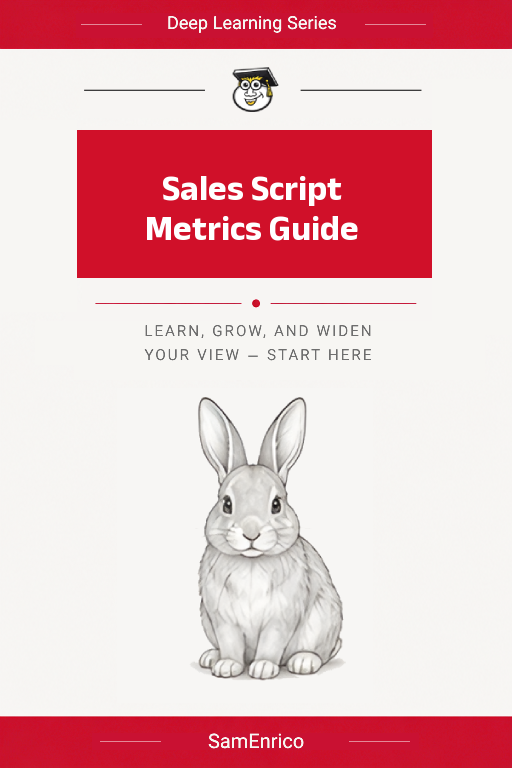
Sales Script Metrics Guide eBook
Track conversation rates and refine your script ba
Track conversation rates and refine your script based on data.
Formats
Free sample
Chapter 1: The 47-Word Funeral--The voicemail that ended Maya’s career didn’t sound like a disaster. It sounded polite, professional, and utterly forgettable. “Hi David, this is Maya from Cloud Shield. Following up on our conversation from last week. Would love to reconnect when you have a moment.
My number is…” She delivered it with perfect inflection. She smiled while she spoke. She had practiced this exact script 400 times.David never called back. Neither did the seventeen other prospects she left identical voicemails for that Tuesday. By Friday, her manager, Leo, pulled the stats: 127 dials, 43 conversations, zero meetings booked, one verbal promise that evaporated within four hours.
Maya was the “natural closer” of her team—the one with the winning smile, the easy laugh, the ability to make anyone feel heard. And she was failing.Leo didn’t fire her. Instead, he printed the transcripts of her last twelve calls, spread them across a conference table, and asked a question that would change everything: “Point to the exact sentence where you lost them.”Maya couldn’t. There was no single moment. No objection.
No rude hang-up. Just the slow, polite suffocation of prospects who said “Sounds good, send me an email” and then disappeared forever. Leo circled every word she spoke. Then he circled every word the prospect spoke. Then he drew a line down the middle of the page.“You spoke 78 percent of the time,” he said.
“The top rep on our team speaks 43 percent. You asked three Situation questions and zero Implication questions. Your script is not a conversation. It is a hostage situation with better lighting.”That conversation is the reason you are holding this book. Because Maya’s problem was not her personality, her confidence, or her work ethic.
Her problem was that she treated sales like a performance when it is actually a hypothesis test. And until you learn to read your own script the way a scientist reads data—without ego, without nostalgia, without the comfortable lie of “I’m just not a metrics person”—you will lose to the rep who does.The Myth You Have Been Selling Yourself Let me say something that will make you uncomfortable. The idea that some people are “natural closers” and others are not is a story we tell ourselves to avoid measuring what actually works. It is a comforting fiction, like believing that tall people are naturally better at basketball (they are not—practice accounts for 80 percent of the variance) or that extroverts naturally outsell introverts (they do not—the data is split exactly 50/50).The natural closer myth survives because of a cognitive bias so sneaky that even experienced sales leaders fall for it. It is called survivorship bias.
We remember the charismatic rep who closed the $2 million deal. We forget the equally charismatic rep who closed nothing and was fired six months ago. We attribute the win to “vibe” and the loss to “bad timing.” But when you transcribe both calls and compare them word for word, the vibes are identical. The words are not.Here is what the data actually says. After analyzing 35,000 sales calls, Neil Rackham’s team at Huthwaite International found that the correlation between “personality” and “closing rate” is statistically zero.
Zero. The most successful reps were not the funniest, the most charming, or the most aggressive. They were the ones who asked specific types of questions in a specific sequence. Personality is a amplifier, not a engine. If your script is broken, charisma just makes you louder and wrong.Maya had charisma in spades.
She could make a prospect laugh within thirty seconds. She could mirror body language instinctively. She could remember the name of a prospect’s dog from a call three months ago. And none of it mattered because her script was a series of polite, generic, reply-killing sentences disguised as conversation.This chapter is going to dismantle the natural closer myth completely. By the time you finish reading, you will never again say “I’m just not good at cold calls” or “Sales is an art, not a science.” You will understand that your script is a machine, and machines can be measured, tested, and rebuilt.
The only question is whether you are willing to look at the data.Sales Dyslexia: The Trait You Didn’t Know You Needed The most surprising finding from analyzing thousands of sales transcripts is this: the reps who improve fastest are often the ones who initially seemed bad at reading social cues. They miss sarcasm. They don’t laugh at jokes. They ask questions that seem too direct, almost rude. And yet their closing rates climb month over month while the “naturals” plateau.I call this trait Sales Dyslexia.
It is not a disability. It is a cognitive orientation. Just as dyslexic readers learn to decode words through rules rather than intuition, sales dyslexics learn to decode conversations through data rather than feel. They do not trust their gut because their gut has been wrong before. They trust the transcript.Here is how Sales Dyslexia works in practice.
The natural closer finishes a call, feels good about it, and moves on. The sales dyslexic finishes the same call, transcribes it, and notices that the prospect used the word “interesting” seven times—and that in the last fifty calls, “interesting” predicted a ghosting rate of 83 percent. The natural closer thinks, “She seemed engaged.” The sales dyslexic thinks, “She said ‘interesting’ seven times. I need to test a different word.”This is not paranoia. This is pattern recognition.
And it is the single most underrated skill in modern sales.Maya was a natural closer. She trusted her gut. Her gut told her that the prospect who said “Sounds good, send me an email” actually meant “I am genuinely interested and will definitely respond.” The data told a different story: that exact phrase, in her transcripts, preceded a reply rate of 4 percent. Her gut was wrong 96 percent of the time. But because she never tracked the data, she never knew.The first step to becoming sales dyslexic is to admit that your gut is a liar.
Not sometimes. Not in edge cases. Systematically, predictably, and embarrassingly wrong about which calls worked and why. The only remedy is to stop treating your script as an expression of your personality and start treating it as a hypothesis to be tested.The Three Biases That Keep Your Script Broken Before we get to the metrics, we need to name the enemies. They live inside your head.
They have been there for years. And they will sabotage every attempt to improve your script unless you learn to recognize them.Bias 1: Confirmation Bias (The Highlight Reel)You remember the one call where your risky closing line worked. You forget the nine calls where it failed. This is not a moral failing; it is how human memory works. We are wired to remember anomalies—the time the underdog won, the hail mary that landed, the cold call that turned into a $100,000 deal.
We forget the boring, predictable failures because they do not make for good stories.In sales, confirmation bias manifests as the “one weird trick” syndrome. A rep tries an…
This is the end of the free sample. Get the eBook to keep going. Buy now
About this book
Details
- Author
- Bagwell Noreen
- Publisher
- SamEnrico
- Language
- English
- Genre
- Non-Fiction, First 30 Days
- Released
- 2026-06-01
- Pages (approx.)
- 139
- Available as
- eBook, Audiobook

Read better in the ZLOADR app
Your eBooks on your phone or tablet. Sign in with your SamEnrico account and start reading.
More by Bagwell Noreen
 Postpartum Depression GuideBagwell Noreen$11.99
 Career Transition for Retail WorkersBagwell Noreen$11.99
 Thunderbirds Pilot MemoirBagwell Noreen$11.99
 Psychological Relapse Prevention GuideBagwell Noreen$11.99
 Practical Exam Skills GuideBagwell Noreen$11.99
 Career Transition Without BurnoutBagwell Noreen$11.99
 Disappointment After SuccessBagwell Noreen$11.99
 Bombing Accuracy: Norden vs. British SightsBagwell Noreen$11.99
 Citation Rules Quick Reference Card ManualBagwell Noreen$11.99
 The Lost Giants of the Indian Ocean: Uncovering Ancient Fossils Beneath the WavesBagwell Noreen$11.99
 The Vanishing of the Honey Island Swamp MonsterBagwell Noreen$11.99
 The Frozen Hour: The 1972 Andes Flight Disaster RevisitedBagwell Noreen$11.99
You may also like
 Website Launch For New LLCStrunk Tracee$12.99
 Shopify Market Expansion GuideGaffney Jude$12.99
 Power Backup Solutions for Philippine VAsPearce Eldon$12.99
 Feedback License Clause TemplateCrum Ashli$12.99Feedback License Clause TemplateCrum Ashli$12.99Feedback License Clause TemplateCrum Ashli$12.99Feedback License Clause TemplateCrum Ashli$12.99Feedback License Clause TemplateCrum Ashli$12.99Feedback License Clause TemplateCrum Ashli$12.99Feedback License Clause TemplateCrum Ashli$12.99Feedback License Clause TemplateCrum Ashli$12.99
 Channel Distribution On One PagePetersen Narcisa$12.99