
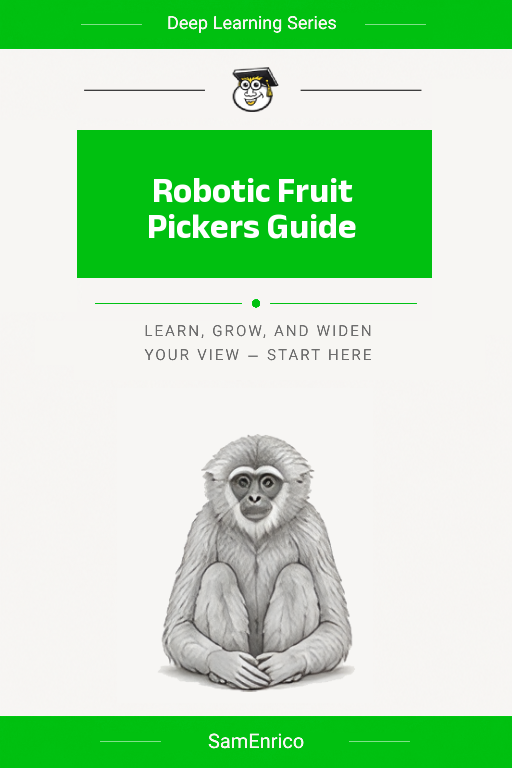
Non-FictionForecast & OutlookHarvest Robotics
Robotic Fruit Pickers Guide eBook
Explore soft grippers and computer vision for deli
by Hackett Nida
Explore soft grippers and computer vision for delicate harvesting of apples, berries, and tomatoes.
Formats
Free sample
Chapter 1: The Bruise Ledger--–- On a crisp October morning in Washington State’s apple country, a veteran picker named Elena fills three bins per hour with Honeycrisp apples. Her hands move with a lifetime of earned efficiency—twisting each fruit just so, supporting its weight, laying it gently into the padded bin. At day’s end, less than one percent of her harvest shows bruising. That single percentage point is the difference between profit and loss for the orchard owner. That percentage point is also the reason why, after fifty years of industrial automation, the apple tree remains one of the few places on Earth where a human hand is still irreplaceable.This book is about closing that gap.
Not by building faster, stronger, or harder-working robots—those have existed for decades in automotive and logistics factories. Rather, it is about building robots that are gentler. Robots that understand not just where the fruit is, but how fragile it is. Robots that can read a strawberry’s ripeness through its color, feel an apple’s give through a silicone fingertip, and decide in a fraction of a second whether to twist, pull, cut, or let go.The problem of robotic fruit harvesting is not a single engineering challenge. It is a constellation of them, bound together by a single unforgiving constraint: biological variability.
No two apples are identical. No two tomato trusses hang the same way. No two raspberries detach with the same force. And yet, a commercial harvesting robot must perform with the consistency of a factory machine and the delicacy of a human expert. It must achieve a damage rate below one percent while operating at a speed that makes economic sense.
It must see through leaves, contort around branches, and adapt to wind, rain, and shifting light.This chapter establishes the foundation for everything that follows. It quantifies the damage problem that defines the entire design space, explains why different fruits require fundamentally different detachment strategies, and introduces the economic realities that separate academic prototypes from commercial equipment. By the end, you will understand why a robot that picks apples perfectly may fail catastrophically on tomatoes, and why the softest gripper is useless without a clear understanding of the force budget it must respect.The Invisible Injury When a consumer bites into a bruised apple, they are tasting cell death. Beneath the skin, a cascade of mechanical failure has occurred. Impact or compression forces have ruptured the cell walls of the parenchyma tissue—the spongy, water-filled cells that give the fruit its crisp texture.
Ruptured cells release polyphenol oxidase, an enzyme that reacts with oxygen to form brown melanins. The bruise darkens. The texture softens. The flavor changes, often becoming mealy or sour.The critical insight for robotic harvesting is that bruising is not always visible at the moment of injury. Subsurface cell rupture can occur without immediate discoloration, appearing only hours or even days later, after the fruit has been packed, shipped, and placed on a grocery shelf.
This means that a harvesting robot can appear to succeed—the fruit looks perfect, the gripper releases it cleanly—and still fail commercially. The damage is deferred, invisible, and therefore extraordinarily difficult to diagnose and correct.For berries, the damage mechanism is different but equally pernicious. A strawberry has no protective skin in the same sense as an apple. Its epidermis is thin and permeable. Compression causes not just cell rupture but structural collapse of the entire achene (seed) network.
A bruised strawberry leaks juice immediately. It becomes unmarketable within hours. For raspberries, the problem is even more acute. Each raspberry is an aggregate of dozens of individual drupelets, each attached to a central core (the receptacle). Squeezing a raspberry causes drupelets to separate from the core.
The fruit literally falls apart. There is no repair mechanism.Tomatoes occupy a middle ground. Their skin is tougher than a berry’s but their flesh is softer than an apple’s. A tomato bruise is typically visible immediately as a water-soaked spot, but the fruit may still be acceptable for processed products like sauce or juice. For fresh-market tomatoes, however, even minor bruising causes rejection.
The standard is absolute: if the consumer would not select that fruit from a display, the robot has failed.Understanding these damage mechanisms is the first step toward designing against them. A robot cannot simply be gentle. It must be gentle in the right way, at the right point of contact, with the right duration and direction of force.The Peduncle Problem Every fruit hangs from its parent plant by a stem. Botanically, this is the peduncle (primary stem) or pedicel (secondary stem for clustered fruits). The attachment point is not a simple mechanical joint.
It is a living boundary layer, often including an abscission zone—a region of specialized cells that weaken naturally as the fruit ripens, eventually allowing the fruit to detach with minimal force.Nature designed the abscission zone to answer a different question than robotics does. For a plant, the abscission zone exists to release the fruit when seeds are mature, often aided by wind or animal contact. For a harvester—human or robotic—the goal is to accelerate that natural detachment without damaging the fruit or the plant. The ideal detachment applies force exactly along the plane of weakness, with minimal deformation of the fruit body.Apples present the most complex mechanical challenge among major commercial fruits. The apple peduncle is short, thick, and deeply embedded in the fruit’s stem cavity.
The abscission layer is not a clean plane but a diffuse zone requiring both tensile force (pulling) and torsional force (twisting) to break. Human pickers learn this instinctively: they cup the apple, rotate it upward and sideways, and feel the stem release with a distinct snap. Pulling straight down, by contrast, often tears the stem from the fruit, leaving a jagged wound that invites rot, or worse, pulls the entire spur (the woody fruiting branchlet) from the tree, reducing next year’s yield.For tomatoes, the mechanics are different. The tomato pedicel has a distinct abscission layer called the joint. As the tomato ripens, this joint becomes brittle.
A clean snap—a sharp, quick pull perpendicular to the stem—separates the fruit cleanly, leaving the calyx (the green star of sepals) attached to the tomato. This is desirable for fresh-market tomatoes because the calyx indicates freshness. For processing tomatoes, the calyx is undesirable, so harvesters often pull without regard for the joint, resulting in stem fragments attached to the fruit. Those fragments must be removed later, adding cost.Berries operate under yet another mechanical regime. Strawberries have no abscission layer.
They do not naturally detach from the plant. Instead, the calyx remains firmly attached to the fruit, and the stem (peduncle) must be cut or torn above the calyx. Pulling a strawberry without cutting tears the fruit tissue around the calyx, causing immediate juice loss. Raspberries and blackberries have a hollow core: when ripe, the drupelets separate from the receptacle, which remains on the plant. Picking a raspberry is therefore a matter of sliding the drupelets off the receptacle, not breaking a stem.
Any lateral force that crushes the drupelets causes separation failure.The key insight is that detachment method must be matched to…
This is the end of the free sample. Get the eBook to keep going. Buy now
About this book
Details
- Author
- Hackett Nida
- Publisher
- SamEnrico
- Language
- English
- Genre
- Non-Fiction, Forecast & Outlook, Harvest Robotics
- Released
- 2026-06-02
- Pages (approx.)
- 142
- Available as
- eBook, Audiobook

Read better in the ZLOADR app
Your eBooks on your phone or tablet. Sign in with your SamEnrico account and start reading.
More by Hackett Nida
 The Car Wash Supreme Court BattleHackett Nida$11.99
 From Passive to AssertiveHackett Nida$11.99
 OKRs for Sleep ImprovementHackett Nida$11.99
 Cocaine Psychotherapy Adjunct GuideHackett Nida$11.99
 Sober Curious A Self Assessment GuideHackett Nida$11.99
 Phantom Tides: The Vanishing of the SS BaychimoHackett Nida$11.99
 Resident Services CoordinatorHackett Nida$11.99
 Endorsement Penalty HandbookHackett Nida$12.99Endorsement Penalty HandbookHackett Nida$12.99
 Understanding Idiopathic Hypereosinophilic SyndromeHackett Nida$17.99
 How to Start a Casting Machines Business (Beginners Guide)Hackett Nida$11.99
You may also like
 Hong Kong Handover 1997Dunn Johnnie$11.99
 Zumba For Postnatal Recovery CourseNeal Christian$11.99
 Zumba for BeginnersLadner Nikia$11.99
 YouTube Comment Mining GuideHumes Pandora$12.99
 Worry Box MeditationCarlin Rudy$11.99
 Workplace Stress MeditationNguyen Lynn$11.99
 Workplace Stress and Sleep RepairHawley Ivory$11.99
 Workplace Perfectionism CureDelaney Jeffry$11.99
 Workplace Injustice Anger GuideWallen Isabelle$11.99
 Work Addiction and Burnout LinkGreenwood Ester$11.99
 Women in Yoga and WellnessBeattie Galina$11.99
 Women in Stand Up ComedyChun Evangeline$11.99