
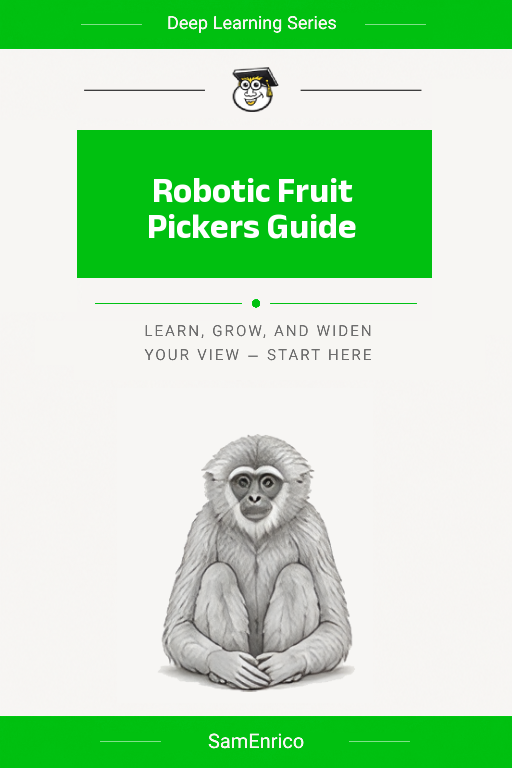
Non-FictionForecast & OutlookHarvest Robotics
Robotic Fruit Pickers Guide
Explore soft grippers and computer vision for deli
by Hackett Nida
Explore soft grippers and computer vision for delicate harvesting of apples, berries, and tomatoes.
Formats
About this book
Free sample
Chapter 1: The Bruise Ledger--–- On a crisp October morning in Washington State’s apple country, a veteran picker named Elena fills three bins per hour with Honeycrisp apples. Her hands move with a lifetime of earned efficiency—twisting each fruit just so, supporting its weight, laying it gently into the padded bin. At day’s end, less than one percent of her harvest shows bruising. That single percentage point is the difference between profit and loss for the orchard owner. That percentage point is also the reason why, after fifty years of industrial automation, the apple tree remains one of the few places on Earth where a human hand is still irreplaceable.This book is about closing that gap.
Not by building faster, stronger, or harder-working robots—those have existed for decades in automotive and logistics factories. Rather, it is about building robots that are gentler. Robots that understand not just where the fruit is, but how fragile it is. Robots that can read a strawberry’s ripeness through its color, feel an apple’s give through a silicone fingertip, and decide in a fraction of a second whether to twist, pull, cut, or let go.The problem of robotic fruit harvesting is not a single engineering challenge. It is a constellation of them, bound together by a single unforgiving constraint: biological variability.
No two apples are identical. No two tomato trusses hang the same way. No two raspberries detach with the same force. And yet, a commercial harvesting robot must perform with the consistency of a factory machine and the delicacy of a human expert. It must achieve a damage rate below one percent while operating at a speed that makes economic sense.
It must see through leaves, contort around branches, and adapt to wind, rain, and shifting light.This chapter establishes the foundation for everything that follows. It quantifies the damage problem that defines the entire design space, explains why different fruits require fundamentally different detachment strategies, and introduces the economic realities that separate academic prototypes from commercial equipment. By the end, you will understand why a robot…
This is the end of the free sample. Get the eBook to keep going. Buy now
Contents
- Chapter 1
- Chapter 2
- Chapter 3
- Chapter 4
- Chapter 5
- Chapter 6
- Chapter 7
- Chapter 8
- Chapter 9
- Chapter 10
- Chapter 11
- Chapter 12
Details
- Author
- Hackett Nida
- Publisher
- SamEnrico
- Language
- English
- Genre
- Non-Fiction, Forecast & Outlook, Harvest Robotics
- Released
- 2026-06-02
- Pages (approx.)
- 142
- Available as
- eBook, Audiobook

Read better in the ZLOADR app
Your eBooks on your phone or tablet. Sign in with your SamEnrico account and start reading.
More by Hackett Nida
 The Car Wash Supreme Court BattleHackett Nida$11.99
 From Passive to AssertiveHackett Nida$11.99
 OKRs for Sleep ImprovementHackett Nida$11.99
 Cocaine Psychotherapy Adjunct GuideHackett Nida$11.99
 Sober Curious A Self Assessment GuideHackett Nida$11.99
 Phantom Tides: The Vanishing of the SS BaychimoHackett Nida$11.99
 Resident Services CoordinatorHackett Nida$11.99
 Endorsement Penalty HandbookHackett Nida$12.99Endorsement Penalty HandbookHackett Nida$12.99
 Understanding Idiopathic Hypereosinophilic SyndromeHackett Nida$17.99
 How to Start a Casting Machines Business (Beginners Guide)Hackett Nida$11.99
You may also like
 Hong Kong Handover 1997Dunn Johnnie$11.99
 Zumba For Postnatal Recovery CourseNeal Christian$11.99
 Zumba for BeginnersLadner Nikia$11.99
 YouTube Comment Mining GuideHumes Pandora$12.99
 Worry Box MeditationCarlin Rudy$11.99
 Workplace Stress MeditationNguyen Lynn$11.99
 Workplace Stress and Sleep RepairHawley Ivory$11.99
 Workplace Perfectionism CureDelaney Jeffry$11.99
 Workplace Injustice Anger GuideWallen Isabelle$11.99
 Work Addiction and Burnout LinkGreenwood Ester$11.99
 Women in Yoga and WellnessBeattie Galina$11.99
 Women in Stand Up ComedyChun Evangeline$11.99