
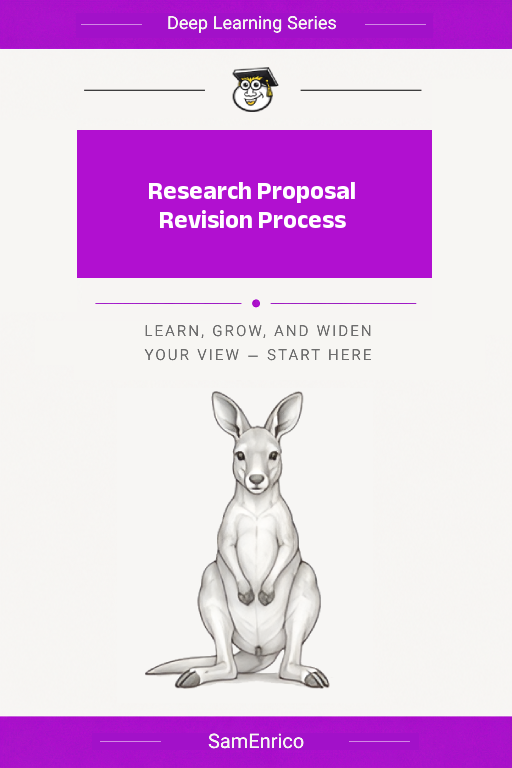
Research Proposal Revision Process Audiobook
Edit and polish your proposal through multiple rou
by Whalen Dayna
Edit and polish your proposal through multiple rounds of feedback and self-review.
Formats
Free sample
Chapter 1: The 72-Hour Rule--–- You have just finished your draft. Your cursor blinks at the end of the final sentence. You lean back. You feel a quiet glow of accomplishment, maybe even something close to pride. You have done it.
You have written a research proposal. Now all that is left is to polish a few sentences, check the formatting, and send it off to your advisor or a funding agency. You are almost there. Almost done.That feeling is a lie.Not because your draft is bad. It might be brilliant.
It might contain the seed of a funded project, a dissertation that changes your field, a grant that launches your career. But the feeling that you are almost done—that sense of proximity to a finished, submission-ready proposal—is the most dangerous illusion in academic writing. It is the illusion that has caused more rejected proposals, more wasted committee meetings, and more late-night panic attacks than any other single belief.Here is the truth that experienced researchers know and beginners learn the hard way: the gap between a completed first draft and a submission-ready proposal is not a short sprint of light editing. It is a wide ocean. And the only way to cross it is to first step away from the shore.This chapter introduces the most counterintuitive but most essential rule of the revision process: before you change a single word, before you show your draft to anyone, before you even open the document again, you must walk away.
For a full 72 hours. Not 24. Not "over the weekend" if the weekend happens to be slow. Three complete days during which you do not look at your proposal, do not think about it, and ideally do not even speak about it to anyone who might make you remember it.This rule is called the 72-Hour Rule. It will save you from yourself.Why Your Brain Lies to You After Writing To understand why the 72-Hour Rule works, you need to understand a quirk of human cognition that neuroscientists call perceptual fluency and writers call the curse of knowledge.
When you write a sentence, your brain does not just record the words. It records the intention behind the words—the meaning you were trying to convey, the argument you were building, the connection you were making. Then, when you read that same sentence five minutes later, your brain…
This is the end of the free sample. Get the Audiobook to keep going. Buy now
About this book
Details
- Author
- Whalen Dayna
- Publisher
- SamEnrico
- Language
- English
- Genre
- research, Student's Shortcut
- Released
- 2026-06-01
- Pages (approx.)
- 138
- Available as
- eBook, Audiobook

Listen in the VoxFlicks app
Audiobooks and audio dramas wherever you go. Sign in with your SamEnrico account and press play.
More by Whalen Dayna
 The Quit Journal MethodWhalen Dayna$11.99
 CrossFit for WomenWhalen Dayna$11.99
 Spaced Repetition MasteryWhalen Dayna$11.99
 Parent Death and Nature HealingWhalen Dayna$11.99
 Napping for High PerformanceWhalen Dayna$11.99
 Child Loss And Social MediaWhalen Dayna$11.99
 The Test Result WaitWhalen Dayna$11.99
 Pain Flare MeditationWhalen Dayna$11.99
 Assertiveness For Stay At Home ParentsWhalen Dayna$11.99
 The Silver Mask of the Moonlit KnightWhalen Dayna$11.99
 The Iron Chancellor: Bismarck's War That Made GermanyWhalen Dayna$11.99
 The Puppet Master: How a Forensic Psychologist Uncovered the Mind of a Serial KillerWhalen Dayna$11.99
You may also like
 Scientific Research On TM GuideMartens Nathanial$11.99
 Research Proposal Methodology Section MasteryPauley Debroah$11.99
 Research Proposal Appendix CompilationRaines Tyisha$11.99
 Academic Researcher Distraction GuideFord Virgil$11.99
 TM Research and ScienceCovert Nicki$11.99
 Social Anxiety Research ReviewRoberge Cole$11.99
 Research Proposal Significance Section GuideBock Tory$12.99
 Research Proposal Reviewer PsychologyLugo Tawanda$11.99
 Research Proposal Research Questions DesignLara Robbi$11.99
 Research Proposal References and CitationsPatten Shanice$11.99
 Research Proposal Mixed Methods DesignCameron Omega$11.99
 Research Proposal Data Management PlanAnderson Roberto$12.99