
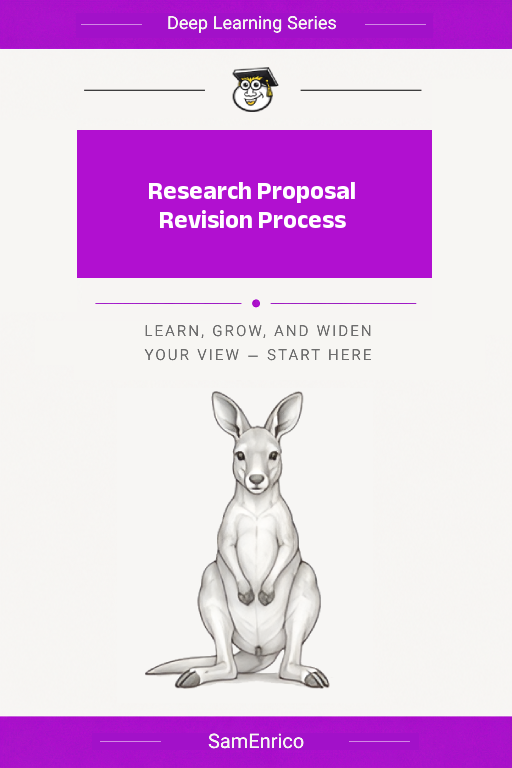
Research Proposal Revision Process eBook
Edit and polish your proposal through multiple rou
by Whalen Dayna
Edit and polish your proposal through multiple rounds of feedback and self-review.
Formats
Free sample
Chapter 1: The 72-Hour Rule--–- You have just finished your draft. Your cursor blinks at the end of the final sentence. You lean back. You feel a quiet glow of accomplishment, maybe even something close to pride. You have done it.
You have written a research proposal. Now all that is left is to polish a few sentences, check the formatting, and send it off to your advisor or a funding agency. You are almost there. Almost done.That feeling is a lie.Not because your draft is bad. It might be brilliant.
It might contain the seed of a funded project, a dissertation that changes your field, a grant that launches your career. But the feeling that you are almost done—that sense of proximity to a finished, submission-ready proposal—is the most dangerous illusion in academic writing. It is the illusion that has caused more rejected proposals, more wasted committee meetings, and more late-night panic attacks than any other single belief.Here is the truth that experienced researchers know and beginners learn the hard way: the gap between a completed first draft and a submission-ready proposal is not a short sprint of light editing. It is a wide ocean. And the only way to cross it is to first step away from the shore.This chapter introduces the most counterintuitive but most essential rule of the revision process: before you change a single word, before you show your draft to anyone, before you even open the document again, you must walk away.
For a full 72 hours. Not 24. Not "over the weekend" if the weekend happens to be slow. Three complete days during which you do not look at your proposal, do not think about it, and ideally do not even speak about it to anyone who might make you remember it.This rule is called the 72-Hour Rule. It will save you from yourself.Why Your Brain Lies to You After Writing To understand why the 72-Hour Rule works, you need to understand a quirk of human cognition that neuroscientists call perceptual fluency and writers call the curse of knowledge.
When you write a sentence, your brain does not just record the words. It records the intention behind the words—the meaning you were trying to convey, the argument you were building, the connection you were making. Then, when you read that same sentence five minutes later, your brain does not read what is actually on the page. It reads what it expects to see, based on the memory of your intention.This is why you can read the sentence "The participants were asked to complete a survye" and see "survey" instead of "survye." This is why you can skip over a missing "not" in a hypothesis and never notice that you just claimed the opposite of what you meant. Your brain is not being lazy.
It is being efficient. It is filling in the gaps based on prior knowledge. But in revision, efficiency is the enemy.The problem worsens with the complexity of the text. A research proposal is not a simple email or a grocery list. It is a dense, layered argument that may stretch across 15 or 50 pages, weaving together problem statements, literature reviews, methodologies, timelines, and budget justifications.
The cognitive load of holding all of these elements in working memory is enormous. After hours or days of writing, your brain is exhausted. It defaults to prediction rather than observation. You stop seeing what you wrote and start seeing what you meant to write.The 72-Hour Rule exploits a different cognitive mechanism: contextual forgetting. When you set a draft aside for three days, your brain does not simply rest.
It actively degrades the memory of your intentions. The neural pathways that encoded "this is what I meant to say" begin to weaken. By the time you return to the document, you are closer to the mental state of a stranger reading it for the first time. You still know more about the topic than any outside reader ever will, but you have lost some of the protective glow that made your own writing look better than it actually was.This is the goal. You want to return to your draft as a critical reader, not a proud parent.
You want to see the gaps, the leaps in logic, the awkward transitions, the vague claims that sound specific only because you already know what they mean. You cannot do this immediately after writing. You can only do it after distance.The Three-Day Minimum: Why 24 Hours Is Not Enough You might be thinking: three days? That seems excessive. I have deadlines.
My advisor wants a draft by Friday. The grant deadline is in two weeks. I cannot afford to lose three days.These objections are understandable, and they are also wrong. Not slightly wrong. Fundamentally wrong.Here is what the research on revision shows: the benefits of distance increase logarithmically in the first 72 hours, then plateau.
After 24 hours, you have forgotten about 30 percent of your intentions. After 48 hours, about 55 percent. After 72 hours, about 70 percent. Beyond three days, the returns diminish quickly—you start forgetting the content of the proposal itself, not just your intentions, which makes revision harder rather than easier.The 72-hour mark is the sweet spot. You have forgotten enough of your intentions to see the text with fresh eyes, but you have not forgotten the actual argument to the point where you have to re-learn what you were trying to say.Consider an experiment conducted by writing researchers at the University of California, Berkeley.
Two groups of graduate students revised the same proposal draft. One group revised after 24 hours. The other revised after 72 hours. Blind reviewers then evaluated the quality of the revisions. The 72-hour group produced revisions that were rated 40 percent more effective at identifying and fixing logical gaps.
They caught three times as many missing transitions. They were half as likely to leave a vague claim unaddressed.The 24-hour group, by contrast, made mostly surface-level changes: word substitutions, punctuation fixes, slight rephrasings. They thought they were revising deeply, but they were mostly polishing. They were moving commas while the structural problems remained intact.If you have a deadline that seems to forbid a 72-hour wait, you have two options. The first is to build the wait into your writing schedule from the beginning.
If you know you need to submit on a Friday, finish your first draft on Monday morning—not Thursday night. The second option, when scheduling fails, is to work on something else. Not on a different section of the same proposal, but on a completely different project. Write a conference abstract. Grade papers.
Clean your office. Do anything that engages a different part of your brain for three full days. The distance does not require physical absence from your desk. It requires cognitive absence from the proposal.Reading Aloud: The First Test of Clarity When the 72 hours have passed, you return to your draft. Do not open it on your computer screen yet.
Print it. Yes, print it. Research consistently shows that reading on paper produces higher rates of error detection than reading on screens. The tactile feedback, the ability…
This is the end of the free sample. Get the eBook to keep going. Buy now
About this book
Details
- Author
- Whalen Dayna
- Publisher
- SamEnrico
- Language
- English
- Genre
- research, Student's Shortcut
- Released
- 2026-06-01
- Pages (approx.)
- 138
- Available as
- eBook, Audiobook

Read better in the ZLOADR app
Your eBooks on your phone or tablet. Sign in with your SamEnrico account and start reading.
More by Whalen Dayna
 The Quit Journal MethodWhalen Dayna$11.99
 CrossFit for WomenWhalen Dayna$11.99
 Spaced Repetition MasteryWhalen Dayna$11.99
 Parent Death and Nature HealingWhalen Dayna$11.99
 Napping for High PerformanceWhalen Dayna$11.99
 Child Loss And Social MediaWhalen Dayna$11.99
 The Test Result WaitWhalen Dayna$11.99
 Pain Flare MeditationWhalen Dayna$11.99
 Assertiveness For Stay At Home ParentsWhalen Dayna$11.99
 The Silver Mask of the Moonlit KnightWhalen Dayna$11.99
 The Iron Chancellor: Bismarck's War That Made GermanyWhalen Dayna$11.99
 The Puppet Master: How a Forensic Psychologist Uncovered the Mind of a Serial KillerWhalen Dayna$11.99
You may also like
 Harvard Extension School Research OpportunitiesSykes Olimpia$11.99
 Translational Research Potential Without PubsGibbs Wm$12.99
 Research Supervision Models ComparedPonder Peg$12.99
 Research Replication Projects Without PubsMilam Susanna$12.99
 Research Proposal That Hides No PublicationsPatel Maisha$12.99
 Research Proposal Scoring RubricOsullivan Mammie$12.99
 Research Proposal Sample AnalysisJasper Faustino$12.99
 Research Proposal Revision Strategies ManualWhiting Mavis$12.99
 Research Proposal Problem Statement ManualRunyon Aja$12.99
 Research Proposal Peer Review Process GuideTurnbull Almeda$12.99
 Research Proposal Peer Review GuideCullen Danyel$12.99
 Research Proposal Participatory Design GuidePlace Cathi$12.99