
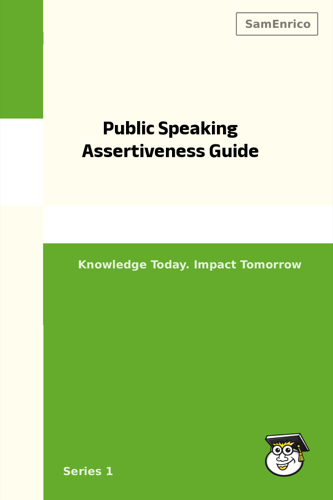
Non-FictionSelf-HelpPublic Speaking
Public Speaking Assertiveness Guide eBook
Project your voice and opinions confidently in fro
by Fisk Marcelo
Project your voice and opinions confidently in front of any audience.
Formats
Free sample
Chapter 1: The Two Voices--You have two voices.Not metaphorically. Not poetically. Literally. You possess two distinct vocal identities, and they are not the same. One of them flows effortlessly, carries warmth, and lands exactly as you intend.
The other emerges in meetings, presentations, confrontations, or any moment you feel watched. It is thinner. Faster. Higher-pitched. Less controlled.
And you have absolutely no idea when you switch between them.This chapter exposes the gap between those two voices. You will learn why your "quiet office voice" fails you exactly when you need it most, why shouting breaks trust instead of building authority, and how to stop the unconscious vocal betrayal that happens every time you step into a room where you want to be taken seriously.The Confession I Hear from Every Client Before I teach you a single technique, let me tell you what hundreds of professionals have said to me in the first five minutes of our first session. You will recognize yourself in at least one of these statements."I can be completely confident with my team. But put me in front of senior leadership, and my voice disappears.""People tell me I sound unsure, but inside I know exactly what I want to say.""I hate the way I sound on recorded calls. It's not me.""My partner says I'm funny and warm at home.
At work, they say I'm 'quiet' or 'hard to read.'""The more I prepare for a presentation, the worse my voice sounds when I actually give it."Here is what all these confessions share. In every case, the person is describing a switch. They are not bad speakers. They are not uninformed. They are not lacking opinions.
They are simply using the wrong voice for the wrong context, and they do not know how to change it because no one ever taught them that voices operate differently in different environments.This book exists because that gap can be closed. Not with abstract confidence mantras. Not with "just be yourself" platitudes. But with specific, repeatable, physiological techniques that retrain how your voice engages when the stakes rise.The Inside Voice: Where You Sound Like You Let us start with the voice that works. The inside voice is the sound you produce when you feel completely safe.
No one is judging you. No one is evaluating you. No one is about to interrupt, critique, or dismiss you.When do you use this voice?You use it with your partner over morning coffee. You use it with your best friend when you are venting about a bad day. You use it with your dog—yes, the slightly ridiculous, unguarded tone that would embarrass you if anyone overheard.
You use it when you are thinking out loud in an empty room. You use it when you leave a voicemail for your mother.What does this voice sound like?It is relaxed. Your jaw is loose. Your throat is open. Your breath comes from low in your body without you thinking about it.
Your pitch moves up and down naturally—not monotone, but not sing-song either. Your pace varies. You speed up when you are excited. You slow down when you are making a point. You pause without panic.
Silence in this voice is just silence, not a countdown to disaster.Most important, this voice sounds like you. Not a version of you. Not a performance. You.Now here is the question that changes everything. Why do you not sound like that when you walk into a meeting?The answer is not that you lack confidence.
The answer is that your nervous system does not distinguish between a quarterly review and a saber-toothed tiger. We will spend an entire chapter on the biology of stage fright later. For now, understand this: your voice changes because your body believes it is in danger. And when your body believes it is in danger, it prioritizes survival over eloquence.The inside voice is your natural state. The outside voice is your stress state.
The gap between them is not a personality flaw. It is a biological response that you can learn to override.The Outside Voice: Where You Lose Yourself Now let us examine the voice that fails you. The outside voice emerges in any situation where you feel watched, judged, evaluated, or compared.This includes meetings, presentations, performance reviews, difficult conversations, networking events, speaking up on Zoom calls, giving feedback to a colleague who outranks you, introducing yourself in a group where everyone seems more accomplished, and basically any moment where you care about the outcome.What does this voice sound like?For most people, it is faster. Your words rush out because you want to get them over with. Speed feels like efficiency, but to listeners, speed signals nervousness.
The faster you speak, the less authoritative you sound.It is higher-pitched. Under stress, the muscles around your larynx tighten, pulling your voice up into a thinner, breathier range. You do not notice this happening. But listeners do. They hear uncertainty.It is quieter—or sometimes louder in exactly the wrong way.
Many people drop their volume when they feel insecure, as if trying to take up less space. Others overcompensate and shout, mistaking volume for authority. Neither works. The quiet voice disappears. The loud voice triggers defensiveness.It is less varied.
Your natural pitch range collapses into a narrow, monotone band. Your pauses disappear—silence becomes terrifying, so you fill it with "um," "like," "you know," or just more words. Your sentences start to rise at the end, turning statements into questions. "I think we should try this approach?" sounds like you are asking permission.And here is the cruelest part. You can feel this happening in real time.
You hear yourself sounding weak or rushed or apologetic. That awareness makes you more anxious. The more anxious you become, the worse your voice sounds. The worse your voice sounds, the more anxious you become.This is the inside-outside voice paradox. When you need your best voice most, it abandons you.The Two Mistakes Everyone Makes When people realize their outside voice is failing them, they typically try one of two solutions.
Both make the problem worse.Mistake One: Shouting The first mistake is believing that volume equals authority. If people cannot hear me, the thinking goes, I will just get louder. If they are not taking me seriously, I will force them to listen.Here is why shouting fails. When you raise your volume beyond a certain point, your voice changes quality. The warmth disappears.
The resonance flattens. What remains is a sharp, staccato, aggressive sound that triggers the listener's amygdala—the part of the brain responsible for threat detection. Once you trigger the amygdala, the listener stops processing your words and starts defending against you.Shouting also signals that you have lost emotional control. In every professional context, composure is authority. The person who raises their voice has, by definition, conceded that they cannot win on the merits of their argument.
They are now trying to win on volume. And listeners know the difference.I have worked with executives who were genuinely confused about why their teams…
This is the end of the free sample. Get the eBook to keep going. Buy now
About this book
Details
- Author
- Fisk Marcelo
- Publisher
- SamEnrico
- Language
- English
- Genre
- Non-Fiction, Self-Help, Public Speaking
- Released
- 2026-06-09
- Pages (approx.)
- 130
- Available as
- eBook, Audiobook

Read better in the ZLOADR app
Your eBooks on your phone or tablet. Sign in with your SamEnrico account and start reading.
More by Fisk Marcelo
 Sleep Meditation for InfantsFisk Marcelo$11.99
 Physical Exercise NeuroprotectionFisk Marcelo$11.99
 Lonely Expat Connection GuideFisk Marcelo$11.99
 The Social Creative AccountabilityFisk Marcelo$11.99
 Verdict of the Sphinx: How an Ancient Judge Solved a Murder That Stumped Modern ForensicsFisk Marcelo$11.99
 How to Start a First Aid Boxes (wholesale) Business (Beginners Guide)Fisk Marcelo$11.99
 Learn to Play the BawuFisk Marcelo$11.99
 Category Based Express EntryFisk Marcelo$12.99
 Pre Launch Community ToolsFisk Marcelo$12.99
 Asynchronous Advantage Actor-Critic OperatorFisk Marcelo$11.99
You may also like
 Hong Kong Handover 1997Dunn Johnnie$11.99
 Zumba For Postnatal Recovery CourseNeal Christian$11.99
 Zumba for BeginnersLadner Nikia$11.99
 YouTube Comment Mining GuideHumes Pandora$12.99
 Worry Box MeditationCarlin Rudy$11.99
 Workplace Stress MeditationNguyen Lynn$11.99
 Workplace Stress and Sleep RepairHawley Ivory$11.99
 Workplace Perfectionism CureDelaney Jeffry$11.99
 Workplace Injustice Anger GuideWallen Isabelle$11.99
 Work Addiction and Burnout LinkGreenwood Ester$11.99
 Women in Yoga and WellnessBeattie Galina$11.99
 Women in Stand Up ComedyChun Evangeline$11.99