
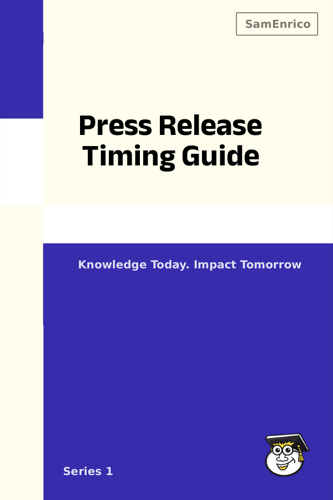
Non-FictionProfessional's Cheat Sheet / Timing
Press Release Timing Guide eBook
undefined
undefined
Formats
Free sample
Chapter 1: The 48-Hour Graveyard--Most authors kill their own book on the day they are most desperate to save it.The scene unfolds like this, thousands of times every year. An author finishes their manuscript after months or years of labor. They secure a publication date. They build a website, gather some early reviews, and design a cover they love. Then, on the morning of launch day—or worse, the week before—they sit down at their computer, craft a press release announcing their book, and click "send" to a list of journalists they have scraped together from Google searches and social media.Then they wait.And nothing happens.If they are lucky, one small blog picks up the release.
If they are exceptionally fortunate, a local newspaper runs a 200-word blurb. But the major outlets they dreamed of—the Washington Post, the Today Show, People magazine, the top podcasts in their genre—do not even send a polite rejection. They simply delete the email. The author checks their email obsessively for a week, then two weeks, then a month. Eventually, they conclude that press releases do not work.
Or that journalists are rude. Or that their book is not good enough.None of these conclusions are correct.The real problem is not the quality of the book, the writing of the press release, or even the size of the media list. The real problem is timing. And more specifically, the belief that a press release is something you send when your book is ready rather than something you send when the media is ready.This chapter will destroy that belief and replace it with a framework that separates successful authors from everyone else: the 180-Day Runway, the distinction between breaking news and editorial planning, and the single most important cheat sheet you will ever use in your publicity career.The Launch Week Delusion Let us start with a hard number that should haunt every author who plans to send a press release on launch day.According to a survey of 500 journalists conducted by the marketing platform Fractl, 75 percent of journalists say they ignore press releases that are not relevant to their current or upcoming editorial calendar. That sounds obvious until you understand what "upcoming editorial calendar" actually means.For a monthly magazine like Real Simple or Bon Appétit, the editorial calendar for the June issue is finalized in January.
The features are assigned in February. The writing happens in March. The layout happens in April. The magazine prints in May. And it appears on newsstands in June.If you send a press release about your summer beach read on May 1st, hoping for coverage in the June issue, you are not early.
You are not on time. You are four months late.The same principle applies, with different lead times, to nearly every media outlet. The New York Times books section plans its coverage three to six weeks in advance. The Today Show books segment books guests four to eight weeks ahead. Podcasts like The Tim Ferriss Show or Smart Less schedule guests three to six months out.
Holiday gift guides are planned in August for November publication.Here is the painful truth that press release wire services will never tell you: the moment your book is available for purchase is the least newsworthy moment of its entire lifecycle. Why? Because by the time a book is in stores, every journalist who might have covered it has already moved on to the next editorial deadline. You are pitching a product. They are building a story.
And those two things operate on completely different clocks.This is the Launch Week Delusion. It is the belief that the day your book becomes available is the day journalists will be most interested in it. In reality, that day is the day journalists are least interested, because they have already planned their coverage for the next three months and are frantically trying to meet their deadlines.Introducing the 180-Day Runway To escape the Launch Week Delusion, you need to stop thinking of a press release as an announcement and start thinking of it as a reservation at a very busy restaurant. You would not walk into a Michelin-starred restaurant on a Saturday night without a reservation and expect a table. Yet authors do this every day with the media equivalent of that restaurant.The 180-Day Runway is your reservation system.
It is a six-month countdown, measured backward from your publication date, that assigns a distinct publicity goal to each month. By the time your book launches, you will have already been building relationships with journalists for half a year. Your press release will not be a cold call. It will be the final step in a carefully orchestrated campaign.Here is the complete 180-Day Runway at a glance. I will explain each window in detail in the chapters that follow, but for now, treat this as your roadmap:T-Minus 180 Days (Six Months Out) – Trade Reviews Target: Kirkus Reviews, Publishers Weekly, Library Journal, Booklist Goal: Secure professional reviews that will be quoted in all future press materials T-Minus 150 Days (Five Months Out) – Long-Lead Magazines Target: Monthly magazines (People, Real Simple, The Atlantic, Wired)Goal: Pitch feature stories tied to seasonal themes (summer reading, fall preview, holiday gift guides)T-Minus 120 Days (Four Months Out) – Embargoed Pitches Target: National newspapers (The New York Times, The Washington Post, USA Today)Goal: Send embargoed press releases with exclusive interview access T-Minus 90 Days (Three Months Out) – Podcasts & TVTarget: Major podcasts, morning shows, cable news Goal: Book interviews that will air around launch date T-Minus 60 Days (Two Months Out) – Local Media Target: Hometown newspapers, regional magazines, NPR affiliates Goal: Secure local coverage and begin event booking T-Minus 30 Days (One Month Out) – Second Wave Target: All journalists who ignored the first pitch Goal: Send a fresh angle (excerpt, endorsement, cover reveal)Launch Day – In-Stock Alert Target: All remaining media, book bloggers, social media influencers Goal: Convert earlier interest into immediate sales T-Plus 30, 60, 90 Days – Milestone Releases Target: All media, with updates on bestseller status, awards, reviews Goal: Extend the publicity window beyond launch day This is not a theory.
This is the actual schedule used by major publishing houses, top publicists, and successful indie authors who consistently land media coverage. The difference between a book that gets reviewed in The New York Times and a book that gets ignored is rarely quality. It is almost always timing.Breaking News Versus Editorial Planning Before we go any further, you need to understand a fundamental distinction that will appear in every chapter of this book. It is the difference between breaking news and editorial planning, and confusing the two is the single most expensive mistake you can make as an author.Breaking news is what journalists cover when something happens right now. A celebrity dies.
A war starts. A company announces a merger. A hurricane makes landfall. Breaking news is reactive, urgent, and unpredictable. If your book is about a topic that suddenly becomes the biggest story in the world, you can sometimes ride that wave.
But you cannot plan for it, and you should never build your publicity strategy around it.Editorial planning is what journalists…
This is the end of the free sample. Get the eBook to keep going. Buy now
About this book
Details
- Author
- Sallee Bryanna
- Publisher
- SamEnrico
- Language
- English
- Genre
- Non-Fiction, Professional's Cheat Sheet / Timing
- Released
- 2026-06-06
- Pages (approx.)
- 136
- Available as
- eBook, Audiobook

Read better in the ZLOADR app
Your eBooks on your phone or tablet. Sign in with your SamEnrico account and start reading.
More by Sallee Bryanna
 Emotional Spending WorkbookSallee Bryanna$11.99
 Wish Fulfillment DreamsSallee Bryanna$11.99
 Student Loan Stress SolutionSallee Bryanna$11.99Student Loan Stress SolutionSallee Bryanna$11.99
 Self Hypnosis For Skiing GuideSallee Bryanna$11.99
 The 5 Minute NetworkerSallee Bryanna$11.99
 Peruvian Asylum Seeker StorySallee Bryanna$11.99
 Concentrating the Mind BreathSallee Bryanna$11.99
 OCD Thought Labeling MeditationSallee Bryanna$11.99
 Sir William Hamilton: The Kiwi Visionary Who Conquered the SkiesSallee Bryanna$11.99
 Montcalm's Last Stand: The Fall of Quebec in 1759Sallee Bryanna$11.99
 How to Produce a BedspreadSallee Bryanna$11.99
You may also like
 Hong Kong Handover 1997Dunn Johnnie$11.99
 Zumba For Postnatal Recovery CourseNeal Christian$11.99
 Zumba for BeginnersLadner Nikia$11.99
 YouTube Comment Mining GuideHumes Pandora$12.99
 Worry Box MeditationCarlin Rudy$11.99
 Workplace Stress MeditationNguyen Lynn$11.99
 Workplace Stress and Sleep RepairHawley Ivory$11.99
 Workplace Perfectionism CureDelaney Jeffry$11.99
 Workplace Injustice Anger GuideWallen Isabelle$11.99
 Work Addiction and Burnout LinkGreenwood Ester$11.99
 Women in Yoga and WellnessBeattie Galina$11.99
 Women in Stand Up ComedyChun Evangeline$11.99