
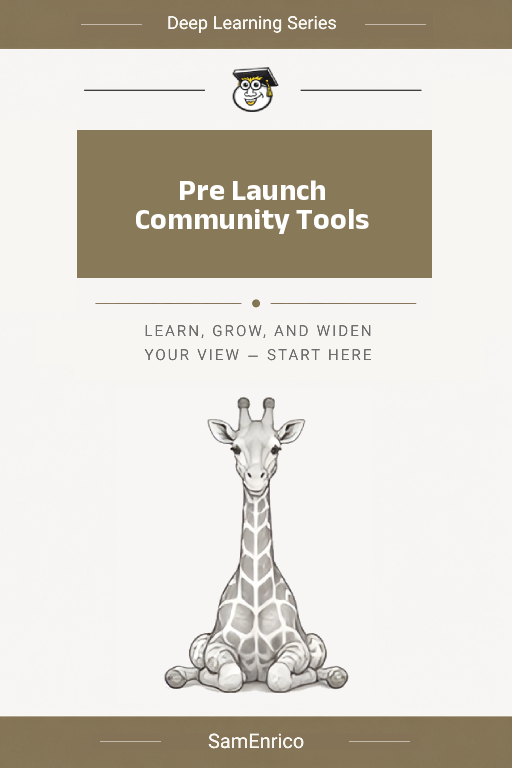
Non-FictionStartup GuideWaitlist Strategy
Pre Launch Community Tools eBook
Tools for building community before launch. Waitli
by Fisk Marcelo
Tools for building community before launch. Waitlist, email, and engagement platforms.
Formats
Free sample
Chapter 1: The Empty Room...--–- You have spent eighteen months writing a book, coding a software platform, or handcrafting a physical product. The morning of your launch finally arrives. You have told your mother, your partner, and the fifteen people who follow your business page on social media. You click "publish," "launch," or "go live." Then you wait. An hour passes.
Three hours. A full day. Your analytics dashboard shows fourteen visitors. Zero purchases. Zero comments.
Zero evidence that anyone beyond your immediate circle cares that you exist.This is the Empty Room Paradox. It is the single most common reason products fail, and almost no one talks about it.Traditional business literature celebrates the product itself. Get the features right, polish the user interface, perfect the pricing model, and customers will naturally appear. This advice worked in 1995, when the internet had fewer than fifty thousand websites. It worked in 2005, when launching on Amazon meant competing against a few hundred books in your category.
It does not work today, when an estimated seven thousand new books are published daily on Amazon alone, when over five hundred new Saa S products launch every week, and when artificial intelligence tools can generate a passable ebook in under two hours.The market is not a vacuum waiting to be filled. It is a roaring river of noise, and launching without a pre-existing community is the equivalent of throwing a message in a bottle into the ocean and expecting a personal reply within twenty-four hours.This book exists because the rules have changed. The modern "pre-launch" is not about announcing a ship date. It is about engineering scarcity, belonging, and commitment long before your product has a final form. The tools you will learn about in these chapters—waitlists, quizzes, CRM platforms, advance review copy systems, and private community channels—are not merely collection mechanisms.
They are validation engines. They transform strangers into co-owners, passive followers into active promoters, and the terrifying uncertainty of an empty room into the predictable momentum of a crowd that arrived before you opened the doors.The data behind the empty room is unforgiving. Across hundreds of product launches analyzed by multiple industry research firms, the single strongest predictor of long-term success is not product quality, pricing strategy, or marketing budget. It is sales velocity in the first twenty-four hours. Algorithms across Amazon, Apple's App Store, Google Search, and Kickstarter are designed to amplify what is already working.
A product that sells one hundred units in the first hour is flagged as trending, pushed into "also bought" recommendations, featured on category pages, and sent to email subscribers who have shown interest in similar items. A product that sells the same one hundred units over the course of a week receives none of these algorithmic boosts. It is statistically invisible.The mathematics of discovery explain why. Most marketplaces use some variation of a Bayesian average or Wilson score confidence interval to rank products. These formulas weight early signals heavily because they lack long-term data.
A product with ten sales in the first hour and zero sales in the subsequent hour is treated as more promising than a product with one sale per hour for ten hours. The algorithm assumes that rapid early adoption signals higher underlying quality or appeal. Whether this assumption is philosophically sound is irrelevant. It is the mechanical reality of how discovery works in 2025 and for the foreseeable future.Consider two identical books launching on the same day. Book A sells fifty copies in the first three hours because its author recruited a waitlist of two hundred committed readers before publication.
Book B sells fifty copies spread across the first seven days through organic search and sporadic social media posts. On day eight, Book A appears on Amazon's "Hot New Releases" list for its category, generating an additional two hundred sales through discovery. Book B remains buried on page twelve of search results, never seen by anyone who is not specifically looking for its exact title. By the end of month one, Book A has sold over one thousand copies. Book B has sold eighty.
The products were identical. The only difference was when the sales happened.This pattern repeats across every major launch platform. Kickstarter projects that reach thirty percent of their funding goal within the first forty-eight hours succeed at a rate of over ninety percent. Projects that take two weeks to reach the same threshold succeed at a rate below thirty percent. App Store editors scan "New & Noteworthy" lists generated by first-day download velocity, not by long-term reviews.
Even traditional publishers, who once relied on physical bookstore placement, now allocate marketing budgets based on pre-order numbers measured in hours, not weeks.The Field of Dreams myth—"if you build it, they will come"—has caused more entrepreneurial failure than bad products, poor pricing, and outright fraud combined. The myth persists because it flatters the builder. It suggests that the quality of your work is the sole determinant of its success. It allows you to focus on the comfortable, controllable act of creation while avoiding the uncomfortable, uncontrollable act of soliciting strangers for attention. The myth is also demonstrably false.
A comprehensive study of over fifty thousand Kickstarter campaigns found zero correlation between product quality (as measured by backer satisfaction surveys) and funding success when controlling for pre-launch audience size. Mediocre products with large waitlists succeeded. Exceptional products with no waitlists failed. Quality was not a protective factor.The case studies are painful and instructive. A hardware engineer spent two years developing a smart plant sensor that could measure soil moisture, light levels, and nutrient content with laboratory accuracy.
The prototype was beautiful. The price point was competitive. The engineer launched on Kickstarter without building any pre-launch audience, relying on what she described as "the inherent virality of solving a real problem." The campaign raised 3,400againsta3,400 against a 3,400againsta50,000 goal. A simpler, less accurate plant sensor launched six months later by a different creator who had recruited a one-thousand-person waitlist through Instagram gardening communities raised $187,000 in its first seventy-two hours. The superior technology lost.
The superior pre-launch community won.A novelist spent four years writing a literary thriller that received glowing feedback from professional editors and beta readers. She published directly to Amazon, believing that good reviews would generate organic word-of-mouth. She received nineteen reviews averaging 4.7 stars. She sold seventy-three copies in the first year. A different novelist in the same genre wrote a competent but unremarkable thriller and spent ninety days before launch recruiting two hundred beta readers from Facebook writing groups, asking them for feedback on the cover, the blurb, and the first three chapters.
That novel sold over two thousand copies in its first week and hit number one in its subcategory. The superior manuscript lost. The superior pre-launch community won.These stories share a common structure. Talented, hardworking creators assume that their talent and hard work will be sufficient. They treat community building as an optional add-on, a "nice to have" for extroverts or social media natives.
They are wrong. Community building is not a personality trait. It is a systematic, learnable, tool-driven process that anyone can execute regardless of…
This is the end of the free sample. Get the eBook to keep going. Buy now
About this book
Details
- Author
- Fisk Marcelo
- Publisher
- SamEnrico
- Language
- English
- Genre
- Non-Fiction, Startup Guide, Waitlist Strategy
- Released
- 2026-05-29
- Pages (approx.)
- 148
- Available as
- eBook, Audiobook

Read better in the ZLOADR app
Your eBooks on your phone or tablet. Sign in with your SamEnrico account and start reading.
More by Fisk Marcelo
 Sleep Meditation for InfantsFisk Marcelo$11.99
 Physical Exercise NeuroprotectionFisk Marcelo$11.99
 Public Speaking Assertiveness GuideFisk Marcelo$11.99
 Lonely Expat Connection GuideFisk Marcelo$11.99
 The Social Creative AccountabilityFisk Marcelo$11.99
 Verdict of the Sphinx: How an Ancient Judge Solved a Murder That Stumped Modern ForensicsFisk Marcelo$11.99
 How to Start a First Aid Boxes (wholesale) Business (Beginners Guide)Fisk Marcelo$11.99
 Learn to Play the BawuFisk Marcelo$11.99
 Category Based Express EntryFisk Marcelo$12.99
 Asynchronous Advantage Actor-Critic OperatorFisk Marcelo$11.99
You may also like
 Hong Kong Handover 1997Dunn Johnnie$11.99
 Zumba For Postnatal Recovery CourseNeal Christian$11.99
 Zumba for BeginnersLadner Nikia$11.99
 YouTube Comment Mining GuideHumes Pandora$12.99
 Worry Box MeditationCarlin Rudy$11.99
 Workplace Stress MeditationNguyen Lynn$11.99
 Workplace Stress and Sleep RepairHawley Ivory$11.99
 Workplace Perfectionism CureDelaney Jeffry$11.99
 Workplace Injustice Anger GuideWallen Isabelle$11.99
 Work Addiction and Burnout LinkGreenwood Ester$11.99
 Women in Yoga and WellnessBeattie Galina$11.99
 Women in Stand Up ComedyChun Evangeline$11.99