
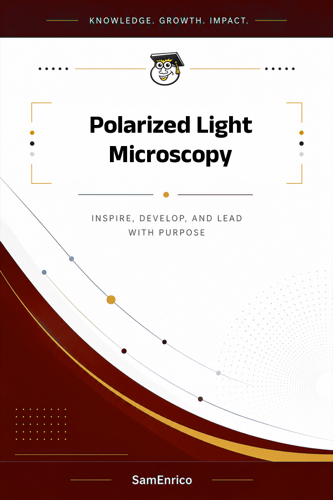
Non-FictionTrue CrimePolarized Light
Polarized Light Microscopy Audiobook
Birefringence for fiber and mineral identification
Birefringence for fiber and mineral identification.
Formats
Free sample
Chapter 1: The Murder of Light...--–- In 1828, a Scottish physicist named William Nicol sliced a crystal of Icelandic spar diagonally, cemented the two halves back together with Canada balsam, and unknowingly handed humanity a key to the invisible world. His simple device—the Nicol prism—was the first practical polarizer. With it, he could take ordinary, chaotic light and force it into a single, disciplined vibration plane. What he could not have known was that his invention would one day help geologists read the thermal history of mountains, enable forensic scientists to identify a single asbestos fiber on a firefighter's lung, and allow art conservators to distinguish an original Rembrandt from a clever forgery. The murder of light's innocence—stripping away its randomness to reveal hidden structure—became the birth of polarized light microscopy.This is the story of how we learned to interrogate light itself, forcing it to confess what it has seen inside crystals, fibers, and minerals.
It is a story that begins with a simple question: why does light sometimes bend, split, or slow down when it passes through transparent materials? The answer to that question leads us down a path from Newton's prisms to modern forensic laboratories, from the physics of waves to the practical art of identifying unknown substances by their optical fingerprints. By the end of this chapter, you will understand not only how light behaves but why that behavior matters when you sit down at a polarized light microscope to solve a real-world problem.The Nature of Light: Waves, Particles, and a Longstanding Debate Before we can understand how crystals manipulate light, we must first understand what light itself is. For most of human history, this question was the exclusive province of philosophers. The ancient Greeks, led by Euclid and Ptolemy, believed that light traveled in straight lines and that vision resulted from rays emanating from the eye—a theory known as extramission.
It was elegant, intuitive, and completely wrong. The Arab scholar Alhazen (Ibn al-Haytham) corrected this in the 11th century, demonstrating through careful experiments that light enters the eye from external sources. But the fundamental nature of light remained mysterious.The 17th century brought two competing visions. Isaac Newton, perhaps the most influential scientist in history, argued that light consisted of tiny particles (corpuscles) traveling in straight lines. His corpuscular theory explained reflection and refraction elegantly, and Newton's immense authority carried…
This is the end of the free sample. Get the Audiobook to keep going. Buy now
About this book
Details
- Author
- Hammer Eleanore
- Publisher
- SamEnrico
- Language
- English
- Genre
- Non-Fiction, True Crime, Polarized Light
- Released
- 2026-06-09
- Pages (approx.)
- 157
- Available as
- eBook, Audiobook

Listen in the VoxFlicks app
Audiobooks and audio dramas wherever you go. Sign in with your SamEnrico account and press play.
More by Hammer Eleanore
 Grandparent Grief Child LossHammer Eleanore$11.99
 Burnout Prevention for PharmacistsHammer Eleanore$11.99
 The Trauma CPR GuideHammer Eleanore$11.99
 The Eye Health MicronutrientHammer Eleanore$11.99
 Organisation of African Unity 1963Hammer Eleanore$11.99
 Incompetent Cervix Loss SupportHammer Eleanore$11.99
 Anki For Bible StudyHammer Eleanore$11.99
 The Lion Kings of the Savannah: The Majestic Hunters of Ancient KushHammer Eleanore$11.99
 How to Start a Property Manager BusinessHammer Eleanore$11.99
 A Collector's Handbook to the Austin A99Hammer Eleanore$11.99
 How to Produce Science and LaboratoryHammer Eleanore$11.99
 Power Distance in Mentoring GuideHammer Eleanore$12.99
You may also like
 Hong Kong Handover 1997Dunn Johnnie$11.99
 Zumba For Postnatal Recovery CourseNeal Christian$11.99
 Zumba for BeginnersLadner Nikia$11.99
 YouTube Comment Mining GuideHumes Pandora$12.99
 Worry Box MeditationCarlin Rudy$11.99
 Workplace Stress MeditationNguyen Lynn$11.99
 Workplace Stress and Sleep RepairHawley Ivory$11.99
 Workplace Perfectionism CureDelaney Jeffry$11.99
 Workplace Injustice Anger GuideWallen Isabelle$11.99
 Work Addiction and Burnout LinkGreenwood Ester$11.99
 Women in Yoga and WellnessBeattie Galina$11.99
 Women in Stand Up ComedyChun Evangeline$11.99