
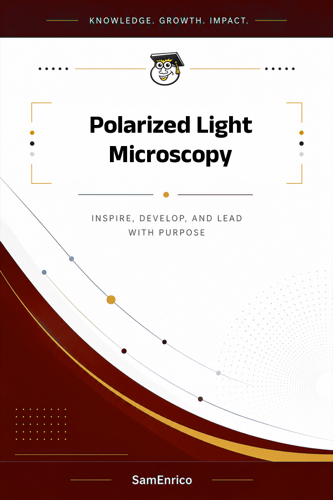
Non-FictionTrue CrimePolarized Light
Polarized Light Microscopy eBook
Birefringence for fiber and mineral identification
Birefringence for fiber and mineral identification.
Formats
Free sample
Chapter 1: The Murder of Light...--–- In 1828, a Scottish physicist named William Nicol sliced a crystal of Icelandic spar diagonally, cemented the two halves back together with Canada balsam, and unknowingly handed humanity a key to the invisible world. His simple device—the Nicol prism—was the first practical polarizer. With it, he could take ordinary, chaotic light and force it into a single, disciplined vibration plane. What he could not have known was that his invention would one day help geologists read the thermal history of mountains, enable forensic scientists to identify a single asbestos fiber on a firefighter's lung, and allow art conservators to distinguish an original Rembrandt from a clever forgery. The murder of light's innocence—stripping away its randomness to reveal hidden structure—became the birth of polarized light microscopy.This is the story of how we learned to interrogate light itself, forcing it to confess what it has seen inside crystals, fibers, and minerals.
It is a story that begins with a simple question: why does light sometimes bend, split, or slow down when it passes through transparent materials? The answer to that question leads us down a path from Newton's prisms to modern forensic laboratories, from the physics of waves to the practical art of identifying unknown substances by their optical fingerprints. By the end of this chapter, you will understand not only how light behaves but why that behavior matters when you sit down at a polarized light microscope to solve a real-world problem.The Nature of Light: Waves, Particles, and a Longstanding Debate Before we can understand how crystals manipulate light, we must first understand what light itself is. For most of human history, this question was the exclusive province of philosophers. The ancient Greeks, led by Euclid and Ptolemy, believed that light traveled in straight lines and that vision resulted from rays emanating from the eye—a theory known as extramission.
It was elegant, intuitive, and completely wrong. The Arab scholar Alhazen (Ibn al-Haytham) corrected this in the 11th century, demonstrating through careful experiments that light enters the eye from external sources. But the fundamental nature of light remained mysterious.The 17th century brought two competing visions. Isaac Newton, perhaps the most influential scientist in history, argued that light consisted of tiny particles (corpuscles) traveling in straight lines. His corpuscular theory explained reflection and refraction elegantly, and Newton's immense authority carried the day for nearly a century.
But a Dutch contemporary, Christiaan Huygens, proposed an alternative: light was a wave, like ripples on a pond. Huygens' principle—that every point on a wavefront acts as a source of secondary spherical wavelets—explained diffraction and interference in ways that Newton's particles could not. Yet Huygens' theory was largely ignored, partly because Newton's reputation overshadowed it and partly because Huygens lacked experimental evidence for certain key predictions.The wave theory finally triumphed in 1801 when Thomas Young performed his famous double-slit experiment. Young shone light through two closely spaced slits and observed an interference pattern of alternating bright and dark bands on a screen behind them. This pattern could only be explained if light was a wave—particles would produce only two bright bands, not the periodic array Young observed.
Augustin-Jean Fresnel refined the theory, and by the mid-19th century, light was understood as a transverse electromagnetic wave, with electric and magnetic fields oscillating perpendicular to the direction of propagation.But there was a catch. Transverse waves—like waves on a string or ripples on water—have a property called polarization. A wave on a string can vibrate vertically, horizontally, or at any angle in between. Normal sunlight is a chaotic mixture of all these vibration directions. A polarizer is a filter that allows only waves vibrating in a particular plane to pass through, blocking all others.
When ordinary light passes through a polarizer, what emerges is plane-polarized light—light whose electric field oscillates in a single, well-defined direction.This is the fundamental transformation that makes polarized light microscopy possible. The polarizer "murders" the light's random vibrations, forcing it into a single plane. When that disciplined light encounters an anisotropic crystal—a material whose atomic structure is not the same in all directions—the crystal splits it into two perpendicularly polarized rays traveling at different speeds. The analyzer, a second polarizer crossed perpendicular to the first, then reveals this splitting as colors and patterns that tell us the crystal's identity.Snell's Law: How Light Bends Before we can understand birefringence—the splitting of light in crystals—we must understand ordinary refraction. When light passes from one transparent medium to another (from air to water, for example), it changes direction.
This bending is called refraction, and it is governed by a remarkably simple relationship known as Snell's Law.Imagine you are pushing a lawnmower from a paved driveway onto a grassy lawn. The mower moves faster on pavement than on grass. If you approach the grass at an angle, the mower will change direction because one wheel hits the grass before the other, slowing that side first. Light behaves similarly. When light passes from a medium where it travels quickly (like air) into a medium where it travels more slowly (like water or glass), it bends toward the perpendicular to the surface.
If it passes from a slow medium to a fast medium, it bends away.Snell's Law quantifies this relationship:n₁ × sin θ₁ = n₂ × sin θ₂Here, n₁ and n₂ are the refractive indices of the two media, and θ₁ and θ₂ are the angles the light ray makes with the perpendicular (normal) to the surface on each side. The refractive index (RI) of a material is defined as the ratio of the speed of light in a vacuum (c) to the speed of light in that material (v):n = c / v Since light always travels slower in any material than in a vacuum, refractive indices are always greater than or equal to 1. Air has an RI of approximately 1.0003 (usually rounded to 1.00 for practical work). Water is about 1.33. Typical optical glasses range from 1.45 to 1.90.
Diamond, famous for its brilliance, has an RI of 2.42.For the microscopist, Snell's Law explains why grains of different minerals appear to "pop" out of their mounting medium (a phenomenon called relief, which we will explore in depth in Chapter 4). It also explains why immersion oils—liquids with precisely calibrated refractive indices—are such powerful tools for mineral identification. When a grain's RI exactly matches the surrounding oil, it effectively disappears, becoming invisible. By testing a grain against oils of different RIs, you can determine its RI with remarkable precision without any complex equipment.Dispersion: The Rainbow Connection Snell's Law, as stated above, treats refractive index as a single number. But this is an approximation—a useful one, but not the whole truth.
In reality, refractive index varies with the wavelength (color) of light. This phenomenon is called dispersion. It is why a glass prism splits white light into a rainbow: blue light bends more than red light because glass has a higher refractive index for shorter wavelengths.Dispersion is not merely a curiosity. It has profound practical implications for polarized light microscopy. The interference colors we observe under crossed polars (Chapter 5)…
This is the end of the free sample. Get the eBook to keep going. Buy now
About this book
Details
- Author
- Hammer Eleanore
- Publisher
- SamEnrico
- Language
- English
- Genre
- Non-Fiction, True Crime, Polarized Light
- Released
- 2026-06-09
- Pages (approx.)
- 157
- Available as
- eBook, Audiobook

Read better in the ZLOADR app
Your eBooks on your phone or tablet. Sign in with your SamEnrico account and start reading.
More by Hammer Eleanore
 Grandparent Grief Child LossHammer Eleanore$11.99
 Burnout Prevention for PharmacistsHammer Eleanore$11.99
 The Trauma CPR GuideHammer Eleanore$11.99
 The Eye Health MicronutrientHammer Eleanore$11.99
 Organisation of African Unity 1963Hammer Eleanore$11.99
 Incompetent Cervix Loss SupportHammer Eleanore$11.99
 Anki For Bible StudyHammer Eleanore$11.99
 The Lion Kings of the Savannah: The Majestic Hunters of Ancient KushHammer Eleanore$11.99
 How to Start a Property Manager BusinessHammer Eleanore$11.99
 A Collector's Handbook to the Austin A99Hammer Eleanore$11.99
 How to Produce Science and LaboratoryHammer Eleanore$11.99
 Power Distance in Mentoring GuideHammer Eleanore$12.99
You may also like
 Hong Kong Handover 1997Dunn Johnnie$11.99
 Zumba For Postnatal Recovery CourseNeal Christian$11.99
 Zumba for BeginnersLadner Nikia$11.99
 YouTube Comment Mining GuideHumes Pandora$12.99
 Worry Box MeditationCarlin Rudy$11.99
 Workplace Stress MeditationNguyen Lynn$11.99
 Workplace Stress and Sleep RepairHawley Ivory$11.99
 Workplace Perfectionism CureDelaney Jeffry$11.99
 Workplace Injustice Anger GuideWallen Isabelle$11.99
 Work Addiction and Burnout LinkGreenwood Ester$11.99
 Women in Yoga and WellnessBeattie Galina$11.99
 Women in Stand Up ComedyChun Evangeline$11.99