
Non-FictionHealth & WellnessPharmacology
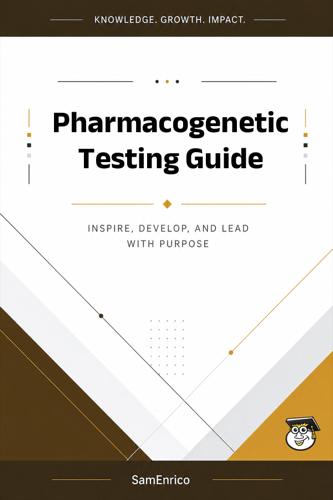
Pharmacogenetic Testing Guide eBook
Shows how DNA influences medication metabolism and
Shows how DNA influences medication metabolism and side effect risk.
Formats
Free sample
Chapter 1: The Universal Adapter--Two middle-aged women, identical in height, weight, and medical history, walked into the same hospital on the same winter morning. Each had the same infection—a routine urinary tract infection caused by E. coli. Each received the same prescription: a standard course of the antibiotic trimethoprim-sulfamethoxazole, commonly known as Bactrim or Septra. Each took the medication exactly as directed.One woman recovered completely within five days.
She returned to work, resumed her daily walks, and never thought about the infection again.The other woman was rushed to the emergency room three days later.Her symptoms had started subtly: fatigue, mild nausea, a strange metallic taste in her mouth. By day two, her urine had darkened to the color of cola. By day three, she was confused, her skin had taken on a yellowish tinge, and her kidneys had stopped producing urine altogether. In the emergency department, her blood work revealed catastrophic kidney failure. She required dialysis.
She spent two weeks in the hospital. She survived, but her kidney function never fully returned to baseline.Two women. One infection. One drug. Two radically different outcomes.The first woman’s doctor called it a "good response." The second woman’s doctor called it an "idiosyncratic reaction"—medical shorthand for we don't really know why this happened.
But the truth is, we do know why. The answer was not in the drug and not in the infection. It was in their DNA.The Hidden Variable No One Talks About Every time you swallow a pill, receive an injection, or apply a cream, your body engages in a complex biochemical negotiation with that medication. The drug enters your bloodstream, travels to your liver, gets broken down by enzymes, is transported to target tissues, binds to receptors, and eventually is eliminated through your kidneys or bile. This process—absorption, distribution, metabolism, and excretion—is not the same in any two human beings.Your doctor prescribes a "standard dose" because clinical trials establish an average dose that works for most people.
But averages hide enormous variation. A dose that saves one patient's life can kill another. A dose that relieves pain for eight hours in one person might wear off in two hours in someone else—or linger for twenty-four hours, causing dangerous side effects.This variation is not random. It is not bad luck. And it is certainly not your fault.It is genetics.The field of pharmacogenetics (often shortened to PGx) is the study of how your DNA influences your response to medications.
It is not about predicting whether you will develop a disease—that is a different branch of genetics. PGx is about predicting, with remarkable accuracy, how your body will handle a specific drug before you ever take it.And yet, despite being one of the most promising advances in modern medicine, pharmacogenetic testing remains dramatically underutilized. Fewer than ten percent of patients who could benefit from PGx guidance actually receive it. Most doctors receive minimal training in genetics during medical school. Most patients have never heard of PGx.
And most prescriptions are still written using the same "trial and error" method that has governed medicine for centuries.This book exists to change that.The Fourth-Leading Cause of Death You Have Never Heard Of Let us start with a number that should shock you: over 1.2 million hospital admissions annually in the United States are caused by adverse drug reactions.That is more than the number of people hospitalized for heart attacks. More than strokes. More than pneumonia.And here is the number that should truly alarm you: adverse drug reactions are the fourth-leading cause of death in the United States, responsible for an estimated 100,000 to 200,000 deaths each year. Only heart disease, cancer, and stroke kill more Americans.When most people hear "adverse drug reaction," they imagine a dramatic allergic reaction—hives, throat swelling, anaphylaxis. Those events are terrifying, but they are rare.
The vast majority of adverse drug reactions are not allergic at all. They are predictable, dose-dependent, and entirely genetic in origin.Consider these examples:A patient with a common genetic variant in the CYP2C9 gene receives a standard starting dose of the blood thinner warfarin. Their body cannot clear the drug normally. The drug accumulates. Within days, they suffer a life-threatening brain hemorrhage.A patient with a variant in the SLCO1B1 gene starts a statin medication for high cholesterol.
Instead of the drug being transported to the liver where it belongs, it accumulates in their muscle tissue. They develop severe muscle pain, weakness, and fatigue—symptoms so debilitating that they stop taking the medication, increasing their long-term risk of heart attack.A breastfeeding mother with an ultrarapid CYP2D6 genotype takes codeine for post-labor pain. Her body converts the codeine to morphine so quickly and completely that dangerous levels pass into her breast milk. Her infant stops breathing.These are not freak accidents. These are predictable tragedies.
And they are preventable.The standard medical approach—"try this drug, see what happens, adjust if needed"—works reasonably well for the population as a whole. But individuals are not populations. For the person who suffers a severe reaction or gets no benefit, the standard approach is a failure.Pharmacogenetic testing transforms this paradigm. Instead of guessing, you can know. Instead of waiting for harm to occur, you can prevent it.The Universal Adapter: An Analogy for Your DNAImagine you are traveling internationally.
You arrive at your hotel, pull out your phone charger, and look for an outlet. The outlet is there, but your charger does not fit. The prongs are the wrong shape. The voltage is wrong. Your phone remains dead.Now imagine that every hotel room in the world had a universal power adapter built into the wall—a single outlet that could accept any plug from any country, automatically adjust the voltage, and safely charge any device.
Your phone would work perfectly every time, regardless of where you traveled.Your DNA is not that universal adapter.In fact, your DNA is the opposite. Your body's drug-processing machinery is a collection of highly specific adapters, each designed to work with certain types of medications. Some of those adapters work perfectly. Some work partially. Some are broken.
And some work so aggressively that they destroy the drug before it can do any good.This is the central reality of pharmacogenetics: one drug, one dose, one person does not equal one drug, one dose, every person.Let us break down what can go wrong—or right—using the universal adapter analogy.Scenario A: The Broken Adapter (Poor Metabolizer)Imagine your adapter is cracked. You plug in your device, but the connection is faulty. Power flows in, but it cannot flow out properly. The device overheats. This is the Poor Metabolizer.
Your liver enzymes work too slowly. Medications linger in your system longer than intended, reaching higher concentrations than intended. A standard dose becomes a toxic dose.Scenario B: The Supercharged Adapter (Ultrarapid Metabolizer)Imagine your adapter has been modified to deliver maximum power instantly. You plug in your device, and within seconds, it is fully charged—but then the voltage spikes and the device burns out. This is the Ultrarapid Metabolizer.…
This is the end of the free sample. Get the eBook to keep going. Buy now
About this book
Details
- Author
- Lessard Michell
- Publisher
- SamEnrico
- Language
- English
- Genre
- Non-Fiction, Health & Wellness, Pharmacology
- Released
- 2026-06-10
- Pages (approx.)
- 153
- Available as
- eBook, Audiobook

Read better in the ZLOADR app
Your eBooks on your phone or tablet. Sign in with your SamEnrico account and start reading.
More by Lessard Michell
 Rejection Sensitivity Childhood GuideLessard Michell$11.99
 Business Plan Risk Assessment HandbookLessard Michell$11.99
 Low Carb Intermittent Fasting GuideLessard Michell$11.99
 Yahoo Data Center SecurityLessard Michell$11.99
 The Silent Codebreakers: Bletchley Park's Unsung HeroesLessard Michell$11.99
 Whispers in the Marid's Lair: The Djinn of the Abandoned BazaarLessard Michell$11.99
 How to Start a Primer for Cartridge Business (Beginners Guide)Lessard Michell$11.99
 Richard Branson Cash Flexibility WorkbookLessard Michell$12.99
 Travel Spending by GenderLessard Michell$12.99
 Fifth Avenue Club AssistantLessard Michell$11.99
 Understanding Gerodermia OsteodysplasticaLessard Michell$17.99
You may also like
 Hong Kong Handover 1997Dunn Johnnie$11.99
 Zumba For Postnatal Recovery CourseNeal Christian$11.99
 Zumba for BeginnersLadner Nikia$11.99
 YouTube Comment Mining GuideHumes Pandora$12.99
 Worry Box MeditationCarlin Rudy$11.99
 Workplace Stress MeditationNguyen Lynn$11.99
 Workplace Stress and Sleep RepairHawley Ivory$11.99
 Workplace Perfectionism CureDelaney Jeffry$11.99
 Workplace Injustice Anger GuideWallen Isabelle$11.99
 Work Addiction and Burnout LinkGreenwood Ester$11.99
 Women in Yoga and WellnessBeattie Galina$11.99
 Women in Stand Up ComedyChun Evangeline$11.99