
Non-FictionSelf-HelpRejection Sensitivity
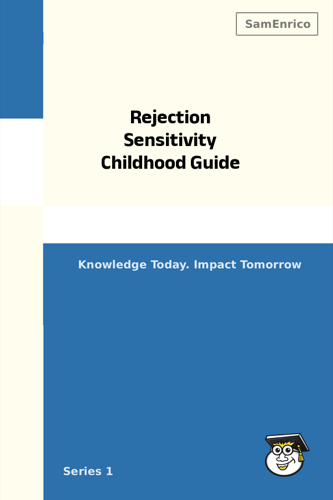
Rejection Sensitivity Childhood Guide
Lower overreaction to perceived rejection rooted i
Lower overreaction to perceived rejection rooted in early criticism.
Formats
About this book
Free sample
Chapter 1: The Smoldering Smoke Detector--The first time you saw it, you probably called it drama. The second time, maybe manipulation. By the tenth time—the meltdown over a birthday party invitation that hadn't even been sent yet, the rage spiral because a friend took three hours to reply to a text, the silent treatment that lasted all evening because you sighed while loading the dishwasher—you might have started using words like "too sensitive" or "overreacting" or even "broken."You are not a bad parent for thinking those things. You are a tired parent. And you have been operating without the one piece of information that makes all of this make sense.Here it is: your child is not choosing to overreact.
Their brain is misfiring.Not sometimes. Not when they're tired or hungry or already upset. Systematically, predictably, and involuntarily, their brain is processing neutral events—a friend not waving back, a teacher's flat tone, a sibling's offhand comment—as if they were physical threats. The same neural pathways that would fire if they touched a hot stove are lighting up because someone walked past them in the hallway without saying hello.This chapter is not about fixing your child. It is about understanding the machinery beneath the behavior.
Because once you see the false alarm for what it is—a protective system doing its best with broken information—your entire approach shifts. You stop asking "Why are you doing this to me?" and start asking "What is your brain telling you right now?" That question changes everything.The Architecture of Social Pain Let us start with a radical proposition: social pain is real pain.For decades, researchers assumed that emotional distress was metaphorically painful—that we said "hurt feelings" as a figure of speech. Then neuroscience caught up. In 2003, psychologists Naomi Eisenberger and Matthew Lieberman conducted a landmark study that would reshape our understanding of rejection. They asked participants to play a virtual ball-tossing game while inside an f MRI scanner.
The game was rigged. After a few throws, the other "players" (actually a computer program) stopped including the participant. They…
This is the end of the free sample. Get the eBook to keep going. Buy now
Contents
- Chapter 1
- Chapter 2
- Chapter 3
- Chapter 4
- Chapter 5
- Chapter 6
- Chapter 7
- Chapter 8
- Chapter 9
- Chapter 10
- Chapter 11
- Chapter 12
Details
- Author
- Lessard Michell
- Publisher
- SamEnrico
- Language
- English
- Genre
- Non-Fiction, Self-Help, Rejection Sensitivity
- Released
- 2026-06-10
- Pages (approx.)
- 121
- Available as
- eBook, Audiobook

Read better in the ZLOADR app
Your eBooks on your phone or tablet. Sign in with your SamEnrico account and start reading.
More by Lessard Michell
 Pharmacogenetic Testing GuideLessard Michell$11.99
 Business Plan Risk Assessment HandbookLessard Michell$11.99
 Low Carb Intermittent Fasting GuideLessard Michell$11.99
 Yahoo Data Center SecurityLessard Michell$11.99
 The Silent Codebreakers: Bletchley Park's Unsung HeroesLessard Michell$11.99
 Whispers in the Marid's Lair: The Djinn of the Abandoned BazaarLessard Michell$11.99
 How to Start a Primer for Cartridge Business (Beginners Guide)Lessard Michell$11.99
 Richard Branson Cash Flexibility WorkbookLessard Michell$12.99
 Travel Spending by GenderLessard Michell$12.99
 Fifth Avenue Club AssistantLessard Michell$11.99
 Understanding Gerodermia OsteodysplasticaLessard Michell$17.99
You may also like
 Hong Kong Handover 1997Dunn Johnnie$11.99
 Zumba For Postnatal Recovery CourseNeal Christian$11.99
 Zumba for BeginnersLadner Nikia$11.99
 YouTube Comment Mining GuideHumes Pandora$12.99
 Worry Box MeditationCarlin Rudy$11.99
 Workplace Stress MeditationNguyen Lynn$11.99
 Workplace Stress and Sleep RepairHawley Ivory$11.99
 Workplace Perfectionism CureDelaney Jeffry$11.99
 Workplace Injustice Anger GuideWallen Isabelle$11.99
 Work Addiction and Burnout LinkGreenwood Ester$11.99
 Women in Yoga and WellnessBeattie Galina$11.99
 Women in Stand Up ComedyChun Evangeline$11.99