
Non-FictionSelf-HelpNegotiation
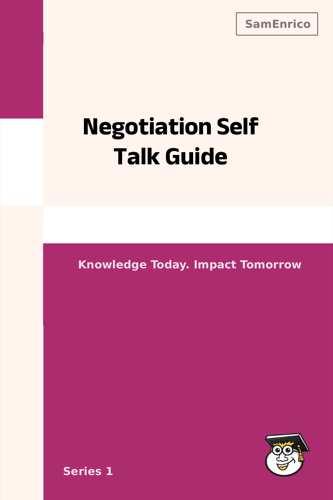
Negotiation Self Talk Guide eBook
Strengthen your bargaining position with empowerin
Strengthen your bargaining position with empowering inner dialogue using this workbook.
Formats
Free sample
Chapter 1: The Autopsy of Silence--–- You already know how to negotiate. That is the first and most important thing to understand about this book. You have read the articles, listened to the podcasts, scrolled through the Linked In posts about BATNA and anchoring and framing. You know you should state your needs clearly. You know you should not apologize.
You know you should walk away when the deal is bad. You know all of this. And yet, when you sit across from the other person—your boss, your partner, the car salesman, your mother-in-law—your mind goes blank. Your mouth opens. And something else comes out.Something smaller.Something softer.Something that sounds like you, but is not the you who prepared in the mirror this morning.This chapter is called The Autopsy of Silence because we are going to do something most negotiation books avoid: we are going to look directly at what you did not say.
We are going to examine the gap between the person you know you could be in a negotiation and the person you actually become. That gap is not a lack of skill. It is not a lack of knowledge. It is a lack of internal permission—and that lack is enforced by a voice inside your head that sounds like you but is not you.I call that voice The Committee.The Committee is not your enemy in the way a monster is an enemy. The Committee is trying to protect you.
It developed over decades of childhood warnings, embarrassing moments, rejections, and social conditioning. Every time you raised your hand in class and the other kids laughed, The Committee took notes. Every time you asked for something and got a no, The Committee filed a report. Every time your parents said "don't be so demanding" or your boss said "that's not how we do things here" or your friend sighed when you stated a preference, The Committee added another rule to its playbook.The Committee's motto is simple: silence is safe. Asking is dangerous.
Wanting is greedy.And for most of human history, The Committee was right. In a tribal village, being seen as difficult could get you exiled. In a hierarchical family, speaking up could get you punished. In a workplace where one person holds all the power, asking for more could cost you everything. The Committee is not stupid.
It is just out of date. It is running software designed for a world that no longer exists—or at least, a world that does not apply to most of the negotiations you face today.But The Committee does not know that. So it keeps sending you the same messages: Don't ask. Don't push. Don't risk it.
Take what they give you and be grateful.And you listen. Not because you are weak, but because you are human.This chapter is the first step toward firing The Committee—or at least, toward demoting it from CEO to middle management. You will not eliminate The Committee. That is impossible and, frankly, not desirable. The Committee has useful things to say sometimes.
But you will learn to recognize its voice, to question its authority, and to negotiate anyway.We begin with an autopsy.The Pre-Negotiation Autopsy: Examining the Corpse of What You Did Not Say An autopsy is an examination of a body after death to determine what went wrong. In this chapter, we are going to perform an autopsy on a recent negotiation that went poorly—not because the other person was unreasonable or the circumstances were unfair, but because you did not say what you wanted to say.Take out a piece of paper. Yes, right now. Not later. Not mentally.
Physical paper. If you are reading an ebook, open a notes app. If you are listening to the audiobook, pause and grab something to write with. This book is a workbook, and workbooks require writing.Now, think of a specific conversation in the last six months where you wanted something and did not get it—or got less than you wanted. It could be a salary negotiation, a request for help from a partner, a conversation with a contractor about a bill, a discussion with a friend about boundaries, or even a simple ask like "can you move your car so I can get out of the driveway."Write down two columns.In the left column, write: What I wanted to say.In the right column, write: What I actually said.Be honest.
No one is going to see this but you.Here is what one of my clients, a software engineer named Priya, wrote after her annual review:What I wanted to say What I actually said"I have delivered three major projects ahead of schedule this year. I am asking for a 20% raise and a promotion to senior engineer.""I know the budget is tight this year, and I appreciate everything the team does, but I was wondering if maybe there was room for a small adjustment?"Priya is not weak. Priya is a brilliant engineer who leads a team of six and has saved her company over two million dollars. But when she sat across from her manager, The Committee took over. The Committee said: Don't brag.
Don't seem greedy. Don't threaten their budget. Be grateful you have a job.Priya's gap between what she wanted to say and what she actually said was a canyon. Your gap might be smaller, or it might be larger. But it is there.
That gap is your Broken Script.The Broken Script is the difference between your internal knowledge and your external performance. It is the space where your competence goes to die. And the wider that gap, the more money you leave on the table, the more respect you lose, the more resentment you build, and the more you reinforce The Committee's central lie: that you cannot ask for what you want.Now, look at the right column of your paper. Read what you actually said out loud. Listen to the words.
How many of them are apologies? How many are justifications? How many are hedges—"maybe," "sort of," "kind of," "I was thinking," "if it's not too much trouble"? How many are questions framed as statements? How many are statements framed as apologies?This is the language of someone who has already lost before the other person has said a word.The Three Faces of The Committee: Identifying Your Sabotage Profile The Committee does not speak with one voice.
It has different members who take the lead depending on the situation. Over the next few chapters, we will meet all four of them, but in this chapter we focus on the three most common sabotage patterns that emerge from The Committee's work. I call these the Three Faces.Take the following quiz. For each statement, answer on a scale of 1 to 5: 1 = never, 3 = sometimes, 5 = always.Face One: The Apologizer I start sentences with "Sorry, but…" even when I have done nothing wrong.I say "I hate to ask" before asking for something reasonable.I use phrases like "if it's not too much trouble"…
This is the end of the free sample. Get the eBook to keep going. Buy now
About this book
Details
- Author
- Nicholson Katlyn
- Publisher
- SamEnrico
- Language
- English
- Genre
- Non-Fiction, Self-Help, Negotiation
- Released
- 2026-06-09
- Pages (approx.)
- 141
- Available as
- eBook, Audiobook

Read better in the ZLOADR app
Your eBooks on your phone or tablet. Sign in with your SamEnrico account and start reading.
More by Nicholson Katlyn
 TM Breathing Myths Clarified WorkbookNicholson Katlyn$11.99
 Equifax's Consumer Restitution FundNicholson Katlyn$11.99
 DNA Vaccine Technology GuideNicholson Katlyn$11.99
 The Self Esteem and Partner Criticism GuideNicholson Katlyn$11.99
 The Celestial Navigators of Aksum: Africa’s Starlight EmpireNicholson Katlyn$11.99
 The Unshakeable CoreNicholson Katlyn$11.99
 How to Start a Museums of Jewellery Business (Beginners Guide)Nicholson Katlyn$11.99
 Unilever SWOT Analysis GuideNicholson Katlyn$12.99
 AI Financial Data VersioningNicholson Katlyn$12.99
 Understanding Myalgia Eosinophilia Associated With TryptophanNicholson Katlyn$17.99
You may also like
 Hong Kong Handover 1997Dunn Johnnie$11.99
 Zumba For Postnatal Recovery CourseNeal Christian$11.99
 Zumba for BeginnersLadner Nikia$11.99
 YouTube Comment Mining GuideHumes Pandora$12.99
 Worry Box MeditationCarlin Rudy$11.99
 Workplace Stress MeditationNguyen Lynn$11.99
 Workplace Stress and Sleep RepairHawley Ivory$11.99
 Workplace Perfectionism CureDelaney Jeffry$11.99
 Workplace Injustice Anger GuideWallen Isabelle$11.99
 Work Addiction and Burnout LinkGreenwood Ester$11.99
 Women in Yoga and WellnessBeattie Galina$11.99
 Women in Stand Up ComedyChun Evangeline$11.99