
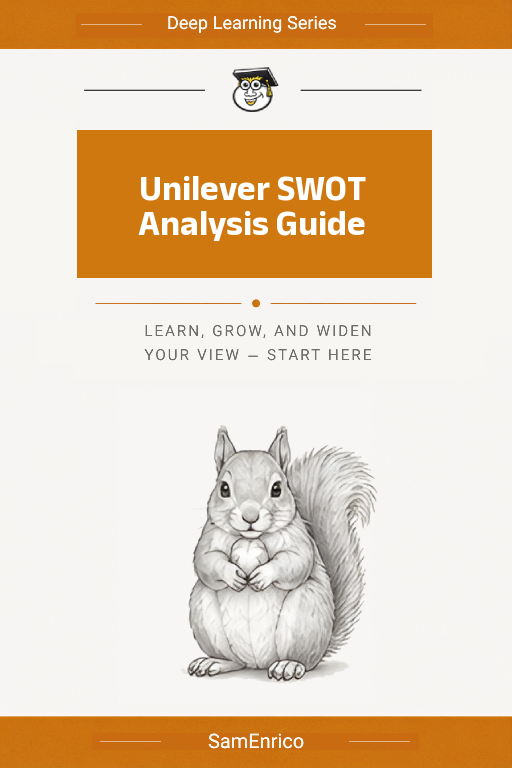
Unilever SWOT Analysis Guide
Assess sustainability focus, brand strength, emerg
Assess sustainability focus, brand strength, emerging market exposure, and input cost inflation pressures.
Formats
About this book
Free sample
Chapter 1: The Frozen Paradox--–- On a sweltering July afternoon in 2022, a group of Unilever executives gathered in a windowless London boardroom to confront an uncomfortable truth. The ice cream sitting in thousands of supermarket freezers across the globe—Ben & Jerry's Cherry Garcia, Magnum Classic, Wall's Cornetto—was slowly eating the company alive. Not because consumers had stopped craving cold, sweet treats. On the contrary, demand was robust. The problem was more insidious: every pint of ice cream sold required a capital-intensive cold chain of freezers, refrigerated trucks, and temperature-controlled warehouses that consumed cash flow at nearly twice the rate of a bottle of Dove shampoo.
The frozen goods division generated 11 percent operating margins while the Beauty and Personal Care units consistently delivered over 20 percent. Yet for decades, Unilever had treated these vastly different businesses as equals under one corporate roof.That July meeting would eventually lead to a historic decision: the spinoff of Unilever's entire Ice Cream division, a move that would separate Ben & Jerry's, Magnum, Wall's, and Talenti into a standalone company. But the deeper story behind that decision reveals something far more important than a single divestiture. It exposes the central tension that has defined Unilever for nearly a century—a tension between the gravitational pull of diversification and the relentless logic of focus. This chapter tells the story of how a company born from a soap-and-margarine merger became one of the most complex consumer goods organizations on the planet, and why that complexity eventually demanded a radical simplification.The 1930 Merger That Built an Empire The origins of Unilever read less like a corporate strategy document and more like a Victorian-era adventure novel.
In the 1880s, two separate entrepreneurs were building what would become rival empires. William Hesketh Lever, a British soap maker, had discovered that using vegetable oils instead of animal fats could produce a superior, longer-lasting soap. His company, Lever Brothers, grew rapidly by supplying Sunlight Soap to industrializing British cities. Meanwhile, in the Netherlands, the Margarine Unie conglomerate had consolidated the country's fragmented margarine industry, recognizing that butter substitutes would become essential as Europe's…
This is the end of the free sample. Get the eBook to keep going. Buy now
Contents
- Chapter 1
- Chapter 2
- Chapter 3
- Chapter 4
- Chapter 5
- Chapter 6
- Chapter 7
- Chapter 8
- Chapter 9
- Chapter 10
- Chapter 11
- Chapter 12
Details
- Author
- Nicholson Katlyn
- Publisher
- SamEnrico
- Language
- English
- Genre
- Non-Fiction, Strategic Atlas, CPG
- Released
- 2026-06-01
- Pages (approx.)
- 146
- Available as
- eBook, Audiobook

Read better in the ZLOADR app
Your eBooks on your phone or tablet. Sign in with your SamEnrico account and start reading.
More by Nicholson Katlyn
 TM Breathing Myths Clarified WorkbookNicholson Katlyn$11.99
 Equifax's Consumer Restitution FundNicholson Katlyn$11.99
 DNA Vaccine Technology GuideNicholson Katlyn$11.99
 Negotiation Self Talk GuideNicholson Katlyn$11.99
 The Self Esteem and Partner Criticism GuideNicholson Katlyn$11.99
 The Celestial Navigators of Aksum: Africa’s Starlight EmpireNicholson Katlyn$11.99
 The Unshakeable CoreNicholson Katlyn$11.99
 How to Start a Museums of Jewellery Business (Beginners Guide)Nicholson Katlyn$11.99
 AI Financial Data VersioningNicholson Katlyn$12.99
 Understanding Myalgia Eosinophilia Associated With TryptophanNicholson Katlyn$17.99
You may also like
 Hong Kong Handover 1997Dunn Johnnie$11.99
 Zumba For Postnatal Recovery CourseNeal Christian$11.99
 Zumba for BeginnersLadner Nikia$11.99
 YouTube Comment Mining GuideHumes Pandora$12.99
 Worry Box MeditationCarlin Rudy$11.99
 Workplace Stress MeditationNguyen Lynn$11.99
 Workplace Stress and Sleep RepairHawley Ivory$11.99
 Workplace Perfectionism CureDelaney Jeffry$11.99
 Workplace Injustice Anger GuideWallen Isabelle$11.99
 Work Addiction and Burnout LinkGreenwood Ester$11.99
 Women in Yoga and WellnessBeattie Galina$11.99
 Women in Stand Up ComedyChun Evangeline$11.99