
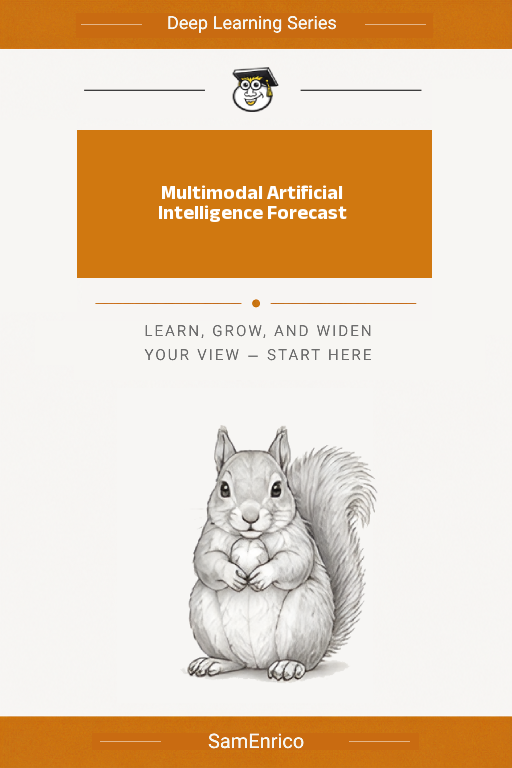
Non-FictionForecast & OutlookMultimodal AI
Multimodal Artificial Intelligence Forecast Audiobook
Project integration of vision, audio, text, and se
by Weeks Teena
Project integration of vision, audio, text, and sensor data into unified models, enabling robotics, accessibility, and content creation breakthroughs.
Formats
Free sample
Chapter 1: The Blind Oracle...--The most dangerous AI in the world today is not the one that fails spectacularly. It is the one that succeeds confidently while missing half of reality.Consider this scenario, drawn from an actual incident at a major tech company’s autonomous vehicle testing facility in 2024. A self-driving car approached a rural intersection at dusk. The car’s primary vision system—a state-of-the-art convolutional neural network trained on fifty million labeled images—detected nothing in its path. The road was clear.
The car proceeded. It struck a stopped school bus.The bus was painted with a massive photographic mural of a forest scene. The car’s vision system, optimized to detect vehicles as bounded boxes with specific features (wheels, windows, rectangular silhouette), saw trees. Because trees, unlike school buses, do not have wheels. The system was not stupid.
It was not broken. It was, in the most literal sense, blind to the context it could not represent.This is the hidden crisis of artificial intelligence in the 2020s. We have built extraordinary single-modality systems—LLMs that pass bar exams, vision models that detect cancer in X-rays, audio systems that transcribe conversations with human-level accuracy. But when these systems operate in the physical world, where vision must coordinate with sound, where text must correspond to sensor readings, where a school bus can look like a forest, they fail not because they are weak but because they are incomplete.The blind oracle knows everything about its narrow domain and nothing about everything else. And that is precisely what makes it so dangerous.The Fallacy of Purity For the past decade, the dominant paradigm in artificial intelligence has been what we might call modality purity.
Researchers and engineers built specialized models for specific input types: BERT for text, Res Net for images, Whisper for audio, Point Net for Li DAR. Each model became extraordinarily good at its single task. The implicit assumption was that integration—combining these specialized systems—could be handled as an afterthought, a simple matter of concatenating outputs or training a small fusion layer on top.This assumption has proven catastrophically wrong.The reason is not technical complexity, though that is considerable. The reason is philosophical. When you train a vision model in isolation, you are implicitly training it to explain the world through vision alone.
It learns that if an object looks like a tree, it is a tree. It has no mechanism—no internal representation—for…
This is the end of the free sample. Get the Audiobook to keep going. Buy now
About this book
Details
- Author
- Weeks Teena
- Publisher
- SamEnrico
- Language
- English
- Genre
- Non-Fiction, Forecast & Outlook, Multimodal AI
- Released
- 2026-06-01
- Pages (approx.)
- 143
- Available as
- eBook, Audiobook

Listen in the VoxFlicks app
Audiobooks and audio dramas wherever you go. Sign in with your SamEnrico account and press play.
More by Weeks Teena
 Shah Modernization VictimWeeks Teena$11.99
 The Sensory Overload InductionWeeks Teena$11.99
 GAD Phobia Overlap GuideWeeks Teena$11.99
 Freemium vs Premium MapWeeks Teena$11.99
 Eisenhower Matrix for Goal SettingWeeks Teena$11.99
 Gilgamesh and the Knight Errant: A Quest for ImmortalityWeeks Teena$11.99
 The Last Pharaoh's Curse: The Secret War of Cleopatra's Lost FleetWeeks Teena$11.99
 Understanding Hajdu–cheney SyndromeWeeks Teena$17.99
 VIP HostWeeks Teena$11.99
 How to Become a Clamp RemoverWeeks Teena$11.99
 African Scholars Abroad WorkbookWeeks Teena$12.99
You may also like
 Hong Kong Handover 1997Dunn Johnnie$11.99
 Zumba For Postnatal Recovery CourseNeal Christian$11.99
 Zumba for BeginnersLadner Nikia$11.99
 YouTube Comment Mining GuideHumes Pandora$12.99
 Worry Box MeditationCarlin Rudy$11.99
 Workplace Stress MeditationNguyen Lynn$11.99
 Workplace Stress and Sleep RepairHawley Ivory$11.99
 Workplace Perfectionism CureDelaney Jeffry$11.99
 Workplace Injustice Anger GuideWallen Isabelle$11.99
 Work Addiction and Burnout LinkGreenwood Ester$11.99
 Women in Yoga and WellnessBeattie Galina$11.99
 Women in Stand Up ComedyChun Evangeline$11.99