
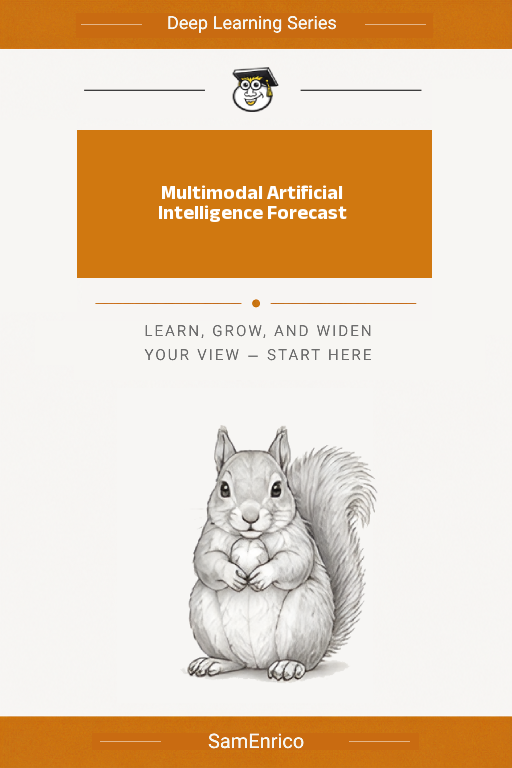
Non-FictionForecast & OutlookMultimodal AI
Multimodal Artificial Intelligence Forecast eBook
Project integration of vision, audio, text, and se
by Weeks Teena
Project integration of vision, audio, text, and sensor data into unified models, enabling robotics, accessibility, and content creation breakthroughs.
Formats
Free sample
Chapter 1: The Blind Oracle...--The most dangerous AI in the world today is not the one that fails spectacularly. It is the one that succeeds confidently while missing half of reality.Consider this scenario, drawn from an actual incident at a major tech company’s autonomous vehicle testing facility in 2024. A self-driving car approached a rural intersection at dusk. The car’s primary vision system—a state-of-the-art convolutional neural network trained on fifty million labeled images—detected nothing in its path. The road was clear.
The car proceeded. It struck a stopped school bus.The bus was painted with a massive photographic mural of a forest scene. The car’s vision system, optimized to detect vehicles as bounded boxes with specific features (wheels, windows, rectangular silhouette), saw trees. Because trees, unlike school buses, do not have wheels. The system was not stupid.
It was not broken. It was, in the most literal sense, blind to the context it could not represent.This is the hidden crisis of artificial intelligence in the 2020s. We have built extraordinary single-modality systems—LLMs that pass bar exams, vision models that detect cancer in X-rays, audio systems that transcribe conversations with human-level accuracy. But when these systems operate in the physical world, where vision must coordinate with sound, where text must correspond to sensor readings, where a school bus can look like a forest, they fail not because they are weak but because they are incomplete.The blind oracle knows everything about its narrow domain and nothing about everything else. And that is precisely what makes it so dangerous.The Fallacy of Purity For the past decade, the dominant paradigm in artificial intelligence has been what we might call modality purity.
Researchers and engineers built specialized models for specific input types: BERT for text, Res Net for images, Whisper for audio, Point Net for Li DAR. Each model became extraordinarily good at its single task. The implicit assumption was that integration—combining these specialized systems—could be handled as an afterthought, a simple matter of concatenating outputs or training a small fusion layer on top.This assumption has proven catastrophically wrong.The reason is not technical complexity, though that is considerable. The reason is philosophical. When you train a vision model in isolation, you are implicitly training it to explain the world through vision alone.
It learns that if an object looks like a tree, it is a tree. It has no mechanism—no internal representation—for the concept that “this tree-looking object has wheels and is therefore a vehicle.” That inference requires cross-modal reasoning: visual features plus prior knowledge about vehicle shapes plus perhaps audio of a diesel engine or text from a road sign.A pure vision model does not know that it lacks audio. It does not know that it lacks text. It simply reports its best guess given the only information it has ever received. That guess can be wrong with absolute confidence.The school bus incident is not an outlier.
In 2023, a warehouse robot equipped with visual object detection repeatedly failed to grasp transparent plastic containers because its vision system—trained on opaque objects—could not reliably detect the edges of clear material. The robot had no tactile sensors. It had no audio feedback to hear the difference between a successful grasp and a slip. It simply reached into empty space with the same certainty as if the container were there.In 2025, a voice-controlled smart home system interpreted a television advertisement saying “Alexa, order paper towels” as a genuine command. The system had no visual context—no camera to see that the user was not speaking, no lip-reading to detect that the audio came from a speaker rather than a human mouth.
It ordered forty rolls of paper towels to a household that did not want them.These failures share a common structure. A system operating on a single modality makes a perfectly reasonable inference given its limited information. That inference is catastrophically wrong in the full multi-modal context. The system is not corrected because it never receives feedback from the modalities it lacks.The Five Languages of Reality To understand why integration is not optional, we must first understand the fundamental heterogeneity of real-world data. The physical universe speaks five distinct languages, each with its own grammar, syntax, and temporal rhythm.Text is discrete, symbolic, and high-level.
A single word like “run” can encode a complex action that would require hundreds of video frames to depict. Text has no inherent temporal rhythm—you can read a sentence in one second or ten—but it carries immense semantic density. When a text model processes “the red car stopped at the sign,” it builds a symbolic representation that a vision model would need dozens of operations to extract.Vision is dense, continuous, and spatially structured. A single 4K video frame contains over eight million pixels, each with three color channels. That is twenty-four million values to represent a single moment.
Vision encodes information that text cannot: exact geometry, lighting conditions, the subtle texture of a surface. But vision is also ambiguous. A shadow can look like an object. A reflection can look like a duplicate world. Motion blur can erase fine detail.Audio is temporal and frequency-based.
A two-second sound clip contains roughly 96,000 samples (at 48 k Hz). Unlike vision, which processes entire frames in parallel, audio is inherently sequential—the meaning of a sound depends on what came before and after. A dog bark is meaningless without knowing whether it followed a footstep (intruder alert) or a doorbell (greeting). Audio also carries spatial information that vision cannot match: you can hear a siren approaching from behind, even when you cannot see it.IMU (Inertial Measurement Unit) data is physical and embodied. Accelerometers measure g-forces; gyroscopes measure rotation; magnetometers measure heading.
These sensors operate at 100-1000 Hz, capturing the body’s movement through space. IMU data tells you that the robot is falling, that the drone is tilting, that the phone is being raised to ear level. Vision can infer some of this from scene motion, but IMU provides direct measurement of the observer’s own state—something no external camera can capture.Li DAR (Light Detection and Ranging) data is geometric and precise. Each laser pulse returns a point in 3D space—x, y, z coordinates, plus intensity. A 64-channel Li DAR generates over a million points per second.
This sparse point cloud encodes depth with millimeter precision, something vision struggles to achieve without stereo cameras or structure from motion. But Li DAR fails on reflective surfaces (glass, polished metal) and provides no color or texture information.Each language has its own failure modes. Text models cannot see. Vision models cannot hear. Audio models cannot touch.
Li DAR cannot read signs. IMU cannot recognize objects. This is not a flaw in the individual models. It is a fundamental property of the sensors and representations themselves.The Alignment Problem If the five languages are different, how do we make them speak to one another? This is the alignment problem, and it has two distinct sub-problems that most engineers discover only after their fusion model has failed in production.The first is temporal alignment.…
This is the end of the free sample. Get the eBook to keep going. Buy now
About this book
Details
- Author
- Weeks Teena
- Publisher
- SamEnrico
- Language
- English
- Genre
- Non-Fiction, Forecast & Outlook, Multimodal AI
- Released
- 2026-06-01
- Pages (approx.)
- 143
- Available as
- eBook, Audiobook

Read better in the ZLOADR app
Your eBooks on your phone or tablet. Sign in with your SamEnrico account and start reading.
More by Weeks Teena
 Shah Modernization VictimWeeks Teena$11.99
 The Sensory Overload InductionWeeks Teena$11.99
 GAD Phobia Overlap GuideWeeks Teena$11.99
 Freemium vs Premium MapWeeks Teena$11.99
 Eisenhower Matrix for Goal SettingWeeks Teena$11.99
 Gilgamesh and the Knight Errant: A Quest for ImmortalityWeeks Teena$11.99
 The Last Pharaoh's Curse: The Secret War of Cleopatra's Lost FleetWeeks Teena$11.99
 Understanding Hajdu–cheney SyndromeWeeks Teena$17.99
 VIP HostWeeks Teena$11.99
 How to Become a Clamp RemoverWeeks Teena$11.99
 African Scholars Abroad WorkbookWeeks Teena$12.99
You may also like
 Hong Kong Handover 1997Dunn Johnnie$11.99
 Zumba For Postnatal Recovery CourseNeal Christian$11.99
 Zumba for BeginnersLadner Nikia$11.99
 YouTube Comment Mining GuideHumes Pandora$12.99
 Worry Box MeditationCarlin Rudy$11.99
 Workplace Stress MeditationNguyen Lynn$11.99
 Workplace Stress and Sleep RepairHawley Ivory$11.99
 Workplace Perfectionism CureDelaney Jeffry$11.99
 Workplace Injustice Anger GuideWallen Isabelle$11.99
 Work Addiction and Burnout LinkGreenwood Ester$11.99
 Women in Yoga and WellnessBeattie Galina$11.99
 Women in Stand Up ComedyChun Evangeline$11.99