
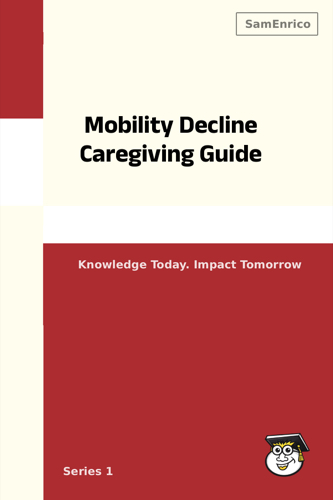
Mobility Decline Caregiving Guide
Wheelchairs, walkers, and home modifications for a
by Razo Tammera
Wheelchairs, walkers, and home modifications for a falling parent.
Formats
About this book
Free sample
Chapter 1: The Invisible Denial--–- Your mother takes three tries to stand up from the kitchen chair, gripping the table edge with white knuckles. When you suggest she try the walker the doctor recommended, she snaps, "I'm not an invalid." Your father shuffles through the living room, his right foot catching on the carpet edge for the third time this week. When you mention it, he says, "You're seeing things. I walked fine." You are not seeing things. You are witnessing the most dangerous and least understood phenomenon in mobility decline: the gap between what your parent can actually do and what their brain believes they can do.
This gap kills.The Fall That Didn't Have to Happen Margaret, 78, was a retired schoolteacher with early-stage Parkinson's disease. Her daughter, Lisa, had installed grab bars in the shower and removed the throw rugs. Margaret used her walker most of the time but refused to use it for the three steps from her bedroom to the bathroom at night. "It's just three steps," she said. "I've walked for 78 years.
I know how to walk." One night at 2:17 AM, Margaret's left foot caught on the door threshold. She reached for the wall but grasped only air. Her hip fractured on impact. She spent four days in the hospital, two weeks in rehab, and never returned to her own home. The three steps she refused to admit were dangerous ended her independence.This is not a story of bad luck or inevitable aging.
This is a story of what neurologists call anosognosia—a brain-based inability to perceive one's own functional decline. Margaret genuinely believed she could safely walk three steps. Her brain had edited out the evidence of her Parkinson's-related gait impairment. No amount of pleading from Lisa could override Margaret's neurological reality. And yet, the fall was preventable.
Not by more pleading, not by taking away her independence, but by understanding the hidden architecture of denial and replacing argument with strategy.The Two Faces of "I Don't Need Help"Every caregiver encounters resistance. But not all resistance is the same. Understanding the difference between two…
This is the end of the free sample. Get the eBook to keep going. Buy now
Contents
- Chapter 1
- Chapter 2
- Chapter 3
- Chapter 4
- Chapter 5
- Chapter 6
- Chapter 7
- Chapter 8
- Chapter 9
- Chapter 10
- Chapter 11
- Chapter 12
Details
- Author
- Razo Tammera
- Publisher
- SamEnrico
- Language
- English
- Genre
- Non-Fiction, Biography, Mobility
- Released
- 2026-06-10
- Pages (approx.)
- 121
- Available as
- eBook, Audiobook

Read better in the ZLOADR app
Your eBooks on your phone or tablet. Sign in with your SamEnrico account and start reading.
More by Razo Tammera
 Minenwerfer Trench TacticsRazo Tammera$11.99
 Food Addiction in Men Recovery GuideRazo Tammera$11.99
 The Anger and Breathing GuideRazo Tammera$11.99
 Child Body Image GuideRazo Tammera$11.99
 The Modern Adventurers Field GuideRazo Tammera$11.99
 The Farm Labor SurvivorRazo Tammera$11.99
 Interoceptive ExposureRazo Tammera$11.99
 The Silent Codebreaker: Alan Turing’s Forgotten WarRazo Tammera$11.99
 Whispers of the Marid: The Djinn Who Drowned the SunRazo Tammera$11.99
 How to Produce Tattooing NeedlesRazo Tammera$11.99
 How to Produce Hole PunchesRazo Tammera$11.99
 A Collector's Handbook to the Ford Corsair Gt 120gtRazo Tammera$11.99
You may also like
 Hong Kong Handover 1997Dunn Johnnie$11.99
 Zumba For Postnatal Recovery CourseNeal Christian$11.99
 Zumba for BeginnersLadner Nikia$11.99
 YouTube Comment Mining GuideHumes Pandora$12.99
 Worry Box MeditationCarlin Rudy$11.99
 Workplace Stress MeditationNguyen Lynn$11.99
 Workplace Stress and Sleep RepairHawley Ivory$11.99
 Workplace Perfectionism CureDelaney Jeffry$11.99
 Workplace Injustice Anger GuideWallen Isabelle$11.99
 Work Addiction and Burnout LinkGreenwood Ester$11.99
 Women in Yoga and WellnessBeattie Galina$11.99
 Women in Stand Up ComedyChun Evangeline$11.99