
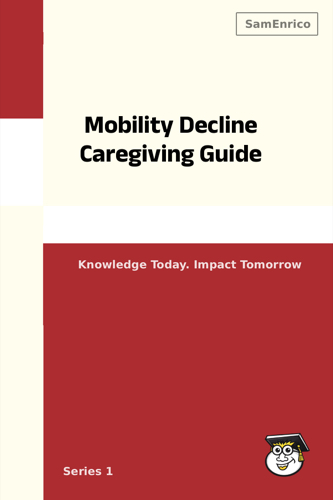
Mobility Decline Caregiving Guide eBook
Wheelchairs, walkers, and home modifications for a
by Razo Tammera
Wheelchairs, walkers, and home modifications for a falling parent.
Formats
Free sample
Chapter 1: The Invisible Denial--–- Your mother takes three tries to stand up from the kitchen chair, gripping the table edge with white knuckles. When you suggest she try the walker the doctor recommended, she snaps, "I'm not an invalid." Your father shuffles through the living room, his right foot catching on the carpet edge for the third time this week. When you mention it, he says, "You're seeing things. I walked fine." You are not seeing things. You are witnessing the most dangerous and least understood phenomenon in mobility decline: the gap between what your parent can actually do and what their brain believes they can do.
This gap kills.The Fall That Didn't Have to Happen Margaret, 78, was a retired schoolteacher with early-stage Parkinson's disease. Her daughter, Lisa, had installed grab bars in the shower and removed the throw rugs. Margaret used her walker most of the time but refused to use it for the three steps from her bedroom to the bathroom at night. "It's just three steps," she said. "I've walked for 78 years.
I know how to walk." One night at 2:17 AM, Margaret's left foot caught on the door threshold. She reached for the wall but grasped only air. Her hip fractured on impact. She spent four days in the hospital, two weeks in rehab, and never returned to her own home. The three steps she refused to admit were dangerous ended her independence.This is not a story of bad luck or inevitable aging.
This is a story of what neurologists call anosognosia—a brain-based inability to perceive one's own functional decline. Margaret genuinely believed she could safely walk three steps. Her brain had edited out the evidence of her Parkinson's-related gait impairment. No amount of pleading from Lisa could override Margaret's neurological reality. And yet, the fall was preventable.
Not by more pleading, not by taking away her independence, but by understanding the hidden architecture of denial and replacing argument with strategy.The Two Faces of "I Don't Need Help"Every caregiver encounters resistance. But not all resistance is the same. Understanding the difference between two distinct types of denial is the single most important factor in preventing the first fall.The first type is fear-based denial. Your parent knows, somewhere deep down, that they are struggling. But admitting it means acknowledging loss, dependency, and decline.
So they deflect, minimize, or get angry. This type of denial has a neurological basis in the brain's threat-detection system—the amygdala perceives the admission of vulnerability as a threat and triggers a defensive response. But crucially, fear-based denial can be reached with patience, demonstration, and gradual exposure. When you show your parent a video of themselves walking and ask, "Does that look steady to you?"—a parent with fear-based denial may pause, reconsider, and eventually accept help.The second type is anosognosia. This is not denial as a psychological defense.
It is a neurological deficit, most commonly caused by damage to the right hemisphere of the brain (stroke, traumatic brain injury) or degenerative conditions like Parkinson's disease, Lewy body dementia, and Alzheimer's disease. The brain's error-detection system—specifically the anterior cingulate cortex and the right parietal lobe—stops functioning correctly. Your parent cannot perceive their own impairment because the brain regions that compare "what I intend to do" with "what actually happens" have been damaged. They are not lying. They are not stubborn.
They are neurologically incapable of seeing the truth.How do you tell the difference? Ask your parent to watch a video of themselves walking. A person with fear-based denial may look away, make excuses, or get angry—but they will recognize the person in the video as themselves. A person with anosognosia may say, "That's not me" or "That's someone else" or simply show no emotional reaction. They can watch themselves fall on video and still insist they do not need a walker.
You cannot reason someone out of anosognosia because the reasoning parts of the brain are not the problem—the perception parts are.The Medical Causes of Mobility Decline Understanding why your parent is falling requires looking beyond the surface "they're getting old." Mobility decline has specific medical drivers, and each requires a different caregiving approach.Arthritis is the most common cause of mobility decline, affecting over 32 million adults in the United States alone. The problem is not just pain—it is the body's protective response to pain. When a joint hurts, the brain unconsciously alters gait patterns to minimize weight on that joint. This creates a limp, but more importantly, it creates unpredictability. A parent with knee arthritis may walk smoothly for five steps, hit a particular angle of flexion that triggers pain, and suddenly lurch.
That unpredictability is what causes falls. The solution is not just pain medication—it is learning to predict the unpredictable. Caregivers should observe which movements trigger pain (rising from a low chair, stepping onto a curb, turning while weight-bearing) and plan around those specific triggers.Parkinson's disease affects nearly one million Americans and is profoundly misunderstood by families. The hallmark of Parkinson's gait is not just slowness—it is freezing and retropulsion. Freezing is the sudden inability to start walking or to continue walking through a doorway or around an obstacle.
The feet feel glued to the floor. Retropulsion is a tendency to fall backward, often when standing up from a chair or when pulled forward by a caregiver. Here is the critical thing most families do not know: you cannot pull a person with Parkinson's out of a freeze. Pulling triggers retropulsion. The correct response is to provide a visual cue—a line of tape on the floor, a laser pointer, or a rhythmic counting "left, right, left, right"—that bypasses the frozen basal ganglia and restarts the gait cycle.Post-stroke weakness (hemiparesis) affects the side of the body opposite the brain injury.
The most dangerous hidden consequence is not weakness but neglect. Unilateral neglect means the brain stops attending to one side of the world. Your parent may not see you approaching from their affected side. They may leave food on the left side of the plate. They may bump their left foot on door frames because their brain has literally deleted that side of their body from awareness.
You cannot remind someone out of neglect. You must modify the environment so the neglected side is protected—clear pathways, furniture against the affected side, and a caregiver who always approaches from the unaffected side.The Home Fall Risk Score: Your First Tool Before you change a single thing in your home or buy any equipment, you need a baseline. The Home Fall Risk Score is a 10-question assessment designed for caregivers to use without any medical training. It takes less than 10 minutes and requires no special equipment—only honest observation.Rate each question as Yes (1 point) or No (0 points):Does your parent need to push off armrests or table edges to stand up from a chair?Do they shuffle their feet rather than lifting them with each step?Do they hold onto walls or furniture while walking?Have they had any falls (or near-falls) in the past three months?Do they have difficulty turning their head to look sideways…
This is the end of the free sample. Get the eBook to keep going. Buy now
About this book
Details
- Author
- Razo Tammera
- Publisher
- SamEnrico
- Language
- English
- Genre
- Non-Fiction, Biography, Mobility
- Released
- 2026-06-10
- Pages (approx.)
- 121
- Available as
- eBook, Audiobook

Read better in the ZLOADR app
Your eBooks on your phone or tablet. Sign in with your SamEnrico account and start reading.
More by Razo Tammera
 Minenwerfer Trench TacticsRazo Tammera$11.99
 Food Addiction in Men Recovery GuideRazo Tammera$11.99
 The Anger and Breathing GuideRazo Tammera$11.99
 Child Body Image GuideRazo Tammera$11.99
 The Modern Adventurers Field GuideRazo Tammera$11.99
 The Farm Labor SurvivorRazo Tammera$11.99
 Interoceptive ExposureRazo Tammera$11.99
 The Silent Codebreaker: Alan Turing’s Forgotten WarRazo Tammera$11.99
 Whispers of the Marid: The Djinn Who Drowned the SunRazo Tammera$11.99
 How to Produce Tattooing NeedlesRazo Tammera$11.99
 How to Produce Hole PunchesRazo Tammera$11.99
 A Collector's Handbook to the Ford Corsair Gt 120gtRazo Tammera$11.99
You may also like
 Hong Kong Handover 1997Dunn Johnnie$11.99
 Zumba For Postnatal Recovery CourseNeal Christian$11.99
 Zumba for BeginnersLadner Nikia$11.99
 YouTube Comment Mining GuideHumes Pandora$12.99
 Worry Box MeditationCarlin Rudy$11.99
 Workplace Stress MeditationNguyen Lynn$11.99
 Workplace Stress and Sleep RepairHawley Ivory$11.99
 Workplace Perfectionism CureDelaney Jeffry$11.99
 Workplace Injustice Anger GuideWallen Isabelle$11.99
 Work Addiction and Burnout LinkGreenwood Ester$11.99
 Women in Yoga and WellnessBeattie Galina$11.99
 Women in Stand Up ComedyChun Evangeline$11.99