
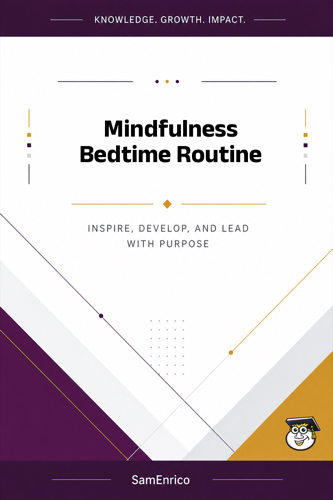
Non-FictionSelf-HelpMindfulness
Mindfulness Bedtime Routine eBook
Transition from wakefulness to sleep with present
by Finney Logan
Transition from wakefulness to sleep with present moment awareness.
Formats
Free sample
Chapter 1: The Wakefulness Trap--We begin with a paradox so common that most people never notice it: the more you try to fall asleep, the more awake you become. This is not a personal failing. It is not a sign of anxiety disorder, broken willpower, or a fundamentally flawed relationship with rest. It is, instead, the predictable outcome of a brain that evolved to solve problems—and that has now turned its problem-solving machinery onto the one problem it cannot solve by effort alone.You have probably experienced this trap hundreds of times. The clock reads 11:47 PM.
You are tired. Your body is heavy. Your eyes have that particular ache that signals genuine need for rest. And yet, the moment your head touches the pillow, something shifts. A thought appears: I really need to sleep.
I have that meeting at 9 AM. Then another: If I fall asleep right now, I will get six hours and forty-three minutes. Then another: Why am I thinking about sleep? Just sleep. Stop thinking about sleep.
This cascade of thoughts is so familiar to so many people that we have given it a name—the racing mind at bedtime—but we rarely stop to ask the most important question: Why does this happen?The answer lies not in your childhood, your stress levels, or your caffeine intake (though those matter). The answer lies in the fundamental architecture of the human brain and its relationship to effort. For millions of years, the brains that survived were the brains that solved problems. A rustle in the bushes required immediate analysis: predator or wind? A shortage of food required planning: where did we see berries yesterday?
A social slight required rumination: did I offend the tribe leader? The brain that asked What should I do about this? outlived the brain that shrugged and went back to sleep. Problem-solving became the default mode of the human mind, the background hum beneath every waking moment.This background hum has a name in neuroscience: the default mode network, or DMN. The DMN is a collection of brain regions—including the medial prefrontal cortex, the posterior cingulate cortex, and the angular gyrus—that become active when you are not focused on the outside world.
When you are daydreaming, planning, ruminating, or replaying past conversations, your DMN is running. It is the brain's autopilot, its resting-state network, its continuous low-grade hum of self-referential thought.The DMN is not your enemy. It is what allows you to learn from the past and prepare for the future. It is what makes you human. But the DMN has a critical flaw when it comes to sleep: it cannot distinguish between a real problem and a manufactured one.
To the DMN, your worry about falling asleep is just as urgent as your worry about a predator in the bushes. Both trigger the same cascade of physiological responses. Both activate the sympathetic nervous system—the fight-or-flight branch of your autonomic nervous system. Both release cortisol and adrenaline. Both tell your body: Stay alert.
There is a problem that requires action.Here is the cruel irony: the action required to solve most problems—planning, analyzing, strategizing—is the exact opposite of the action required to fall asleep. Sleep requires the deactivation of the DMN. Sleep requires the downregulation of the sympathetic nervous system. Sleep requires you to stop solving problems. But the DMN cannot stop solving problems because it believes, with absolute sincerity, that your inability to sleep is itself a problem to be solved.
And so the loop begins. You try to sleep. The DMN interprets the effort as a sign of danger. The DMN activates alertness. Alertness prevents sleep.
You try harder. The DMN interprets the increased effort as increased danger. You become more alert. This is the wakefulness trap, and it is self-reinforcing.Let us trace the neurophysiology of this trap in detail, because understanding the mechanism is the first step toward disarming it.The Architecture of Waking The human brain produces electrical activity that can be measured in cycles per second, or hertz. These cycles, known as brainwaves, correlate with different states of consciousness.
When you are fully awake and actively engaged in problem-solving—reading a dense document, having an argument, calculating a budget—your brain is dominated by Beta waves, which range from 13 to 30 hertz. Beta waves are fast, low-amplitude, and highly synchronized with focused attention. They are the brainwaves of effort.As you begin to relax—perhaps closing your eyes, settling into a comfortable chair, letting your attention soften—Beta waves begin to slow down. They are replaced by Alpha waves, which range from 8 to 12 hertz. Alpha waves are slower and higher in amplitude.
They are associated with relaxed wakefulness, with eyes-closed rest, with the state just before sleep. You have experienced Alpha many times: that pleasant drifting feeling when you are lying on a beach or listening to quiet music, not quite asleep but no longer fully alert.From Alpha, the brain can move in two directions. With continued relaxation, Alpha waves slow further into Theta waves (4 to 7 hertz). Theta is the borderland of sleep. It is associated with light sleep, with hypnagogic imagery (those fleeting dreamlike images just as you drift off), with sudden muscle jerks, with the loss of external awareness.
Theta is not yet deep sleep, but it is no longer wakefulness. It is the threshold.Finally, deep sleep—the restorative, body-repairing, memory-consolidating stage—is dominated by Delta waves (0.5 to 3 hertz). Delta is slow, high-amplitude, and profoundly unconscious. In Delta, the DMN is largely offline. The brain is not solving problems.
It is washing itself with cerebrospinal fluid, clearing metabolic waste, pruning synapses, integrating memory. Delta is where sleep does its deepest work.The wakefulness trap occurs when the brain gets stuck in Beta. You are lying in bed, physically still, but your brain is producing the electrical signature of active problem-solving. You cannot jump directly from Beta to Delta. You must pass through Alpha and Theta.
But the DMN, interpreting your effort to sleep as a problem requiring analysis, keeps generating Beta. You are trying to drive a car while keeping your foot on the gas and the brake simultaneously. The car cannot move.This is why "trying to sleep" is a contradiction in terms. Sleep is not something you do. Sleep is something that happens when you stop doing.
The athlete does not try to fall asleep before a competition; the athlete creates the conditions for sleep and then gets out of the way. The parent of a newborn does not try to sleep during the baby's nap; the parent lies down and allows sleep to arrive or not, without performance pressure. The teenager sleeping until noon on Saturday does not try to stay asleep; the teenager's body simply continues resting until it is done. In all these cases, sleep is not an achievement. Sleep is a surrender.Performance Anxiety and the Insomnia Spiral Clinical sleep medicine has a name for the wakefulness trap: psychophysiological insomnia.
This is not insomnia caused by pain, medication, shift work, or another medical condition. It is insomnia caused by the very act of trying to sleep. The Diagnostic and Statistical Manual of…
This is the end of the free sample. Get the eBook to keep going. Buy now
About this book
Details
- Author
- Finney Logan
- Publisher
- SamEnrico
- Language
- English
- Genre
- Non-Fiction, Self-Help, Mindfulness
- Released
- 2026-06-07
- Pages (approx.)
- 148
- Available as
- eBook, Audiobook

Read better in the ZLOADR app
Your eBooks on your phone or tablet. Sign in with your SamEnrico account and start reading.
More by Finney Logan
 The Paris Dakar OverlandFinney Logan$11.99
 McClintock Cold Spring Harbor WorkbookFinney Logan$11.99
 Paramedic PTSD PreventionFinney Logan$11.99
 Antwerp Heist Museum ExhibitFinney Logan$11.99
 Iron Over the Abyss: The Bridge That Defied TimeFinney Logan$11.99
 The Ice and the Gene: A Race for Arctic Secrets in the AmazonFinney Logan$11.99
 Spruce HarvestingFinney Logan$11.99
 UAE Golden Visa HandbookFinney Logan$12.99
 Remote Conflict ScenariosFinney Logan$12.99
 Understanding Fiber Type Disproportion, CongenitalFinney Logan$17.99
 A Beginners Guide to Calypso (Volume 1)Finney Logan$11.99
You may also like
 Hong Kong Handover 1997Dunn Johnnie$11.99
 Zumba For Postnatal Recovery CourseNeal Christian$11.99
 Zumba for BeginnersLadner Nikia$11.99
 YouTube Comment Mining GuideHumes Pandora$12.99
 Worry Box MeditationCarlin Rudy$11.99
 Workplace Stress MeditationNguyen Lynn$11.99
 Workplace Stress and Sleep RepairHawley Ivory$11.99
 Workplace Perfectionism CureDelaney Jeffry$11.99
 Workplace Injustice Anger GuideWallen Isabelle$11.99
 Work Addiction and Burnout LinkGreenwood Ester$11.99
 Women in Yoga and WellnessBeattie Galina$11.99
 Women in Stand Up ComedyChun Evangeline$11.99