
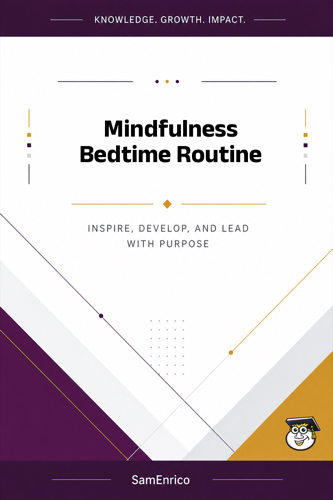
Non-FictionSelf-HelpMindfulness
Mindfulness Bedtime Routine Audiobook
Transition from wakefulness to sleep with present
by Finney Logan
Transition from wakefulness to sleep with present moment awareness.
Formats
Free sample
Chapter 1: The Wakefulness Trap--We begin with a paradox so common that most people never notice it: the more you try to fall asleep, the more awake you become. This is not a personal failing. It is not a sign of anxiety disorder, broken willpower, or a fundamentally flawed relationship with rest. It is, instead, the predictable outcome of a brain that evolved to solve problems—and that has now turned its problem-solving machinery onto the one problem it cannot solve by effort alone.You have probably experienced this trap hundreds of times. The clock reads 11:47 PM.
You are tired. Your body is heavy. Your eyes have that particular ache that signals genuine need for rest. And yet, the moment your head touches the pillow, something shifts. A thought appears: I really need to sleep.
I have that meeting at 9 AM. Then another: If I fall asleep right now, I will get six hours and forty-three minutes. Then another: Why am I thinking about sleep? Just sleep. Stop thinking about sleep.
This cascade of thoughts is so familiar to so many people that we have given it a name—the racing mind at bedtime—but we rarely stop to ask the most important question: Why does this happen?The answer lies not in your childhood, your stress levels, or your caffeine intake (though those matter). The answer lies in the fundamental architecture of the human brain and its relationship to effort. For millions of years, the brains that survived were the brains that solved problems. A rustle in the bushes required immediate analysis: predator or wind? A shortage of food required planning: where did we see berries yesterday?
A social slight required rumination: did I offend the tribe leader? The brain that asked What should I do about this? outlived the brain that shrugged and went back to sleep. Problem-solving became the default mode of the human mind, the background hum beneath every waking moment.This background hum has a name in neuroscience: the default mode network, or DMN. The DMN is a collection of brain regions—including the medial prefrontal cortex, the posterior cingulate cortex, and the angular gyrus—that become active when you are not focused on the outside world.
When you are daydreaming, planning, ruminating, or replaying past conversations, your DMN is running. It is the brain's autopilot, its resting-state network, its continuous low-grade hum of self-referential thought.The…
This is the end of the free sample. Get the Audiobook to keep going. Buy now
About this book
Details
- Author
- Finney Logan
- Publisher
- SamEnrico
- Language
- English
- Genre
- Non-Fiction, Self-Help, Mindfulness
- Released
- 2026-06-07
- Pages (approx.)
- 148
- Available as
- eBook, Audiobook

Listen in the VoxFlicks app
Audiobooks and audio dramas wherever you go. Sign in with your SamEnrico account and press play.
More by Finney Logan
 The Paris Dakar OverlandFinney Logan$11.99
 McClintock Cold Spring Harbor WorkbookFinney Logan$11.99
 Paramedic PTSD PreventionFinney Logan$11.99
 Antwerp Heist Museum ExhibitFinney Logan$11.99
 Iron Over the Abyss: The Bridge That Defied TimeFinney Logan$11.99
 The Ice and the Gene: A Race for Arctic Secrets in the AmazonFinney Logan$11.99
 Spruce HarvestingFinney Logan$11.99
 UAE Golden Visa HandbookFinney Logan$12.99
 Remote Conflict ScenariosFinney Logan$12.99
 Understanding Fiber Type Disproportion, CongenitalFinney Logan$17.99
 A Beginners Guide to Calypso (Volume 1)Finney Logan$11.99
You may also like
 Hong Kong Handover 1997Dunn Johnnie$11.99
 Zumba For Postnatal Recovery CourseNeal Christian$11.99
 Zumba for BeginnersLadner Nikia$11.99
 YouTube Comment Mining GuideHumes Pandora$12.99
 Worry Box MeditationCarlin Rudy$11.99
 Workplace Stress MeditationNguyen Lynn$11.99
 Workplace Stress and Sleep RepairHawley Ivory$11.99
 Workplace Perfectionism CureDelaney Jeffry$11.99
 Workplace Injustice Anger GuideWallen Isabelle$11.99
 Work Addiction and Burnout LinkGreenwood Ester$11.99
 Women in Yoga and WellnessBeattie Galina$11.99
 Women in Stand Up ComedyChun Evangeline$11.99