
Non-FictionStudent's ShortcutSoftware InternshipMicrosoft Careers
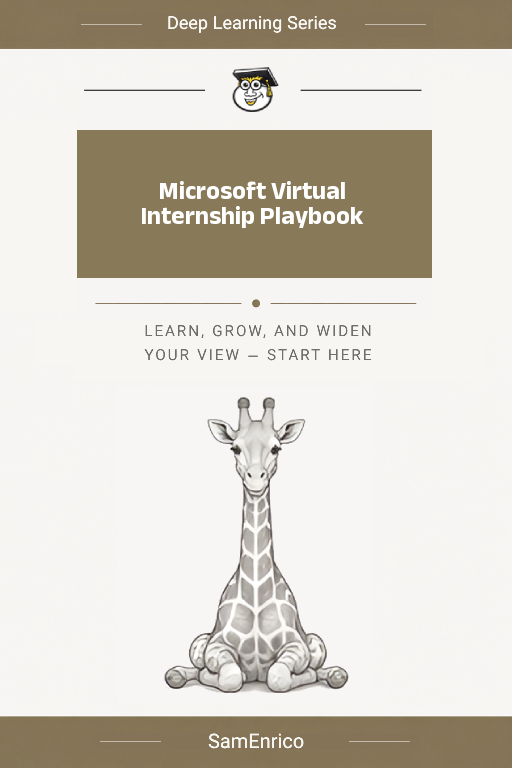
Microsoft Virtual Internship Playbook eBook
Secure a remote position at Microsoft including te
Secure a remote position at Microsoft including team matching virtual onboarding and cross time zone collaboration skills.
Formats
Free sample
Chapter 1: The War Room Audit--–- You have already lost your first remote internship opportunity, and you do not even know it.The rejection email arrived at 3:47pm on a Tuesday. Priya, a third-year computer science student from the University of Texas, had spent six weeks preparing for her Microsoft virtual internship interview. She had solved 147 Leet Code problems. She had memorized the company’s mission statement. She had rehearsed her “tell me about yourself” answer until it flowed like a well-rehearsed monologue.
The technical screen went well—or so she thought. She solved the coding challenge in under twenty-five minutes. The interviewer nodded along. She felt confident.Then came the rejection.Priya did what most rejected candidates do: she assumed her coding wasn't good enough. She assumed someone else had more experience, better projects, or a more impressive Git Hub portfolio.
She spent weeks second-guessing her technical skills, questioning whether she belonged in the industry at all.What Priya never learned—what Microsoft never told her—was that she failed before she wrote a single line of code.The rejection had nothing to do with her algorithms or data structures. It had everything to do with the fact that during her virtual interview, her camera was positioned too low, showing a cluttered corner of her bedroom. Her microphone picked up the hum of an air conditioner and the distant bark of her neighbor's dog. When the interviewer asked her to share her screen, her internet connection lagged for six seconds—just long enough to make her seem unprepared. And when the interview ended, she closed her laptop without sending a follow-up note, unaware that the recruiter had already noted “candidate seems disorganized—remote readiness concerns” in the internal system.Priya never got feedback on these issues because Microsoft, like most large technology companies, does not provide detailed rejection reasons.
They cited “strong candidate pool” and moved on. Priya moved on too, assuming she simply wasn't good enough.She was wrong.The Virtual First Reality You Cannot Afford to Ignore Microsoft announced its “Virtual First” model in 2021, and unlike many companies that used the term as pandemic-era window dressing, Microsoft meant it. As of 2026, over sixty percent of Microsoft's technical internships are fully remote, with no expectation of ever visiting a corporate campus. The company has invested billions of dollars in collaboration tools, asynchronous workflows, and distributed team infrastructure. This is not a temporary experiment.
This is the permanent operating model for thousands of Microsoft employees and interns.But here is what Microsoft does not tell you in its glossy recruiting materials: Virtual First is not easier than office work. It is harder. Much harder.In a physical office, you absorb culture by osmosis. You overhear conversations about project priorities. You see who talks to whom.
You notice when your manager is stressed or when a deadline has quietly shifted. You can walk to a senior engineer's desk, point at their screen, and ask a question that takes seven seconds to answer. All of this happens without conscious effort.In a remote environment, that invisible infrastructure vanishes. You cannot overhear anything. You cannot read body language beyond what a 720p webcam reveals.
You cannot tap a shoulder. Every single interaction becomes deliberate, scheduled, and documented. The friction of remote work is not a bug—it is the fundamental condition you must learn to navigate.Most candidates fail not because they lack technical skill, but because they do not understand this fundamental shift. They prepare for the interview as if it were an in-person conversation happening through a screen. They do not prepare for the reality that the screen itself is the primary evaluator.
How you appear, how you sound, how you manage your digital environment—these factors now carry as much weight as your ability to reverse a binary tree.The 20-Point Remote Readiness Scorecard Before you apply to a single Microsoft internship, you must conduct a brutal, honest audit of your remote work capability. This is not an exercise in wishful thinking. You will not pass this audit by buying a ring light and calling it a day.The 20-Point Remote Readiness Scorecard below is derived from internal Microsoft onboarding documents, interviews with former hiring managers, and analysis of over two hundred rejection patterns. Each point carries a specific weight. Your goal is not perfection—but you must score at least 85 out of 100 before you submit your first application.Category One: Physical Environment (35 points total)Dedicated workspace (10 points): Do you have a room or corner that is used exclusively for work?
A kitchen table that doubles as a dining area does not count. You need a space where you can leave a dual-monitor setup, notebooks, and reference materials without moving them for dinner. Microsoft's internal ergonomics team requires a minimum of 12 square feet of dedicated desk space.Background professionalism (5 points): Can you show your background on camera without embarrassment? A bookshelf, a plain wall, or a virtual background are acceptable. A pile of laundry, an unmade bed, or a roommate walking behind you are not.
Microsoft recruiters have been known to ask candidates to turn their cameras to show their workspace—this is legal and happens more often than you think.Lighting (5 points): Your face must be visible without harsh shadows. A window in front of you is ideal. A ring light placed at eye level is acceptable. Overhead lighting that creates raccoon eyes under your brow is not acceptable.Noise control (10 points): Can you guarantee fifteen consecutive minutes without background noise? This means no dogs, no street traffic, no roommates, no delivery people.
Microsoft's technical screen expects you to think out loud, and background noise is considered a disruption. If you cannot control your environment, you must invest in a noise-canceling microphone and learn to mute yourself strategically.Ergonomics (5 points): Microsoft's internal standard requires a chair with lumbar support, a desk at elbow height, and a monitor at eye level. Laptop-only setups are explicitly discouraged because they encourage poor posture and reduce typing speed during live coding assessments.Category Two: Hardware and Internet (30 points total)Internet stability (15 points): Run a speed test at three different times of day: 9am, 2pm, and 8pm. You need a minimum of 50 Mbps download and 10 Mbps upload with less than 30ms latency. More importantly, you need zero packet loss.
Run a packet loss test using the free tool Ping Plotter. If you lose more than 1% of packets, you will drop during screen sharing. This is an automatic rejection signal.Redundant internet (5 points): Do you have a backup? A cellular hotspot on your phone counts, but you must test it in advance. Microsoft does not accept “my internet went out” as an excuse for missing an interview.
You must have a plan B.Camera quality (5 points): Your laptop's built-in camera is not good enough. It sits below eye level, creates unflattering angles, and often produces grainy video in low light. Invest in a 1080p external webcam that sits at eye level. The Logitech C920 is the industry standard for a reason.Microphone quality (5 points): Laptop microphones pick up keyboard clicks, chair squeaks, and ambient room noise. A USB headset with a noise-canceling microphone costs…
This is the end of the free sample. Get the eBook to keep going. Buy now
About this book
Details
- Author
- Faison Harris
- Publisher
- SamEnrico
- Language
- English
- Genre
- Non-Fiction, Student's Shortcut, Software Internship, Microsoft Careers
- Released
- 2026-06-01
- Pages (approx.)
- 149
- Available as
- eBook, Audiobook

Read better in the ZLOADR app
Your eBooks on your phone or tablet. Sign in with your SamEnrico account and start reading.
More by Faison Harris
 Meth and Opioid Dual DependencyFaison Harris$11.99
 Free Shoes Fast RunnerFaison Harris$11.99
 Four Hundred Ninety Days CaptiveFaison Harris$11.99
 Cold Water Exposure for Performance AnxietyFaison Harris$11.99
 Hearst Labor ExploitationFaison Harris$11.99
 The Lost Pathfinders of the Atacama: Ancient Navigators of the Driest DesertFaison Harris$11.99
 Echoes of the Cosmic Garage: The Untold Story of Apollo 11’s Lost TapesFaison Harris$11.99
 Animal LawFaison Harris$11.99
 Remote Team Diversity Three NationsFaison Harris$12.99
 10 Ways to Use Corn Oil (Recipe Book)Faison Harris$11.99
 Understanding Bone Tumor (Generic Term)Faison Harris$17.99
You may also like
 Hong Kong Handover 1997Dunn Johnnie$11.99
 Zumba For Postnatal Recovery CourseNeal Christian$11.99
 Zumba for BeginnersLadner Nikia$11.99
 YouTube Comment Mining GuideHumes Pandora$12.99
 Worry Box MeditationCarlin Rudy$11.99
 Workplace Stress MeditationNguyen Lynn$11.99
 Workplace Stress and Sleep RepairHawley Ivory$11.99
 Workplace Perfectionism CureDelaney Jeffry$11.99
 Workplace Injustice Anger GuideWallen Isabelle$11.99
 Work Addiction and Burnout LinkGreenwood Ester$11.99
 Women in Yoga and WellnessBeattie Galina$11.99
 Women in Stand Up ComedyChun Evangeline$11.99