
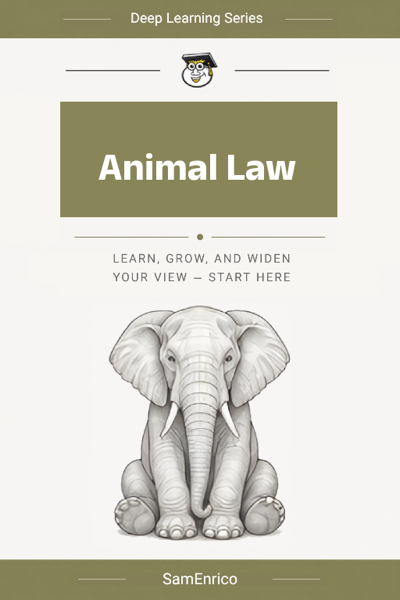
Non-FictionInformativeEducational
Animal Law
A Coursebook on Animal Law
A Coursebook on Animal Law
Formats
About this book
Free sample
Chapter 1: The Fox and the Frozen Dog--–- The courthouse in upstate New York was freezing on the December morning when the fox changed American property law. Outside, snow piled against the iron railings. Inside, two hunters argued over who owned a single red fox, and in doing so, they unknowingly set the legal foundation for every animal case that would follow for the next two centuries. The case was Pierson v. Post, decided in 1805, and its logic still determines whether a lost dog belongs to you, whether a zoo can keep an elephant, and whether a slaughterhouse can be sued for cruelty.
The fox, of course, never had a lawyer. No animal did. That was the point.The Common Law Baseline: Animals as Chattel To understand animal law, you must first understand what animals are not. In the eyes of the common law—the judge-made law that England exported to its colonies, including the United States, Canada, Australia, and New Zealand—animals are not persons, not citizens, not rights-holders. They are chattel.
The word shares a root with "cattle" and means, simply, movable property. A horse is legally indistinguishable from a plow. A dog is no different from a wagon. A chimpanzee has the same legal status as a chair.This classification was not an accident or an oversight. It was a deliberate choice made by centuries of judges who understood that treating animals as property was essential to the agricultural economy, the hunting economy, and the social order.
If a farmer's cow wandered onto a neighbor's land, the law did not ask whether the cow suffered during the journey. It asked who had the superior property claim. If a hunter shot a fox, the law did not ask whether the fox felt fear. It asked who had first possession.The logic is circular but relentless. Animals are property because they have always been property.
They have always been property because the law treats them as property. The cases that established this principle are not obscure relics; they are the bedrock of first-year property courses in every common law…
This is the end of the free sample. Get the eBook to keep going. Buy now
Contents
- Chapter 1
- Chapter 2
- Chapter 3
- Chapter 4
- Chapter 5
- Chapter 6
- Chapter 7
- Chapter 8
- Chapter 9
- Chapter 10
- Chapter 11
- Chapter 12
Details
- Author
- Faison Harris
- Publisher
- SamEnrico
- Language
- English
- Genre
- Non-Fiction, Informative, Educational
- Released
- 2026-06-03
- Pages (approx.)
- 159
- Available as
- eBook, Audiobook

Read better in the ZLOADR app
Your eBooks on your phone or tablet. Sign in with your SamEnrico account and start reading.
More by Faison Harris
 Meth and Opioid Dual DependencyFaison Harris$11.99
 Free Shoes Fast RunnerFaison Harris$11.99
 Four Hundred Ninety Days CaptiveFaison Harris$11.99
 Cold Water Exposure for Performance AnxietyFaison Harris$11.99
 Hearst Labor ExploitationFaison Harris$11.99
 The Lost Pathfinders of the Atacama: Ancient Navigators of the Driest DesertFaison Harris$11.99
 Echoes of the Cosmic Garage: The Untold Story of Apollo 11’s Lost TapesFaison Harris$11.99
 Microsoft Virtual Internship PlaybookFaison Harris$12.99
 Remote Team Diversity Three NationsFaison Harris$12.99
 10 Ways to Use Corn Oil (Recipe Book)Faison Harris$11.99
 Understanding Bone Tumor (Generic Term)Faison Harris$17.99
You may also like
 Hong Kong Handover 1997Dunn Johnnie$11.99
 Zumba For Postnatal Recovery CourseNeal Christian$11.99
 Zumba for BeginnersLadner Nikia$11.99
 YouTube Comment Mining GuideHumes Pandora$12.99
 Worry Box MeditationCarlin Rudy$11.99
 Workplace Stress MeditationNguyen Lynn$11.99
 Workplace Stress and Sleep RepairHawley Ivory$11.99
 Workplace Perfectionism CureDelaney Jeffry$11.99
 Workplace Injustice Anger GuideWallen Isabelle$11.99
 Work Addiction and Burnout LinkGreenwood Ester$11.99
 Women in Yoga and WellnessBeattie Galina$11.99
 Women in Stand Up ComedyChun Evangeline$11.99