
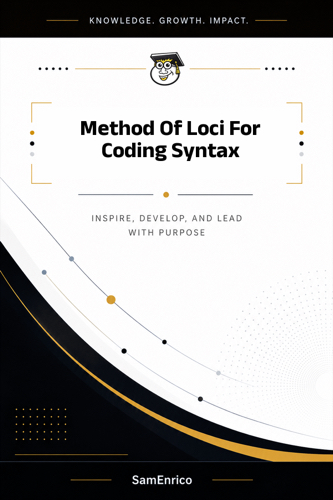
Non-FictionSelf-HelpProgramming
Method Of Loci For Coding Syntax eBook
Store programming functions in a virtual workspace
Store programming functions in a virtual workspace.
Formats
Free sample
Chapter 1: The 72-Hour Wipe--–- The first time Alex stared at a blank editor and couldn't remember whether it was array.length() or array.length without the parentheses, he laughed it off as a brain fart. The second time, during a technical interview for a junior developer role, he felt his face flush. The third time, two weeks into his first real job, his senior engineer glanced over and said, "You're Googling for loop syntax? Really?" Alex didn't have an answer. He had written hundreds of loops.
He had built three portfolio projects. He had studied for months. And yet, in the moment of need, the syntax had simply evaporated.This is not a story about laziness, low intelligence, or lack of practice. This is a story about how the human brain is fundamentally mismatched to the task of memorizing programming syntax—and how almost every coder, from bootcamp graduates to senior engineers, suffers from the same invisible problem. They just don't talk about it.Welcome to Chapter 1.
Before we build any memory palaces, before we encode a single function into a bizarre image, we must first understand the enemy. That enemy is not your forgetfulness. That enemy is the architecture of your own brain colliding with the architecture of programming languages. And once you see the problem clearly, you will never blame yourself again.The Great Illusion: "Just Code More"There is a myth perpetuated in coding bootcamps, online tutorials, and even by well-meaning senior developers: "Don't memorize syntax. Just build things.
The repetition will teach you." On its surface, this advice seems reasonable. After all, you learned to speak your native language by speaking it, not by memorizing grammar rules in isolation. Why should coding be different?The answer lies in a critical distinction that almost no one makes explicit: the difference between recognition memory and recall memory.Recognition memory is what happens when you see code and understand it. You glance at a function, recognize the pattern, and think, "Yes, I know what this does." Recognition is passive, forgiving, and context-rich. It is the reason you can read a novel and follow the plot without memorizing every sentence.
Recognition memory is powerful—but it is also a trap.Recall memory is what happens when you start from a blank editor, with no visual cues, no autocomplete, no syntax highlighting, and no stack overflow tab open. Your brain must generate the correct sequence of characters from nothing. Recall is active, brittle, and context-poor. It is the difference between recognizing a song on the radio and singing it from memory, a cappella, in a quiet room.Here is the uncomfortable truth that bootcamps rarely advertise: you can recognize 90% of a language's syntax and still be unable to recall 50% of it under pressure. The two memory systems are not proportional.
You do not gradually improve from recognition to recall through osmosis. Recall requires a completely different cognitive mechanism—one that most programmers never deliberately train.Consider the humble for loop. Every Java Script developer has seen it thousands of times:javascript Copy Downloadfor (let i = 0; i < array.length; i++) { // do something }Show that to any junior developer, and they will recognize it instantly. But ask them to write it from memory, starting with no editor, no template, no autocomplete. The first thing many will forget: is it i < array.length or i used for pointers in C, but => used for arrow functions in Java Script?
These symbols have no intrinsic connection to their meaning. They are arbitrary conventions that must be brute-forced into memory.Inconsistent Naming: In Python, you get the length of a list with len(list). In Java Script, it's array.length. In Ruby, it's array.length (same as JS) but for strings, it's string.length again—except in older Ruby where it was string.size. In C, it's strlen(str) for strings but sizeof(array)/sizeof(array[0]) for arrays.
There is no universal logic. Each language reinvents the wheel with different spokes.Context-Sensitive Syntax: The same symbol can mean different things in different contexts. In Java Script, + means addition for numbers but concatenation for strings. In C++, * means multiplication, pointer dereferencing, or declaring a pointer, depending on where it appears. Your brain cannot rely on a one-to-one mapping.
It must constantly switch mental models.Edge Cases Exceptions: Every language has them. Java Script's typeof null === "object" (a bug enshrined as a feature). Python's default mutable arguments persisting between function calls. PHP's inconsistent parameter order in built-in functions (needle, haystack vs. haystack, needle).
These exceptions violate any simple rule you try to learn. They must be memorized as separate, arbitrary facts.Case Sensitivity and Punctuation: Python uses indentation as syntax. Java Script uses semicolons optionally but not really optionally because automatic semicolon insertion will ruin your day. Swift is case-sensitive but keywords like self aren't always. C++ is case-sensitive and template syntax looks like a punctuation explosion: std::vector.Taken together, these features create what we call the Anti-Mnemonic Index of a programming language.
The higher the index, the less the language conforms to natural human memory patterns. Natural languages (English, Mandarin, Spanish) have an anti-mnemonic index near zero because they evolved through human use. Programming languages have indices ranging from moderate (Python, Ruby) to extreme (C++, Perl).The brain did not evolve to store semicolon placement or === versus ==. The brain evolved to remember where the tiger was yesterday and which berries made you sick. Your hippocampus—the region central to spatial memory—is exquisitely tuned for physical environments, social relationships, and cause-effect sequences with survival stakes.
It is not tuned for std::unordered_map.This is not a bug in your brain. It is a feature of your brain. And it is the feature we are going to exploit.Cognitive Load Theory: Why Your Working Memory Is a Leaky Bucket To understand why syntax recall fails, we must understand cognitive load theory, developed by educational psychologist John Sweller in the 1980s. Cognitive load refers to the total amount of mental effort being used in working memory. Working memory is not infinite.
In fact, it is severely limited.The classic estimate, from George Miller's 1956 paper "The Magical Number Seven, Plus or Minus Two," is that working memory can hold approximately seven chunks of information at once. More recent research suggests the number may be as low as four. That is it. Your entire conscious processing power—everything you can hold in mind simultaneously—is roughly the length of a phone number.When you code, your working memory is juggling multiple chunks: the problem you are solving, the algorithm you are implementing, the variable names you have chosen, the data structures you are using, and—critically—the syntax of the language you are writing in. Each chunk consumes capacity.If syntax recall is automatic (you don't have to think about whether it's length() or length), then it occupies minimal cognitive load.
Your working memory is free to focus on the algorithm and the problem. This is the state of fluency: syntax is subconscious, like typing without looking at the keyboard.If syntax recall is effortful (you pause, you guess, you second-guess), then it consumes significant cognitive load. Your working memory…
This is the end of the free sample. Get the eBook to keep going. Buy now
About this book
Details
- Author
- Galvan Catheryn
- Publisher
- SamEnrico
- Language
- English
- Genre
- Non-Fiction, Self-Help, Programming
- Released
- 2026-06-06
- Pages (approx.)
- 151
- Available as
- eBook, Audiobook

Read better in the ZLOADR app
Your eBooks on your phone or tablet. Sign in with your SamEnrico account and start reading.
More by Galvan Catheryn
 Recurring Nightmares in ChildrenGalvan Catheryn$11.99
 Hinton Compensation After ReleaseGalvan Catheryn$11.99
 Full Retirement Age CalculationGalvan Catheryn$11.99
 Reconstruction of Patricide CasesGalvan Catheryn$11.99
 Pomodoro for ParamedicsGalvan Catheryn$11.99
 Irish Famine British NeglectGalvan Catheryn$11.99
 Dream Journaling for PTSDGalvan Catheryn$11.99
 The Beirut Bank Heist: The Counterfeit Crisis That Shook the Middle EastGalvan Catheryn$11.99
 The Luthiers of the Andes: Crafting Soul into Strings (1500s)Galvan Catheryn$11.99
 How to Produce PotatoesGalvan Catheryn$11.99
 How to Produce Drinking Straws and StirrersGalvan Catheryn$11.99
 Custard Apple: Cherimoya & Sugar AppleGalvan Catheryn$11.99
You may also like
 Hong Kong Handover 1997Dunn Johnnie$11.99
 Zumba For Postnatal Recovery CourseNeal Christian$11.99
 Zumba for BeginnersLadner Nikia$11.99
 YouTube Comment Mining GuideHumes Pandora$12.99
 Worry Box MeditationCarlin Rudy$11.99
 Workplace Stress MeditationNguyen Lynn$11.99
 Workplace Stress and Sleep RepairHawley Ivory$11.99
 Workplace Perfectionism CureDelaney Jeffry$11.99
 Workplace Injustice Anger GuideWallen Isabelle$11.99
 Work Addiction and Burnout LinkGreenwood Ester$11.99
 Women in Yoga and WellnessBeattie Galina$11.99
 Women in Stand Up ComedyChun Evangeline$11.99