
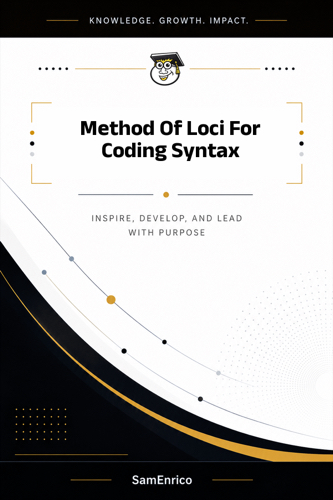
Method Of Loci For Coding Syntax
Store programming functions in a virtual workspace
Store programming functions in a virtual workspace.
Formats
About this book
Free sample
Chapter 1: The 72-Hour Wipe--–- The first time Alex stared at a blank editor and couldn't remember whether it was array.length() or array.length without the parentheses, he laughed it off as a brain fart. The second time, during a technical interview for a junior developer role, he felt his face flush. The third time, two weeks into his first real job, his senior engineer glanced over and said, "You're Googling for loop syntax? Really?" Alex didn't have an answer. He had written hundreds of loops.
He had built three portfolio projects. He had studied for months. And yet, in the moment of need, the syntax had simply evaporated.This is not a story about laziness, low intelligence, or lack of practice. This is a story about how the human brain is fundamentally mismatched to the task of memorizing programming syntax—and how almost every coder, from bootcamp graduates to senior engineers, suffers from the same invisible problem. They just don't talk about it.Welcome to Chapter 1.
Before we build any memory palaces, before we encode a single function into a bizarre image, we must first understand the enemy. That enemy is not your forgetfulness. That enemy is the architecture of your own brain colliding with the architecture of programming languages. And once you see the problem clearly, you will never blame yourself again.The Great Illusion: "Just Code More"There is a myth perpetuated in coding bootcamps, online tutorials, and even by well-meaning senior developers: "Don't memorize syntax. Just build things.
The repetition will teach you." On its surface, this advice seems reasonable. After all, you learned to speak your native language by speaking it, not by memorizing grammar rules in isolation. Why should coding be different?The answer lies in a critical distinction that almost no one makes explicit: the difference between recognition memory and recall memory.Recognition memory is what happens when you see code and understand it. You glance at a function, recognize the pattern, and think, "Yes, I know what this does." Recognition is passive, forgiving, and context-rich. It is the reason you can read a…
This is the end of the free sample. Get the eBook to keep going. Buy now
Contents
- Chapter 1
- Chapter 2
- Chapter 3
- Chapter 4
- Chapter 5
- Chapter 6
- Chapter 7
- Chapter 8
- Chapter 9
- Chapter 10
- Chapter 11
- Chapter 12
Details
- Author
- Galvan Catheryn
- Publisher
- SamEnrico
- Language
- English
- Genre
- Non-Fiction, Self-Help, Programming
- Released
- 2026-06-06
- Pages (approx.)
- 151
- Available as
- eBook, Audiobook

Read better in the ZLOADR app
Your eBooks on your phone or tablet. Sign in with your SamEnrico account and start reading.
More by Galvan Catheryn
 Recurring Nightmares in ChildrenGalvan Catheryn$11.99
 Hinton Compensation After ReleaseGalvan Catheryn$11.99
 Full Retirement Age CalculationGalvan Catheryn$11.99
 Reconstruction of Patricide CasesGalvan Catheryn$11.99
 Pomodoro for ParamedicsGalvan Catheryn$11.99
 Irish Famine British NeglectGalvan Catheryn$11.99
 Dream Journaling for PTSDGalvan Catheryn$11.99
 The Beirut Bank Heist: The Counterfeit Crisis That Shook the Middle EastGalvan Catheryn$11.99
 The Luthiers of the Andes: Crafting Soul into Strings (1500s)Galvan Catheryn$11.99
 How to Produce PotatoesGalvan Catheryn$11.99
 How to Produce Drinking Straws and StirrersGalvan Catheryn$11.99
 Custard Apple: Cherimoya & Sugar AppleGalvan Catheryn$11.99
You may also like
 Pomodoro for Coding PracticePearson Enrique$11.99
 Growth Mindset In CodingBray Silas$11.99
 Method of Loci For Software CodeStine Alva$11.99
 Coding Syntax CardsElias Rusty$11.99
 Emotional Intelligence for ProgrammersMcneill Shantae$11.99
 Dream Incubation For Coders Programmers WorkbookSalas Cori$11.99
 Coding Syntax PegsHook Ina$11.99
 The Working Memory for Coding GuideEscalante Gabriele$11.99
 Anki For Coding SyntaxCoates Carlyn$11.99
 Pattern Recognition in DebuggingGould Ellie$11.99
 Programmer Coding BlocksStanfield Chanda$11.99
 Dream Incubation for Coding BugsKimbrell Wilhelmina$11.99