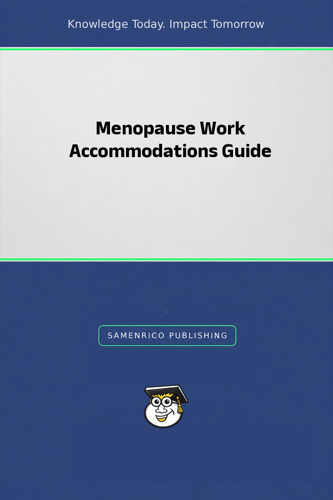
Menopause Work Accommodations Guide eBook
Request workplace adjustments for hot flashes, fat
by Pepper Sybil
Request workplace adjustments for hot flashes, fatigue, and brain fog legally and professionally.
Formats
Free sample
Chapter 1: The 3AM Confession--The sterile white light of the hospital operating room hummed overhead. Dr. Maya Chen, a 49-year-old cardiothoracic surgeon with steady hands that had repaired hundreds of beating hearts, felt the first wave of heat rise from her chest like a slow-motion explosion. She ignored it. She had learned to ignore many things over the past eighteen months—the night sweats that soaked through her sheets, the insomnia that left her staring at the ceiling at 3:00 AM, the strange forgetfulness that made her pause mid-sentence searching for words like "scalpel" or "clamp."But this time was different.The heat climbed her neck, engulfed her face, and then the sweat came—not a polite glisten but a torrent that rolled down her temples and dripped onto the sterile field.
Her surgical gown clung to her back. Her gloves felt slick. And for three terrifying seconds, her vision blurred at the edges."Dr. Chen?" the surgical nurse asked. "Are you alright?"Maya blinked hard.
Her hands, which had never trembled in seventeen years of surgery, were now shaking over a patient's open chest."I need a moment," she heard herself say. "Someone else take over. Now."She backed away from the table, stripped off her gloves, and walked—not ran, because running would have been an admission—out of the OR and into the locker room. She locked the door, slid down the wall, and sat on the cold tile floor, pressing her palms against the concrete to ground herself.Her phone buzzed. A text from her 16-year-old daughter: Mom, are you picking me up from practice?Maya stared at the screen and realized she had forgotten.
Again. For the third time this month.She was a surgeon. She had completed a fellowship at Johns Hopkins. She had been named one of the top cardiothoracic surgeons in her region three years running. And now she was sitting on a bathroom floor, drenched in sweat, unable to remember her own daughter's schedule.That night, at 3:17 AM, lying awake in sweat-soaked pajamas while her husband slept soundly beside her, Maya Chen typed into her phone's notes app: Something is wrong with me.
I can't keep doing this. I don't know who to tell.She was not alone. There were 25 million women just like her—working women in perimenopause and menopause—who were waking up at 3:00 AM with the same terrifying thought. And most of them, like Maya, had no idea that the law was on their side.The Silent Epidemic No One Is Talking About Let us name what Maya could not name that night: perimenopause. The transitional years leading up to menopause, typically beginning in a woman's 40s, when estrogen and progesterone levels fluctuate unpredictably before declining permanently.
For some women, the transition is mild. For millions of others, it is a cascading medical crisis that affects every system in the body—thermoregulation (hot flashes), sleep architecture (insomnia), cognition (brain fog), mood (anxiety and depression), and even continence.Yet despite affecting half the population at some point in their lives, menopause remains the last great workplace taboo. We have reasonable accommodations for pregnancy. We have them for disabilities. We have them for religious observances.
But ask a room of 100 HR professionals what their company's policy is on menopause accommodations, and 97 of them will stare back blankly.This silence has catastrophic consequences.The data is staggering: One in four women report considering leaving the workforce entirely due to unmanaged menopause symptoms. Among women with severe symptoms—those experiencing multiple hot flashes per day, chronic insomnia, or debilitating brain fog—that number rises to nearly one in two. Each woman who leaves represents a loss of institutional knowledge, a costly replacement cycle (150% of annual salary for mid-career professionals), and a silent reduction in the pipeline of women in leadership.And yet, 73% of women with moderate to severe menopausal symptoms have never requested a single workplace accommodation. Not because they don't need one—but because they don't know they can.They don't know that the Americans with Disabilities Act (ADA) covers severe menopausal symptoms as disabilities. They don't know that the Pregnant Workers Fairness Act (PWFA) creates a legal pathway through the "menstruation connection." They don't know that states like Rhode Island have already passed explicit menopause accommodation laws, and that California, New York, and Pennsylvania are on the verge of doing the same.They don't know that a $20 desk fan, a 30-minute schedule shift, or permission to wear a cotton blouse instead of a polyester uniform could be the difference between a thriving career and a quiet exit.This book exists to close that gap.The Old Paradigm: Suffering in Silence Before we build the new framework, we must understand the old one.
For generations, women have been socialized to endure menopause in silence. Why? Three powerful forces converge:First, shame. Hot flashes are embarrassing. Sweating through a blouse during a client presentation feels like a public failure.
Brain fog that makes you forget a colleague's name mid-conversation feels like early dementia. The physical symptoms of menopause—especially incontinence and heavy bleeding—are so culturally taboo that most women would rather suffer than speak.Second, ageism. In workplaces that worship youth, energy, and "culture fit," admitting to a condition associated with aging feels like career suicide. Women fear that disclosing menopause will lead to being sidelined, passed over for promotions, or tagged as "over the hill." These fears are not irrational—research consistently shows that age discrimination against women begins as early as age 40.Third, lack of knowledge. Most women—and nearly all managers and HR professionals—simply do not know that menopause accommodations are legally permissible.
They assume that accommodations are only for "real" disabilities like blindness or paralysis. They assume that requesting a fan or a flexible schedule will be seen as demanding special treatment. They assume that the word "menopause" has no place in a professional conversation.These assumptions are wrong. And they are costing women their careers.Consider Sarah, a 52-year-old high school teacher who had to leave her classroom three times during a single 90-minute period to change her clothing after stress incontinence leaks. She never told her principal why she was leaving.
She just stopped drinking water during the school day, became chronically dehydrated, developed recurring kidney infections, and eventually took early retirement—five years before she was ready.Consider Linda, a 48-year-old logistics manager who could no longer concentrate on complex shipping manifests due to severe brain fog. Her supervisor placed her on a Performance Improvement Plan for "lack of attention to detail." She never disclosed her perimenopause symptoms because she didn't know she could. She was fired three months later.Consider Fatima, a 55-year-old nurse who worked 12-hour night shifts despite hot flashes that left her dizzy and disoriented. She was afraid to ask for a shift change because she believed accommodations were only for "pregnant women or disabled people." She eventually made a medication error—mixing up two patients' insulin doses—and was terminated. The error was her fault, yes.
But it was also a direct consequence of an unaccommodated medical condition.These are not isolated stories. They are the daily reality of millions of…
This is the end of the free sample. Get the eBook to keep going. Buy now
About this book
Details
- Author
- Pepper Sybil
- Publisher
- SamEnrico
- Language
- English
- Genre
- Non-Fiction, Health & Wellness, Workplace, Accommodations
- Released
- 2026-06-09
- Pages (approx.)
- 145
- Available as
- eBook, Audiobook

Read better in the ZLOADR app
Your eBooks on your phone or tablet. Sign in with your SamEnrico account and start reading.
More by Pepper Sybil
 Omega Three Fatty Acids Brain HealthPepper Sybil$11.99
 Athletic Failure Resilience GuidePepper Sybil$11.99
 Thunberg Climate Crisis Language GuidePepper Sybil$11.99
 The Caregiver Bedbound Care GuidePepper Sybil$11.99
 Huldra's Lure: The Forest Witch of the Hidden FolkPepper Sybil$11.99
 The Trial of the Century: The People v. O.J. SimpsonPepper Sybil$11.99
 How to Become a Seal-extrusion OperatorPepper Sybil$11.99
 Transmission Electron Microscopy (Tem)Pepper Sybil$11.99
 Value Metric Pricing GuidePepper Sybil$12.99
 Promotion Case MistakesPepper Sybil$12.99
 Understanding Focal Facial Dermal DysplasiaPepper Sybil$17.99