
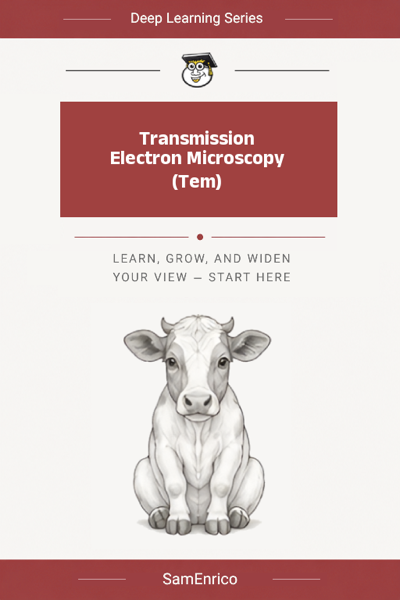
Transmission Electron Microscopy (Tem)
A Coursebook on Transmission Electron Microscopy (
by Pepper Sybil
A Coursebook on Transmission Electron Microscopy (Tem)
Formats
About this book
Free sample
Chapter 1: The Resolution Revolution...–- In the winter of 1931, two German electrical engineers named Max Knoll and Ernst Ruska watched a faint green glow form on a phosphor screen inside a homemade apparatus in Berlin. The device was crude by any modern standard—a brass cylinder pumped by a leaky vacuum system, powered by voltages that fluctuated with the city's grid, and focused by magnetic coils wound by hand. But when they saw the image of a platinum grid magnified by a factor of fifteen—barely beating the best light microscopes of the day—they had done something no human had ever done. They had used electrons to see the invisible.Ruska was a twenty-five-year-old doctoral student at the time. His advisors told him the instrument was an interesting toy but would never outperform light microscopes.
The physics seemed insurmountable: electrons are charged particles that repel each other; magnetic lenses have unavoidable aberrations; the vacuum required is nearly impossible to maintain. Ruska ignored them. Within two years, he had built a microscope that resolved details down to 50 nanometers—already surpassing the theoretical limit of light. By the time he submitted his Ph D in 1933, his instrument had reached 10 nanometers. Fifty years later, in 1986, Ernst Ruska received the Nobel Prize in Physics for his stubborn belief that electrons could see what light could not.This chapter is about why Ruska was right.
It is about the fundamental limits of human vision, the clever trick of using electrons as a substitute for light, and the trade-offs that make transmission electron microscopy one of the most powerful tools ever invented. By the end of this chapter, you will understand not just how a TEM works, but why it had to exist.The Tyranny of the Eye Before we can understand why electron microscopes are remarkable, we must first understand what they overcome: the fundamental limitations of human biology. The human eye is a marvel of evolution, but it is also profoundly limited. Your retina contains roughly 120 million photoreceptor cells, yet the smallest detail your eye can resolve under ideal conditions is about 0.1…
This is the end of the free sample. Get the eBook to keep going. Buy now
Contents
- Chapter 1
- Chapter 2
- Chapter 3
- Chapter 4
- Chapter 5
- Chapter 6
- Chapter 7
- Chapter 8
- Chapter 9
- Chapter 10
- Chapter 11
- Chapter 12
Details
- Author
- Pepper Sybil
- Publisher
- SamEnrico
- Language
- English
- Genre
- Non-Fiction, Informative, Educational
- Released
- 2026-06-02
- Pages (approx.)
- 160
- Available as
- eBook, Audiobook

Read better in the ZLOADR app
Your eBooks on your phone or tablet. Sign in with your SamEnrico account and start reading.
More by Pepper Sybil
 Omega Three Fatty Acids Brain HealthPepper Sybil$11.99
 Athletic Failure Resilience GuidePepper Sybil$11.99
 Menopause Work Accommodations GuidePepper Sybil$11.99
 Thunberg Climate Crisis Language GuidePepper Sybil$11.99
 The Caregiver Bedbound Care GuidePepper Sybil$11.99
 Huldra's Lure: The Forest Witch of the Hidden FolkPepper Sybil$11.99
 The Trial of the Century: The People v. O.J. SimpsonPepper Sybil$11.99
 How to Become a Seal-extrusion OperatorPepper Sybil$11.99
 Value Metric Pricing GuidePepper Sybil$12.99
 Promotion Case MistakesPepper Sybil$12.99
 Understanding Focal Facial Dermal DysplasiaPepper Sybil$17.99