
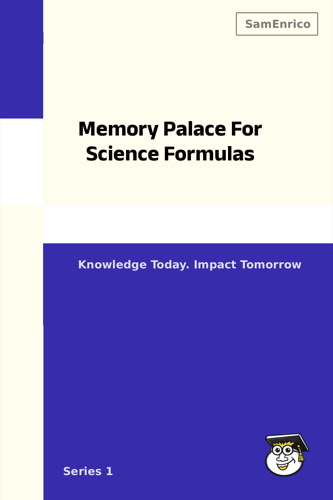
Non-FictionSelf-HelpScience Memory
Memory Palace For Science Formulas
Places physics, chemistry, and math equations alon
by Dion Kecia
Places physics, chemistry, and math equations along palace corridors.
Formats
About this book
Free sample
Chapter 1: The Flashcard Funeral--You have probably spent hundreds of hours staring at flashcards. You have rewritten formulas until your hand cramped. You have highlighted textbooks in four colors. And still, when the exam begins, your mind becomes a blank wall where equations used to live. This is not because you are bad at science or math.
It is because you have been fighting against the way your brain actually works.Let me tell you a story about a student named Elena. She was a second-year engineering student who could solve complex circuit problems in her sleep. She understood the physics of electromagnetism better than her professor. But she kept failing her midterms because she could never remember the exact formulas under pressure. She knew what the equations meant.
She could derive them from first principles given enough time. But on a 50-minute exam, she did not have enough time. After her second failed midterm, she came to me with a simple question: "Why do I remember the layout of my childhood home perfectly, but I cannot remember Ohm's Law when I need it?"That question is the key to everything in this book.The Evolutionary Mismatch The answer lies deep in your brain's architecture. The human hippocampus, which handles spatial navigation and location memory, has been evolving for over 40 million years. Our ancestors who could remember where the water hole was, which cave had the bears, and which path led to berries survived.
The ones who could not remember died. Your brain is a spatial supercomputer because your ancestors needed to navigate complex environments to stay alive.The prefrontal cortex, which handles abstract symbols like x, y, ∫, and Δ, is a much newer addition to your brain. In evolutionary terms, it is practically a beta release. It works slowly. It tires easily.
It cannot hold more than about four to seven items at once. This is why you can remember the path from your front door to your bedroom after walking it once, but you need to review a formula fifty times before it sticks.Elena's problem was not her intelligence. It…
This is the end of the free sample. Get the eBook to keep going. Buy now
Contents
- Chapter 1
- Chapter 2
- Chapter 3
- Chapter 4
- Chapter 5
- Chapter 6
- Chapter 7
- Chapter 8
- Chapter 9
- Chapter 10
- Chapter 11
- Chapter 12
Details
- Author
- Dion Kecia
- Publisher
- SamEnrico
- Language
- English
- Genre
- Non-Fiction, Self-Help, Science Memory
- Released
- 2026-06-10
- Pages (approx.)
- 129
- Available as
- eBook, Audiobook

Read better in the ZLOADR app
Your eBooks on your phone or tablet. Sign in with your SamEnrico account and start reading.
More by Dion Kecia
 Anger De escalation for Bus DriversDion Kecia$11.99
 Low Carb Travel Survival GuideDion Kecia$11.99
 Cognitive Restructuring For NightmaresDion Kecia$11.99
 Myo Inositol GuideDion Kecia$11.99
 Grand Canyon Missing PersonsDion Kecia$11.99
 Quit Smoking for Truck DriversDion Kecia$11.99
 Self Exclusion Laws GuideDion Kecia$11.99
 The Hollow Hill: Where the Fair Folk Still BargainDion Kecia$11.99
 The Hapsburgs at War: Splendor and Strategy in the Austro-Hungarian EmpireDion Kecia$11.99
 How to Start a Metal Road Signs Business (Beginners Guide)Dion Kecia$11.99
 Understanding SpasticityDion Kecia$11.99
 Qualified Retirement Plan TransferDion Kecia$12.99
You may also like
 Hong Kong Handover 1997Dunn Johnnie$11.99
 Zumba For Postnatal Recovery CourseNeal Christian$11.99
 Zumba for BeginnersLadner Nikia$11.99
 YouTube Comment Mining GuideHumes Pandora$12.99
 Worry Box MeditationCarlin Rudy$11.99
 Workplace Stress MeditationNguyen Lynn$11.99
 Workplace Stress and Sleep RepairHawley Ivory$11.99
 Workplace Perfectionism CureDelaney Jeffry$11.99
 Workplace Injustice Anger GuideWallen Isabelle$11.99
 Work Addiction and Burnout LinkGreenwood Ester$11.99
 Women in Yoga and WellnessBeattie Galina$11.99
 Women in Stand Up ComedyChun Evangeline$11.99