
Non-FictionSelf-HelpScience Memory
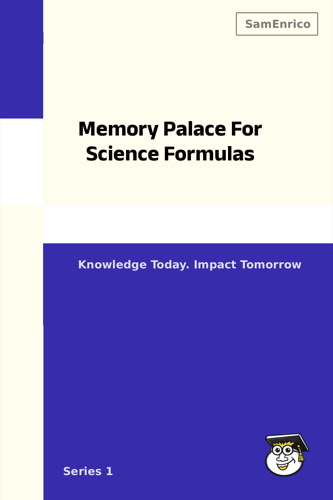
Memory Palace For Science Formulas eBook
Places physics, chemistry, and math equations alon
by Dion Kecia
Places physics, chemistry, and math equations along palace corridors.
Formats
Free sample
Chapter 1: The Flashcard Funeral--You have probably spent hundreds of hours staring at flashcards. You have rewritten formulas until your hand cramped. You have highlighted textbooks in four colors. And still, when the exam begins, your mind becomes a blank wall where equations used to live. This is not because you are bad at science or math.
It is because you have been fighting against the way your brain actually works.Let me tell you a story about a student named Elena. She was a second-year engineering student who could solve complex circuit problems in her sleep. She understood the physics of electromagnetism better than her professor. But she kept failing her midterms because she could never remember the exact formulas under pressure. She knew what the equations meant.
She could derive them from first principles given enough time. But on a 50-minute exam, she did not have enough time. After her second failed midterm, she came to me with a simple question: "Why do I remember the layout of my childhood home perfectly, but I cannot remember Ohm's Law when I need it?"That question is the key to everything in this book.The Evolutionary Mismatch The answer lies deep in your brain's architecture. The human hippocampus, which handles spatial navigation and location memory, has been evolving for over 40 million years. Our ancestors who could remember where the water hole was, which cave had the bears, and which path led to berries survived.
The ones who could not remember died. Your brain is a spatial supercomputer because your ancestors needed to navigate complex environments to stay alive.The prefrontal cortex, which handles abstract symbols like x, y, ∫, and Δ, is a much newer addition to your brain. In evolutionary terms, it is practically a beta release. It works slowly. It tires easily.
It cannot hold more than about four to seven items at once. This is why you can remember the path from your front door to your bedroom after walking it once, but you need to review a formula fifty times before it sticks.Elena's problem was not her intelligence. It was that she was asking her prefrontal cortex to do work that her hippocampus was designed to do. She was using a screwdriver to hammer a nail.The Flashcard Illusion Flashcards are the most common study tool for formulas, and they are also one of the worst. Here is why.When you flip through a deck of flashcards, you are engaging in passive recognition.
You see the left side of the card, and you check whether the answer on the right side looks familiar. Your brain becomes very good at recognizing the correct answer when the card is in front of you. This is like being able to recognize a song when someone plays it for you versus being able to sing the entire song from memory without any music playing.Recognition is not recall. Recognition is passive. Recall is active.
And only active recall builds long-term memory.Here is a simple experiment you can do right now. Think of a friend's phone number that you dial frequently. Can you recite it right now without looking? Probably yes. That is active recall.
Now think of a phone number you have seen many times but never dialed, like the number on a store sign. Can you recite it? Probably not. You have recognized that number dozens of times, but you have never recalled it actively.Flashcards trick you into believing that recognition equals learning. It does not.
You can recognize a formula a hundred times and still fail to recall it during an exam. The exam does not present you with the left side of a card and ask whether the right side looks familiar. The exam asks you to retrieve the formula from nothing.The Ancient Solution The Method of Loci, or Memory Palace technique, is over 2,500 years old. The Greek poet Simonides of Ceos discovered it when he was the only survivor of a building collapse. He was able to identify the bodies because he remembered exactly where each guest had been sitting at the banquet table.
From this tragedy, he realized that human memory is fundamentally spatial.The Romans adopted the technique. Cicero used it to memorize his speeches. He would walk through his house mentally and place each section of his speech in a different room. When he spoke, he would walk through the house in his mind and read the speech from the walls. He could deliver six-hour speeches without notes.Here is what you need to understand.
If this technique worked for entire speeches, it can certainly work for a few dozen formulas. You are not asking your brain to do something unnatural. You are asking your brain to do what it evolved to do. You are asking it to remember locations, objects, and movements. You are just attaching formulas to those objects.The Picture Principle The single most important rule in this book is the Picture Principle.
Here it is stated once, and we will refer back to it throughout: You cannot memorize what you cannot picture.Read that sentence again. If you cannot create a vivid, concrete image of something in your mind, you will not remember it. This is not an opinion. It is neuroscience. The brain's visual cortex is massively interconnected with the hippocampus.
The abstract symbol cortex is not.Think of the most memorable dream you have ever had. It was probably full of bizarre images, strange characters, impossible events. You remember it because your brain processed it visually. Now think of the last time you tried to memorize the quadratic formula by repeating it in your head. You probably forgot it within an hour.The difference is not the importance of the information.
The difference is the medium. Dreams are visual. Formulas are abstract. If you want to remember formulas, you must convert them into images.Elena learned this lesson after her second failed midterm. She started turning every formula into a little scene.
Ohm's Law became a vampire (V) standing on an iron (I) next to a raccoon (R). The absurdity made it stick. Within two weeks, she had memorized over 200 formulas. She passed her final exam with a B plus. She cried in the parking lot afterward because she had never passed a physics exam before.Your First Memory Palace: The House Tour You do not need to build a grand palace with marble floors and chandeliers.
You need a familiar path. Your childhood home is perfect. Your current dorm room or apartment works. Even your daily walking route from the bus stop to class can work.For this first exercise, you will identify ten locations. I call these loci (singular: locus).
Each locus is a specific spot along your path where you will later place an image. For now, you are just mapping the territory.Take out a notebook or open a blank document. Close your eyes. Walk through your childhood home or your current living space. Name ten specific spots in order.
Here is an example from a typical house:Front door mat Coat hook on the wall Bottom step of the staircase Living room…
This is the end of the free sample. Get the eBook to keep going. Buy now
About this book
Details
- Author
- Dion Kecia
- Publisher
- SamEnrico
- Language
- English
- Genre
- Non-Fiction, Self-Help, Science Memory
- Released
- 2026-06-10
- Pages (approx.)
- 129
- Available as
- eBook, Audiobook

Read better in the ZLOADR app
Your eBooks on your phone or tablet. Sign in with your SamEnrico account and start reading.
More by Dion Kecia
 Anger De escalation for Bus DriversDion Kecia$11.99
 Low Carb Travel Survival GuideDion Kecia$11.99
 Cognitive Restructuring For NightmaresDion Kecia$11.99
 Myo Inositol GuideDion Kecia$11.99
 Grand Canyon Missing PersonsDion Kecia$11.99
 Quit Smoking for Truck DriversDion Kecia$11.99
 Self Exclusion Laws GuideDion Kecia$11.99
 The Hollow Hill: Where the Fair Folk Still BargainDion Kecia$11.99
 The Hapsburgs at War: Splendor and Strategy in the Austro-Hungarian EmpireDion Kecia$11.99
 How to Start a Metal Road Signs Business (Beginners Guide)Dion Kecia$11.99
 Understanding SpasticityDion Kecia$11.99
 Qualified Retirement Plan TransferDion Kecia$12.99
You may also like
 Hong Kong Handover 1997Dunn Johnnie$11.99
 Zumba For Postnatal Recovery CourseNeal Christian$11.99
 Zumba for BeginnersLadner Nikia$11.99
 YouTube Comment Mining GuideHumes Pandora$12.99
 Worry Box MeditationCarlin Rudy$11.99
 Workplace Stress MeditationNguyen Lynn$11.99
 Workplace Stress and Sleep RepairHawley Ivory$11.99
 Workplace Perfectionism CureDelaney Jeffry$11.99
 Workplace Injustice Anger GuideWallen Isabelle$11.99
 Work Addiction and Burnout LinkGreenwood Ester$11.99
 Women in Yoga and WellnessBeattie Galina$11.99
 Women in Stand Up ComedyChun Evangeline$11.99