
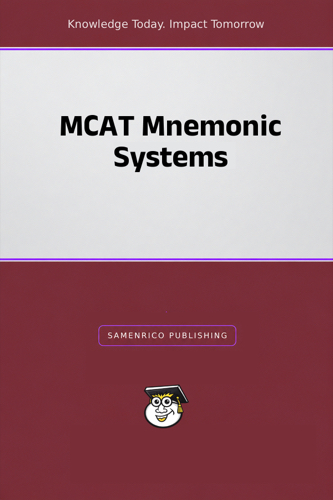
MCAT Mnemonic Systems
Applies loci and peg methods to biology, chemistry
by Mclain Myrle
Applies loci and peg methods to biology, chemistry, and physics sections.
Formats
About this book
Free sample
Chapter 1: The Broken Hourglass--–- The first time Maria scored in the 99th percentile on a practice MCAT, she thought it was luck. The second time, she thought it was hard work. The third time, she realized she had accidentally discovered something that contradicted everything she had been taught about studying. Two weeks earlier, she had spent an entire weekend building what she called a "memory palace" – a mental walk through her grandmother's house, where each room contained a ridiculous, unforgettable image representing a biochemistry pathway. She had not opened a single textbook since.
And yet, when she sat for the practice exam, the answers came to her not as struggle, but as recognition. She did not "retrieve" facts. She walked through that house, and the facts were simply there, waiting for her. This book is the explanation of why Maria succeeded – and how you will, too.The Illusion of Competence Let us begin with a confession that most study guides are too polite to make: the way you are currently studying is almost certainly failing you. You may not feel it yet.
You may believe that the hours you spend re-reading your Kaplan or Princeton Review books, the yellow highlights accumulating like autumn leaves, the notecards stacked in neat piles – these activities feel productive. They feel like learning. But feelings, in the context of memory, are notoriously dishonest.Cognitive psychologists have a name for this phenomenon: the illusion of competence. It occurs when you mistake familiarity for mastery. When you re-read a chapter on the Krebs cycle, the material looks familiar because you have seen it before.
Your brain registers that familiarity as a signal of understanding. But familiarity is not recall. Recognizing a fact when it is in front of you is entirely different from producing that fact from scratch under the pressure of a timed exam. The MCAT does not ask you to recognize correct answers among obvious decoys. It asks you to generate, differentiate, and apply knowledge across contexts that are deliberately unfamiliar.Consider a simple experiment that has been replicated dozens of times in cognitive science…
This is the end of the free sample. Get the eBook to keep going. Buy now
Contents
- Chapter 1
- Chapter 2
- Chapter 3
- Chapter 4
- Chapter 5
- Chapter 6
- Chapter 7
- Chapter 8
- Chapter 9
- Chapter 10
- Chapter 11
- Chapter 12
Details
- Author
- Mclain Myrle
- Publisher
- SamEnrico
- Language
- English
- Genre
- Non-Fiction, Self-Help, MCAT Prep
- Released
- 2026-06-07
- Pages (approx.)
- 135
- Available as
- eBook, Audiobook

Read better in the ZLOADR app
Your eBooks on your phone or tablet. Sign in with your SamEnrico account and start reading.
More by Mclain Myrle
 Beta Diversity Clinical UseMclain Myrle$11.99
 Bedtime Story Sleep MeditationMclain Myrle$11.99
 Mindfulness Meditation for Public SpeakingMclain Myrle$11.99
 Entrepreneur Sleep GuideMclain Myrle$11.99
 Neuropathic Pain AppsMclain Myrle$11.99
 TM for Anxiety Relief GuideMclain Myrle$11.99
 SWOT Analysis One PagerMclain Myrle$12.99
 Turkey Remote Tax GuideMclain Myrle$11.99
 Bipolar Mood Charting WorkbookMclain Myrle$11.99Bipolar Mood Charting WorkbookMclain Myrle$11.99
 The Phantom of the Caribbean: The Unsolved Murder on the S.S. Morro CastleMclain Myrle$11.99
 The Last Parachute: The Untold Story of Operation EntebbeMclain Myrle$11.99
You may also like
 Hong Kong Handover 1997Dunn Johnnie$11.99
 Zumba For Postnatal Recovery CourseNeal Christian$11.99
 Zumba for BeginnersLadner Nikia$11.99
 YouTube Comment Mining GuideHumes Pandora$12.99
 Worry Box MeditationCarlin Rudy$11.99
 Workplace Stress MeditationNguyen Lynn$11.99
 Workplace Stress and Sleep RepairHawley Ivory$11.99
 Workplace Perfectionism CureDelaney Jeffry$11.99
 Workplace Injustice Anger GuideWallen Isabelle$11.99
 Work Addiction and Burnout LinkGreenwood Ester$11.99
 Women in Yoga and WellnessBeattie Galina$11.99
 Women in Stand Up ComedyChun Evangeline$11.99