
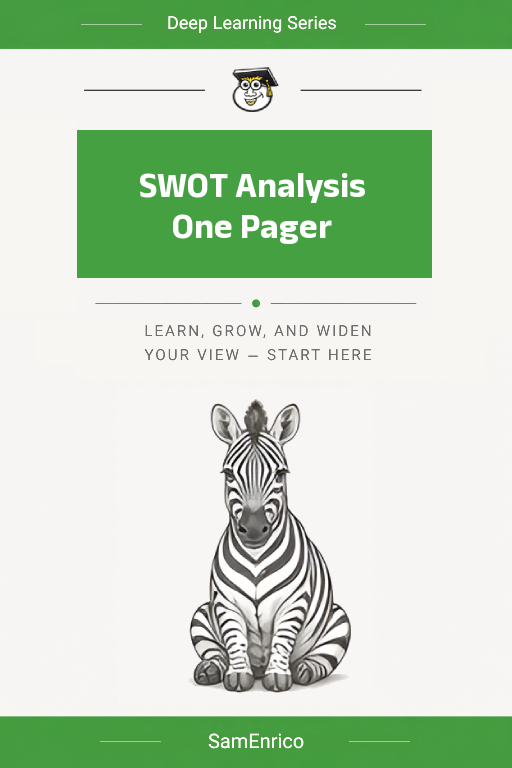
SWOT Analysis One Pager
List strengths, weaknesses, opportunities, threats
by Mclain Myrle
List strengths, weaknesses, opportunities, threats.
Formats
About this book
Free sample
Chapter 1: The 47 Slides--–- In 2019, a $40 million hardware company called Omni Core Solutions collapsed into bankruptcy. The official reasons cited were "market headwinds" and "execution challenges." The unofficial reason, known only to the twelve people in the room six months earlier, was a 47-slide Power Point deck. The leadership team had spent six weeks building what they called "the most comprehensive SWOT analysis in company history." They had listed 18 strengths, 22 weaknesses, 14 opportunities, and 11 threats. The deck was beautiful. It had color-coded quadrants, animated transitions, and a cover page with the company logo embossed in gold foil.
They presented it to the board. Everyone nodded. They filed it away. Eight months later, the company was dead.The CEO of Omni Core later admitted in a private post-mortem: "We knew everything. We just didn't know what to do with any of it." That confession is the single most expensive sentence in business strategy.
It reveals the gap that this entire book exists to close: the difference between knowing and choosing.You are about to learn a method that would have saved Omni Core. It takes 60 minutes. It fits on one page. And it requires you to kill 80 percent of what you think you know.The Invention That Broke Strategy Albert Humphrey is credited with creating the SWOT analysis in the 1960s at the Stanford Research Institute. He studied Fortune 500 companies to understand why strategic planning failed.
His insight was elegant: companies needed a structured way to look inward (strengths and weaknesses) and outward (opportunities and threats) before making big decisions. The four-box grid was born.For twenty years, it worked beautifully. Then something went wrong.What Humphrey intended as a pre-decision diagnostic became a post-decision decoration. Teams started treating SWOT as something you do after you already know what you want to do—a way to retroactively justify a budget request or a hiring plan. The grid became a compliance exercise, not a discovery tool.
By the 1990s, SWOT was being taught in business schools as a "basic tool" alongside the business model canvas and Porter's Five Forces. But "basic" became a…
This is the end of the free sample. Get the eBook to keep going. Buy now
Contents
- Chapter 1
- Chapter 2
- Chapter 3
- Chapter 4
- Chapter 5
- Chapter 6
- Chapter 7
- Chapter 8
- Chapter 9
- Chapter 10
- Chapter 11
- Chapter 12
Details
- Author
- Mclain Myrle
- Publisher
- SamEnrico
- Language
- English
- Genre
- Non-Fiction, First 30 Days, SWOT
- Released
- 2026-06-07
- Pages (approx.)
- 134
- Available as
- eBook, Audiobook

Read better in the ZLOADR app
Your eBooks on your phone or tablet. Sign in with your SamEnrico account and start reading.
More by Mclain Myrle
 Beta Diversity Clinical UseMclain Myrle$11.99
 Bedtime Story Sleep MeditationMclain Myrle$11.99
 Mindfulness Meditation for Public SpeakingMclain Myrle$11.99
 Entrepreneur Sleep GuideMclain Myrle$11.99
 Neuropathic Pain AppsMclain Myrle$11.99
 TM for Anxiety Relief GuideMclain Myrle$11.99
 MCAT Mnemonic SystemsMclain Myrle$11.99
 Turkey Remote Tax GuideMclain Myrle$11.99
 Bipolar Mood Charting WorkbookMclain Myrle$11.99Bipolar Mood Charting WorkbookMclain Myrle$11.99
 The Phantom of the Caribbean: The Unsolved Murder on the S.S. Morro CastleMclain Myrle$11.99
 The Last Parachute: The Untold Story of Operation EntebbeMclain Myrle$11.99
You may also like
 Hong Kong Handover 1997Dunn Johnnie$11.99
 Zumba For Postnatal Recovery CourseNeal Christian$11.99
 Zumba for BeginnersLadner Nikia$11.99
 YouTube Comment Mining GuideHumes Pandora$12.99
 Worry Box MeditationCarlin Rudy$11.99
 Workplace Stress MeditationNguyen Lynn$11.99
 Workplace Stress and Sleep RepairHawley Ivory$11.99
 Workplace Perfectionism CureDelaney Jeffry$11.99
 Workplace Injustice Anger GuideWallen Isabelle$11.99
 Work Addiction and Burnout LinkGreenwood Ester$11.99
 Women in Yoga and WellnessBeattie Galina$11.99
 Women in Stand Up ComedyChun Evangeline$11.99