
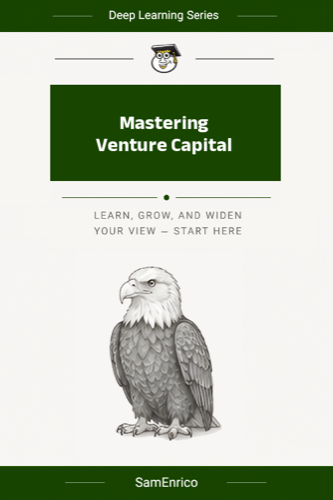
Non-FictionInformativeEducational
Mastering Venture Capital eBook
This publication, published by SamEnrico, covers M
by Mccune Rocky
This publication, published by SamEnrico, covers Mastering Venture Capital
Formats
Free sample
Chapter 1: The Cathedral Builders...--– Venture capital is not a science. It is not an art. It is a bet on the future, wrapped in a financial instrument, sold to the impatient, and won by the patient. If you are reading this book, you likely believe that venture capital is about term sheets, valuation models, and Sand Hill Road mystique. You are partly right.
But before you write your first check or raise your first fund, you must understand one uncomfortable truth: everything you think you know about modern venture capital is less than seventy years old, and most of it will be obsolete within a decade. The only way to master the future is to understand how we got here.This is a book about mastering venture capital as an operational discipline, not a collection of war stories. It is written from two perspectives simultaneously: the venture capitalist who must raise and deploy capital, and the founder who must acquire and utilize that capital. Neither perspective is complete without the other. The best VCs were often founders.
The best founders learn to think like VCs. This first chapter, therefore, is not a soft introduction. It is a hard reset. We are going to tear down the myths of venture capital by building a cathedral.The title of this chapter, "The Cathedral Builders," is deliberate. Georges Doriot, the father of modern venture capital, once said that venture capital is the art of building cathedrals.
Not skyscrapers, which rise quickly and are forgotten. Cathedrals, which take generations to complete, outlive their builders, and serve a purpose far beyond commerce. Doriot understood something that the era of unicorns, growth at all costs, and two-year exits has largely forgotten: great companies take time. But time is expensive. And the tension between patience and pressure is the engine of every venture fund.In this chapter, we will walk through the origin story of venture capital, from the founding of ARDC in 1946 to the AI-driven, remote-first, crypto-curious world of the 2020s.
We will meet the unlikely cast of characters—academics, generals, engineers, and refugees—who built the financial architecture that powers innovation. We will analyze the three great eras of venture capital: Era One (Hardware and Engineering), Era Two (Software and Network Effects), and Era Three (Intelligence and Data). And we will confront the central tension of our time: the Doriot ideal of patient capital versus the modern reality of hyper-growth and rapid liquidity. This tension is not a bug. It is a feature.
And how you resolve it will determine whether you build a cathedral or a crumbling facade.Let us begin where all modern venture capital begins: in the ashes of the Second World War, with a French-born, Harvard-educated general who believed that finance could be a force for good.The Accidental Inventor: Georges Doriot and the Birth of ARDCIn 1946, the world was exhausted. Europe lay in rubble. The United States, though victorious, faced the daunting challenge of converting a wartime economy into a peacetime one. Millions of soldiers were returning home. Factories that had built tanks and bombers now needed to build cars and refrigerators.
And yet, among the chaos, a quiet revolution was taking place in Boston.Georges Doriot was not a banker. He was a soldier and a professor. Born in France in 1899, Doriot moved to the United States in his twenties, earned an MBA from Harvard (then a young and unproven degree), and eventually became a professor at Harvard Business School. When World War II broke out, he joined the US Army, rose to the rank of brigadier general, and played a key role in the research and development of military logistics. After the war, he returned to Harvard, but his mind was elsewhere.
Doriot had witnessed something extraordinary during the war: small teams of scientists and engineers, working with limited resources but immense focus, could solve problems that large bureaucracies could not. He wondered: could the same principle be applied to peacetime industry?The answer was the American Research and Development Corporation, or ARDC. Founded in 1946 with $3.5 million raised from a handful of institutional investors (including MIT and several insurance companies), ARDC was the first publicly owned venture capital firm. Its structure was radical for its time: ARDC would raise money from institutions, not wealthy families. It would invest in early-stage technology companies that traditional banks deemed too risky.
And it would provide not just money but operational guidance, taking board seats and working closely with founders.Doriot called this "mentor capital," a phrase that would become the motto of modern venture capital. He believed that his role was not to pick stocks but to build companies. He famously told his partners: "Whenever you make an investment, you are buying a piece of someone's dream. Never forget that."For nearly a decade, ARDC struggled. Most of its early investments failed or returned modest results.
Doriot was patient, but his investors were not. By the mid-1950s, ARDC's fund was underwater, and its partners were questioning whether the experiment had failed. Doriot held firm. He reminded them that cathedrals take time.Then, in 1957, a small team of engineers walked into ARDC's Boston office. They had left their previous employer, a conservative Eastern company, because they wanted to build a new kind of semiconductor.
They had no business plan, no prototype, and no customers. They had only an idea and a ferocious determination. Their names were Robert Noyce and Gordon Moore. The company they wanted to build was Fairchild Semiconductor.Doriot invested 1.5million.Overthenextdecade,Fairchildwouldbecometheseedcrystalfromwhich Silicon Valleygrew.Noyceand Moorewouldlaterleave Fairchildtofound Intel.Fairchildalumniwouldgoontofoundorfunddozensofcompanies,including AMD,Applied Materials,and Kleiner Perkins.Thevaluationof Fairchild Semiconductoreventuallyreachedhundredsofmillions.But Doriotdidnotsellimmediately.Hewaited.Andwhen ARDCfinallyexitedits Fairchildinvestmentyearslater,the1.5 million. Over the next decade, Fairchild would become the seed crystal from which Silicon Valley grew.
Noyce and Moore would later leave Fairchild to found Intel. Fairchild alumni would go on to found or fund dozens of companies, including AMD, Applied Materials, and Kleiner Perkins. The valuation of Fairchild Semiconductor eventually reached hundreds of millions. But Doriot did not sell immediately. He waited.
And when ARDC finally exited its Fairchild investment years later, the 1.5million.Overthenextdecade,Fairchildwouldbecometheseedcrystalfromwhich Silicon Valleygrew.Noyceand Moorewouldlaterleave Fairchildtofound Intel.Fairchildalumniwouldgoontofoundorfunddozensofcompanies,including AMD,Applied Materials,and Kleiner Perkins.Thevaluationof Fairchild Semiconductoreventuallyreachedhundredsofmillions.But Doriotdidnotsellimmediately.Hewaited.Andwhen ARDCfinallyexitedits Fairchildinvestmentyearslater,the1.5 million had grown to over $400 million—a return of more than 250x.The year was 1968. Doriot was 69 years old. He had just proven that venture capital could generate returns that dwarfed any other asset class. And yet, he never celebrated. He simply said: "We are just beginning."ARDC would eventually be sold, and Doriot would retire.
But his legacy was secure. He had invented an industry. And he had established the first and most important principle of venture capital: patience is not passive. It is an active, disciplined, and excruciatingly difficult strategy.From Boston to Sand Hill Road: The Evolution of an Industry If Doriot invented venture capital in Boston, the industry moved to California to grow up. The shift was not accidental.
By the late 1960s, the geographic center of technology innovation had shifted from the East Coast's defense and aerospace corridors to the San Francisco Bay Area, where…
This is the end of the free sample. Get the eBook to keep going. Buy now
About this book
Details
- Author
- Mccune Rocky
- Publisher
- SamEnrico
- Language
- English
- Genre
- Non-Fiction, Informative, Educational
- Released
- 2026-05-11
- Pages (approx.)
- 150
- Available as
- eBook, Audiobook

Read better in the ZLOADR app
Your eBooks on your phone or tablet. Sign in with your SamEnrico account and start reading.
More by Mccune Rocky
 Magnesium Miracle Mineral HandbookMccune Rocky$11.99
 Fear Trigger Taming GuideMccune Rocky$11.99
 Research Proposal Theoretical Framework GuideMccune Rocky$12.99
 Pure O OCD GuideMccune Rocky$11.99
 Water Tech InvestmentMccune Rocky$11.99
 MBSR for MusiciansMccune Rocky$11.99
 Sam Sheppard Polygraph ExaminersMccune Rocky$11.99
 Menstrual Cycle IBS GuideMccune Rocky$11.99
 Daley RichardMccune Rocky$11.99
 Resentment Release GuideMccune Rocky$11.99
 The Sleep Experiment: Cold War Secrets Under the Arctic IceMccune Rocky$11.99
 The Serpent’s Lament: The Music of the Rainbow SerpentMccune Rocky$11.99
You may also like
 Hong Kong Handover 1997Dunn Johnnie$11.99
 Zumba For Postnatal Recovery CourseNeal Christian$11.99
 Zumba for BeginnersLadner Nikia$11.99
 YouTube Comment Mining GuideHumes Pandora$12.99
 Worry Box MeditationCarlin Rudy$11.99
 Workplace Stress MeditationNguyen Lynn$11.99
 Workplace Stress and Sleep RepairHawley Ivory$11.99
 Workplace Perfectionism CureDelaney Jeffry$11.99
 Workplace Injustice Anger GuideWallen Isabelle$11.99
 Work Addiction and Burnout LinkGreenwood Ester$11.99
 Women in Yoga and WellnessBeattie Galina$11.99
 Women in Stand Up ComedyChun Evangeline$11.99