
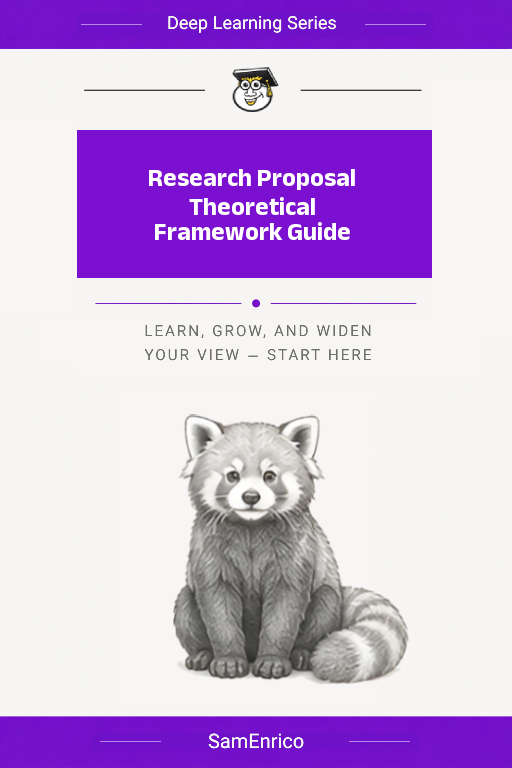
Research Proposal Theoretical Framework Guide
Select and apply relevant theories to ground your
by Mccune Rocky
Select and apply relevant theories to ground your study.
Formats
About this book
Free sample
Chapter 1: The Invisible Engine--Every year, thousands of graduate students sit across a table from their dissertation committee, having spent eighteen months collecting data, running analyses, and writing four polished chapters. Their Power Point slides are beautiful. Their literature review cites three hundred sources. Their methodology section describes every statistical test in precise detail.And they still fail.Not because their data is flawed. Not because their writing is poor.
Not because they cannot answer questions about their methods.They fail because when someone asks, "What is your theoretical framework?"—or worse, "Where is your theory?"—they cannot give a clear, confident, defensible answer. Their mouth goes dry. They shuffle through their notes. They say something vague about "drawing on the literature" or "taking an exploratory approach." The committee members exchange glances. The chair leans forward.
And the student knows, in that sinking moment, that everything else they have done—the careful sampling, the meticulous coding, the elegant regressions—has been built on sand.This book exists to make sure that never happens to you.I wrote this book because I have watched this scene play out more than three hundred times. As a dissertation methodologist and former faculty chair, I have sat on both sides of that table. I have been the student whose framework was called "a beautiful pile of unrelated concepts." I have also been the committee member who had to say, with genuine regret, "I cannot approve this proposal until you tell me what lens you are using to see your data."The painful truth is this: methodology alone will not save you. Your statistics can be flawless. Your interview protocol can be a work of art.
Your sample size can be perfectly powered. But if you cannot answer the question, "Why these variables and not others?" or "Why this research question and not that one?" or "What is the mechanism you believe is operating here?"—you are not doing research. You are collecting facts.Theory is the invisible engine that turns data into knowledge. It is the set of assumptions, concepts, and propositions that tells you what to…
This is the end of the free sample. Get the eBook to keep going. Buy now
Contents
- Chapter 1
- Chapter 2
- Chapter 3
- Chapter 4
- Chapter 5
- Chapter 6
- Chapter 7
- Chapter 8
- Chapter 9
- Chapter 10
- Chapter 11
- Chapter 12
Details
- Author
- Mccune Rocky
- Publisher
- SamEnrico
- Language
- English
- Genre
- research, Student's Shortcut, Student's Shortcut, Theory Application
- Released
- 2026-06-10
- Pages (approx.)
- 159
- Available as
- eBook, Audiobook

Read better in the ZLOADR app
Your eBooks on your phone or tablet. Sign in with your SamEnrico account and start reading.
More by Mccune Rocky
 Magnesium Miracle Mineral HandbookMccune Rocky$11.99
 Fear Trigger Taming GuideMccune Rocky$11.99
 Pure O OCD GuideMccune Rocky$11.99
 Water Tech InvestmentMccune Rocky$11.99
 MBSR for MusiciansMccune Rocky$11.99
 Sam Sheppard Polygraph ExaminersMccune Rocky$11.99
 Menstrual Cycle IBS GuideMccune Rocky$11.99
 Daley RichardMccune Rocky$11.99
 Resentment Release GuideMccune Rocky$11.99
 The Sleep Experiment: Cold War Secrets Under the Arctic IceMccune Rocky$11.99
 The Serpent’s Lament: The Music of the Rainbow SerpentMccune Rocky$11.99
 The Deep Blue Code: Unlocking Life’s Secrets in the PacificMccune Rocky$11.99